
Water Hazards at Home: A Room-by-Room Checklist
Bathtubs, toilets, buckets, coolers and yard water can all drown a toddler. Find every water hazard in your home, room by room, and the simple fix for each.
Key takeaways
- Drowning is the leading cause of death for U.S. children ages 1 to 4, and much of the risk is inside or right outside the home.
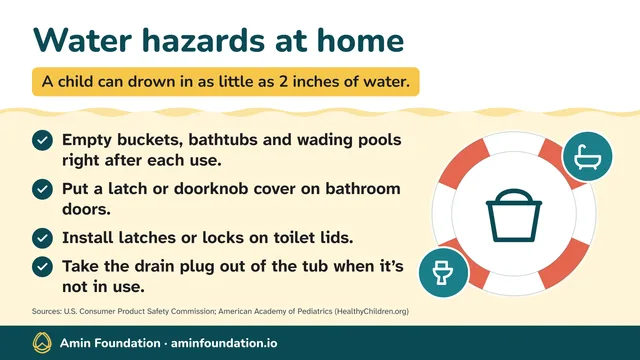
- A child can drown in as little as 2 inches of water, so tubs, toilets, buckets and coolers all count.
- Most hazards have a simple fix: empty it right after use, block it with a latch or lock, or keep an adult within arm's reach.
- Keep the bathroom closed with a latch or doorknob cover, and put locks on toilet lids.
- Check for water when your child visits a relative's, friend's or neighbor's home, too.
The most common water hazards at home are bathtubs, toilets, buckets and other containers, and water in the yard such as kiddie pools, ponds and hot tubs. For almost every one, the fix is simple: empty it, block it, or watch it.
This guide walks through your home one room at a time. Each hazard comes with a fix you can do this week.
Why the home matters so much for young children
No. 1
Babies and toddlers spend most of their day at home, and that is where much of their drowning risk is. The U.S. Consumer Product Safety Commission (CPSC) says nearly 90 children drown inside the home every year, and two-thirds of those deaths happen in the bathtub (opens in a new tab) (CPSC In-Home Drowning page, checked October 2026).
Three things make young children vulnerable:
- Very little water is enough. CPSC says a child can drown in as little as 2 inches of water (opens in a new tab), and it happens quickly and silently.
- Toddlers are top-heavy and curious. They lean over edges to reach toys or water and can tip in headfirst. CPSC describes exactly this with buckets and toilets (opens in a new tab).
- It happens outside "water time." Many young children who drown were not expected to be near water at all. Read more in drowning when nobody is swimming.
None of this means your home is unsafe. It means a few small changes go a long way.
Bathroom: tubs, toilets and the door
The bathroom has the most water and the most risk for babies.
Bathtubs. The American Academy of Pediatrics (AAP) recommends children not bathe alone until they are at least 6, and that another young sibling never supervise them (opens in a new tab). CPSC puts it simply: never leave a baby alone, or with young siblings, in a bathtub even for a second (opens in a new tab). Drain the tub as soon as bath time ends. Our bath time safety guide covers setup, distractions and bath seats.
The drain plug. The AAP suggests you consider removing the bathtub drain plug when it's not in use (opens in a new tab), so the tub can't fill if a child turns on the faucet.
Toilets. CPSC calls toilets an often-overlooked hazard. The typical case is a child under 3 falling headfirst into the bowl (opens in a new tab). Keep the lid down, and add a toilet lid lock. The AAP recommends safety latches or locks on all toilet seat lids (opens in a new tab).
The door. The best bathroom fix is keeping a toddler out when no adult is there. The AAP advises safety latches or doorknob covers to keep bathrooms closed when they're not in use (opens in a new tab). CPSC suggests a latch on the bathroom door out of reach of young children (opens in a new tab).
Make the barrier a habit
Latches only work when they're used. Agree as a family that the bathroom door stays shut, and tell older children why. Put a small sign on the inside of the door if it helps.
Kitchen and laundry: buckets, sinks and mop pails
Buckets. CPSC warns that 5-gallon buckets used for chores pose a serious threat to toddlers (opens in a new tab): their tall, straight sides and stability make it nearly impossible for a top-heavy child to get out after falling in headfirst. Empty mop and cleaning buckets the moment you finish, and store them upside down.
Sinks. CPSC lists sinks among the containers where young children have drowned (opens in a new tab). Don't leave a full sink when you step away, and keep step stools out of reach.
Everything else. The AAP's list of containers to empty completely whenever they're not in use (opens in a new tab) includes buckets, wading pools, coolers with melted ice, pet water bowls, and trash or recycling bins that collect rainwater. CPSC adds pails, fish tanks and landscape ponds. See buckets, coolers and containers for an "empty it now" routine.
Yard: kiddie pools, ponds, rain barrels and coolers
Outdoor water collects without anyone noticing.
- Kiddie pools. Empty and flip them after every use. Larger portable pools need a fence. See inflatable and portable pool safety.
- Ponds, fountains and bird baths. The AAP says to consider holding off on installing or using them until your child is older (opens in a new tab).
- Rain barrels, bins and ditches. The AAP's rule is never leave a filled, open-top water container unattended (opens in a new tab). It also names wells, irrigation ditches and drainage ditches as hazards, and open post holes during building work.
- Hot tubs. The AAP says to always cover and lock hot tubs, spas and whirlpools right after using them (opens in a new tab).
- Home pools. A fence on all four sides is the most important layer. Start with the home pool safety checklist.
Our backyard water hazards guide has more on ponds, barrels and covers.
Doors to the outside
Many toddlers reach water by slipping out a door. The AAP recommends safety gates, door locks or doorknob covers to keep a toddler from going outside (opens in a new tab), plus door alarms or the door chime on a home security system. Older children should learn to close the door behind them. The full how-to is in stopping toddlers from slipping outside.
Visiting other homes
The AAP notes that many drownings among young children take place at the home of a friend, relative or neighbor (opens in a new tab). In CPSC's latest report, 19% of pool and spa drowning deaths of children under 5 happened at the home of family, a friend or an acquaintance, and another 5% at a neighbor's home (opens in a new tab) (2021-2023).
When you arrive somewhere new, take two minutes to look for water: a pool gate, a tub, a bucket on the porch. Ask your host who is watching the children. If grandparents or sitters care for your child, share your rules with them using water safety rules for babysitters.
Your room-by-room checklist
Walk through your home with this list, or use the interactive audit.
Interactive tool
Home water hazard audit
Go room by room to find drowning hazards at home, from bathtubs and buckets to doors and backyard water, and get a printable to-do list with fixes.
Bathroom
Kitchen and laundry
Yard
Doors and visits
Print the same list as the Home Water Safety Checklist and stick it on the fridge.
What you can do today
- Do a 10-minute walk-through with the Home water hazard audit or the checklist above.
- Fix the bathroom first. A doorknob cover and a toilet lid lock are small, low-cost changes.
- Empty every container you find, and turn buckets upside down.
- Make it a family job. Older kids can learn to spot hazards with the Spot the Hazard game.
- Write it down in a family water safety plan, so everyone knows the rules.
Common questions
How much water can a toddler drown in?
Very little. The U.S. Consumer Product Safety Commission says a child can drown in as little as 2 inches of water, and it happens quickly and silently. That is why buckets, toilets and a bathtub with a little water left in it all need attention.
Do I really need a toilet lock?
If you have a child under 3, it is a cheap and useful layer. CPSC says the typical toilet drowning involves a child under 3 falling headfirst into the bowl. Keep the lid down, add a lid lock, and keep the bathroom door latched so a toddler can't get in alone.
At what age can a child take a bath alone?
The American Academy of Pediatrics recommends that children not bathe alone until they are at least 6 years old, and that another young sibling never be left in charge of them.
Tools and printables for this guide
Interactive tool
Home water hazard audit
Go room by room to find drowning hazards at home, from bathtubs and buckets to doors and backyard water, and get a printable to-do list with fixes.
Printable
Home Water Safety Checklist
A one-page, room-by-room checklist to find and fix drowning hazards at home: bathtubs, toilets, buckets, coolers, doors, hot tubs and pools.
Sources
- Drowning Facts (opens in a new tab) CDC
- In-Home Drowning (Safety Education Center) (opens in a new tab) U.S. Consumer Product Safety Commission
- Prevent Child In-Home Drowning Deaths (Publication 5013) (opens in a new tab) U.S. Consumer Product Safety Commission, 2012
- Drowning Prevention for Curious Toddlers: What Parents Need to Know (opens in a new tab) American Academy of Pediatrics (HealthyChildren.org), 2026
- Infant Drowning Prevention & Water Safety: How to Protect Your Baby (opens in a new tab) American Academy of Pediatrics (HealthyChildren.org), 2026
- Pool Dangers and Drowning Prevention: When It's Not Swimming Time (opens in a new tab) American Academy of Pediatrics (HealthyChildren.org), 2026
- Pool or Spa Submersion: Estimated Nonfatal Drowning Injuries and Reported Drownings, 2026 Report (opens in a new tab) U.S. Consumer Product Safety Commission, 2026
More in Water Safety at Home
Door Alarms and Locks: Stop Toddlers From Slipping Outside Unnoticed
Secure doors, sliding doors, windows and pet doors so a toddler can't reach a pool or yard water unseen: high locks, CPSC-style door alarms and habits.
Drowning When Nobody Is Swimming: The Everyday Moments That Matter
Most young children who drown weren't expected to be near water. How toddlers reach water unseen, the busy moments to plan for, and barriers that help.
Flash Flood Safety at Home: Basements, Streets and Floodwater
How to stay safe when a flash flood threatens your home: move up from basement units early, never walk or drive into floodwater, and sign up for alerts.