
Home Pool Safety Checklist: Layers of Protection
Check your home pool against every layer of protection: supervision, a four-sided fence and gate, alarms, swim skills, rescue gear and CPR. Printable list.
Key takeaways
- An average of 376 children under 15 died each year in U.S. pool or spa drownings from 2021 to 2023, and 77% of them were under 5.
- No single step prevents every drowning. Pool safety works in layers that back each other up.
- The most important barrier is a fence on all four sides that separates the pool from the house, with a self-closing, self-latching gate.
- Add door alarms or a safety cover, name a Water Watcher every swim, and keep rescue gear and a phone by the pool.
- Pool fence rules differ by state and town. Check with your local building department.
A safe home pool has several layers of protection working together: an adult watching every swim, a four-sided fence with a self-closing, self-latching gate, a backup such as door alarms or a safety cover, swim skills and life jackets, and rescue gear, a phone and CPR skills at the poolside. Use the checklist on this page to check each layer.
A pool is a wonderful thing to have. These steps let your family enjoy it with fewer worries.
Why layers matter
376
Young children face the most risk. In the U.S. Consumer Product Safety Commission's (CPSC) latest report, 77% of child pool and spa drowning deaths from 2021 to 2023 involved children younger than 5 (opens in a new tab), and 71% happened at a home (opens in a new tab), most often the child's own.
The American Academy of Pediatrics (AAP) recommends multiple "layers" of protection, since no single method can prevent all drowning (opens in a new tab). The National Drowning Prevention Alliance says each layer should be used together (opens in a new tab). If one layer fails, such as a gate left open, the next one is still there.
Layer 1: Supervision
Every swim needs an adult whose only job is watching.
- Name a Water Watcher. Pool Safely says a Water Watcher's supervising should be their only task (opens in a new tab): no reading, texting or phone games.
- Touch supervision for babies, toddlers and weak swimmers: an adult who can swim, within arm's reach.
- Stay sober. CDC says do not drink alcohol while supervising children (opens in a new tab).
- Close up after swim time. CDC advises you shut and lock doors that give access to water (opens in a new tab) and remove toys from the pool area (opens in a new tab) that might tempt children back.
See how to supervise kids around water for handoffs and Water Watcher cards.
Layer 2: Barriers and alarms
Barriers protect children during the moments no one is watching. The AAP calls fences the most effective, proven way to prevent drowning of young children (opens in a new tab).
- A four-sided isolation fence. CDC reports that a four-sided fence separating the pool from the house and yard reduces a child's risk of drowning by 83% compared to three-sided property-line fencing (opens in a new tab).
- The right gate. The AAP says it should be self-closing and self-latching, open away from the pool, with the latch at least 54 inches from the ground (opens in a new tab).
- A second barrier if the house forms one side of the pool area. The Red Cross suggests door alarms and locks out of a child's reach on all doors and windows with direct access to the pool, or lockable covers (opens in a new tab).
- Covers and alarms are extras, not substitutes. Only a true safety cover counts as a barrier. See pool safety covers vs. solar covers and pool alarms.
Our pool fences and gates guide covers height, gaps and climbing in detail.
Local rules differ
The AAP notes that there is no national pool fence law (opens in a new tab). CPSC's barrier guidelines are not a CPSC standard and not mandatory (opens in a new tab), although some states and towns have built them into their codes. Ask your local building department what applies to your pool. This page is safety guidance, not legal advice.
Layer 3: Swim skills and life jackets
- Swim lessons lower risk but don't remove it. The AAP reminds parents that swim lessons don't make kids "drown proof" (opens in a new tab).
- Life jackets for weak or non-swimmers. The AAP says weak or non-swimmers should also wear life jackets when at a pool (opens in a new tab), and they should be U.S. Coast Guard-approved and fit properly.
- No floaties as safety gear. CDC warns that air-filled or foam toys are not safety devices (opens in a new tab).
- Pool rules that children understand. See pool rules for kids.
Layer 4: Rescue equipment, a phone and CPR
When something goes wrong, the first minutes matter.
- Rescue gear by the pool. CPSC recommends having life-saving equipment such as life rings, floats or a reaching pole available and easily accessible (opens in a new tab).
- A phone close by. Pool Safely says to have a phone close by at all times (opens in a new tab), and to check the pool first if a child is missing.
- CPR skills. Pool Safely notes that bystanders are often the first to aid a drowning victim (opens in a new tab), so learning CPR can help save a life.
- Drain covers. Federal law requires anti-entrapment drain covers in public pools. CPSC says residential pools are not required to install these, but they are highly recommended (opens in a new tab). See drain entrapment.
Our pool rescue equipment guide lists what to keep where.
Your printable checklist
Check your pool with the interactive tool, or tick through the list below.
Interactive tool
Pool barrier check
Check your pool fence and gate against the CPSC barrier guidelines: height, gaps, latches, door alarms and covers. Get a printable list of what to fix.
Supervision
Barriers
Skills and gear
Print the same list as the Pool Safety Checklist.
What you can do today
- Walk around your fence and test the gate ten times. Does it close and latch by itself every time?
- Run the Pool barrier check to find gaps in your barrier.
- Name your Water Watchers for the next swim, and make cards with the Water Watcher card and timer tool.
- Hang a reaching pole and ring buoy by the pool and post your address by the phone.
- Add the pool to your family water safety plan.
Common questions
What are the layers of protection for a pool?
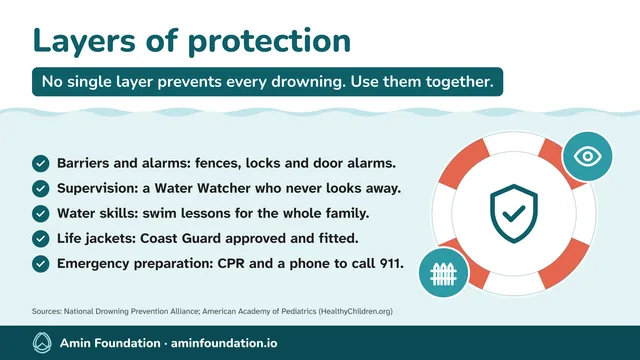
The National Drowning Prevention Alliance names five: barriers and alarms, supervision, water competency (swim skills), life jackets, and emergency preparation such as CPR training and a phone ready to call 911. Each layer covers for the moments another one fails, so use them together.
Is there a national pool fence law?
No. The AAP notes there is no national pool fence law in the U.S.; only some states and towns require pool fences. CPSC's barrier guidelines are advice, not a mandatory standard. Ask your local building department what applies where you live.
Do residential pools need anti-entrapment drain covers?
Federal law requires them for public pools and spas. CPSC says residential pools are not required to install them, but they are highly recommended. Ask a pool professional whether your drain covers are compliant.
Tools and printables for this guide
Interactive tool
Pool barrier check
Check your pool fence and gate against the CPSC barrier guidelines: height, gaps, latches, door alarms and covers. Get a printable list of what to fix.
Interactive tool
Water Watcher card and timer
Print a Water Watcher card and run a rotation timer so adults take turns watching children in the water, handing over every 15 to 20 minutes.
Printable
Pool Safety Checklist
A one-page checklist for pool and hot tub owners: four-sided fencing, self-latching gates, alarms, covers, drains, Water Watchers and rescue gear.
Sources
- CPSC Report Highlights Persistent Risk of Childhood Drowning (opens in a new tab) U.S. Consumer Product Safety Commission, 2026
- Pool or Spa Submersion: Estimated Nonfatal Drowning Injuries and Reported Drownings, 2026 Report (opens in a new tab) U.S. Consumer Product Safety Commission, 2026
- Layers of Protection (opens in a new tab) National Drowning Prevention Alliance
- Drowning Prevention for Curious Toddlers: What Parents Need to Know (opens in a new tab) American Academy of Pediatrics (HealthyChildren.org), 2026
- Pool Dangers and Drowning Prevention: When It's Not Swimming Time (opens in a new tab) American Academy of Pediatrics (HealthyChildren.org), 2026
- Safety Barrier Guidelines for Residential Pools (Publication 362) (opens in a new tab) U.S. Consumer Product Safety Commission, 2023
- Risk Factors for Drowning (opens in a new tab) CDC
- Home Pool & Hot Tub Safety (opens in a new tab) American Red Cross
- Safety Tips (opens in a new tab) Pool Safely (CPSC)
- Preventing Drowning (opens in a new tab) CDC, 2025
- Swim Lessons for Children: When to Start & What to Consider (opens in a new tab) American Academy of Pediatrics (HealthyChildren.org), 2026
More in Pool and Hot Tub Safety
Above-Ground Pool Safety: Ladders, Barriers and Rules
Secure an above-ground pool: remove or lock the ladder, clear anything a child can climb, add a barrier, check for recalled strap models, and never dive in.
Hot Tub and Spa Safety for Kids and Adults
Use a hot tub or spa safely: lock the cover after every use, keep children under 5 out, stay at 104°F or below, avoid alcohol, and keep away from drains.
How to Host a Safe Pool Party
Plan a safe pool party: Water Watcher shifts with a card, life jackets for weak swimmers, sober supervision, rescue gear, and a locked gate when it ends.