
Backyard Water Hazards: Ponds, Fountains, Rain Barrels and Spas
How to make ponds, fountains, rain barrels, ditches and hot tubs safe for small children: what to remove, what to cover or lock, and when to fence it off.
Key takeaways
- Yard water that isn't a pool still counts: ponds, fountains, bird baths, rain barrels, bins, ditches and hot tubs.
- The AAP suggests holding off on ponds, fountains and bird baths until children are older.
- Any open container of water needs a lid that stays on, or it needs to be empty.
- Hot tubs are pools under CPSC's barrier guidelines. Cover and lock them after every use.
- Check for yard water when your child visits neighbors, relatives and friends.
To make your yard safe for small children, find every place water sits or collects, then remove it, cover it with a lid a child can't open, or fence it off. Ponds, fountains, rain barrels, bins, ditches and hot tubs all count, not just pools.
Yard water is easy to overlook because it is part of the scenery. A toddler sees it differently: as something shiny to touch, splash or reach into.
Water in the yard that isn't a pool
60%
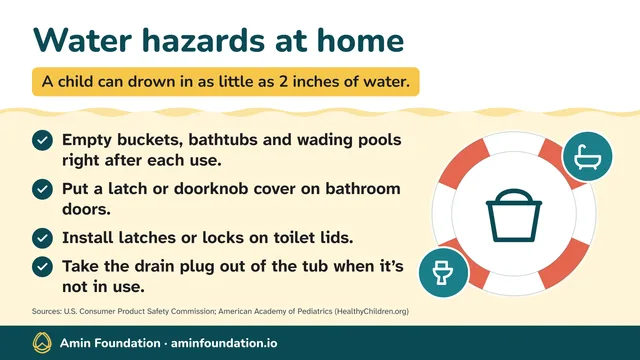
Young children usually reach yard water when no one expects them to be outside. They slip out a door, follow a pet or chase a ball. The U.S. Consumer Product Safety Commission (CPSC) says a child can drown in as little as 2 inches of water, quickly and silently (opens in a new tab), so even shallow water features matter.
The American Academy of Pediatrics (AAP) names the ones to look for: natural bodies of water such as ponds and standing water in or around the home (opens in a new tab), bird baths, fountains, wells, irrigation ditches and drainage ditches. CPSC adds landscape ponds and coolers (opens in a new tab).
Walk your yard at a toddler's height. Look for anything that holds water now, or will after the next rain.
Ponds, fountains and bird baths
These are the hardest to make safe, because they are meant to hold water all the time.
The AAP's advice for families with young children is to consider holding off on installing or using them until your child is older (opens in a new tab). In practice, that can mean:
- Pausing it. Drain a fountain or bird bath and leave it dry for a few years.
- Changing it. Some families turn a pond into a planter or a dry garden bed while their children are small.
- Fencing it off. If a pond has to stay, keep it behind a fence and a gate a toddler can't open. CPSC's pool guidelines call an isolation barrier or fence the best defense (opens in a new tab) when a pet door leads to a pool or other backyard water.
Never count on a toddler "knowing" not to go near it. Rules help older children. Barriers protect younger ones.
Rain barrels, bins and ditches
The AAP's rule covers every container in the yard: never leave a filled, open-top water container unattended (opens in a new tab). It specifically lists trash or recycling bins that collect rainwater (opens in a new tab) as containers to empty.
- Rain barrels. Use a barrel with a lid a child can't lift off, and keep it closed. Keep crates, steps and garden furniture away from it so a child can't climb up.
- Bins. Keep lids shut. Tip out any rain that collects.
- Empty containers. CPSC says not to leave empty containers in yards or around the house, where they may collect water and attract young children (opens in a new tab). Flip buckets, toy pails and planters.
- Ditches and wells. The AAP names wells, irrigation ditches and drainage ditches as hazards. Keep children out of reach of them with a fence or a closed gate.
- Building work. The AAP also says to block children's access to open post holes during construction (opens in a new tab). Holes and trenches fill with rain.
More on everyday containers is in buckets, coolers and containers.
Hot tubs and spas
A hot tub is deep water for a toddler. CPSC's barrier guidelines include spas and hot tubs in the definition of a "pool" (opens in a new tab), so the same barrier advice applies.
- The AAP says to always cover and lock hot tubs, spas and whirlpools right after using them (opens in a new tab).
- CPSC warns that a solar cover can let children slip into the water while the cover appears to stay in place, hiding the child (opens in a new tab). Only a locked safety cover is a barrier.
Our hot tub safety guide covers covers, drains, heat and rules for children.
Fences, gates and covers
Barriers work when your attention slips, which is when most young children reach water. The AAP calls fences the most effective, proven way to prevent drowning of young children (opens in a new tab).
For any yard water you can't remove:
Have a kiddie pool or inflatable pool? Empty and flip it after every use. Larger portable pools need a fence. See inflatable and portable pool safety.
Neighbors' yards and shared spaces
The AAP notes that many drownings among young children take place at the home of a friend, relative or neighbor (opens in a new tab).
- Know what's next door. If a neighbor has a pond, pool or hot tub, it is part of your child's world. CPSC's barrier booklet encourages pool owners to ask neighbors with pools or spas to use self-closing, self-latching gates too (opens in a new tab).
- If a child is missing, CPSC advises looking in the pool or spa first, including neighbors' pools or spas (opens in a new tab). Check ponds and other yard water too.
- Shared yards and buildings. Ask the landlord or building manager about covers and gates on shared water features, and report broken ones.
What you can do today
- Walk the yard after the next rain and list every place water sits.
- Empty, flip or lid every container you find.
- Decide on the pond or fountain: drain it, change it or fence it while your children are small.
- Check the hot tub cover is locked, and stays locked after every use.
- Use the Home water hazard audit to cover the rest of your home, and review the room-by-room hazard checklist.
Common questions
Is a small garden pond dangerous for a toddler?
It can be. A child can drown in as little as 2 inches of water, according to CPSC, and CPSC lists landscape ponds among the places young children have drowned. The AAP suggests holding off on installing or using ponds, fountains and bird baths until your child is older.
How do I make a rain barrel safe?
Treat it like any other container of water. The AAP says never leave a filled, open-top water container unattended. Use a barrel with a lid that a child can't open, keep it closed, and keep anything a child could climb on away from it.
Does a hot tub need a fence?
CPSC's pool barrier guidelines count spas and hot tubs as pools, so the same barrier advice applies. The AAP says to always cover and lock hot tubs, spas and whirlpools right after using them.
Tools and printables for this guide
Interactive tool
Home water hazard audit
Go room by room to find drowning hazards at home, from bathtubs and buckets to doors and backyard water, and get a printable to-do list with fixes.
Printable
Home Water Safety Checklist
A one-page, room-by-room checklist to find and fix drowning hazards at home: bathtubs, toilets, buckets, coolers, doors, hot tubs and pools.
Sources
- Drowning Prevention for Curious Toddlers: What Parents Need to Know (opens in a new tab) American Academy of Pediatrics (HealthyChildren.org), 2026
- Pool Dangers and Drowning Prevention: When It's Not Swimming Time (opens in a new tab) American Academy of Pediatrics (HealthyChildren.org), 2026
- Prevent Child In-Home Drowning Deaths (Publication 5013) (opens in a new tab) U.S. Consumer Product Safety Commission, 2012
- In-Home Drowning (Safety Education Center) (opens in a new tab) U.S. Consumer Product Safety Commission
- Safety Barrier Guidelines for Residential Pools (Publication 362) (opens in a new tab) U.S. Consumer Product Safety Commission, 2023
- Pool or Spa Submersion: Estimated Nonfatal Drowning Injuries and Reported Drownings, 2026 Report (opens in a new tab) U.S. Consumer Product Safety Commission, 2026
More in Water Safety at Home
Bath Time Safety: How to Keep Babies and Toddlers Safe in the Tub
How to bathe a baby or toddler safely: stay within arm's reach, set up before the water runs, and why bath seats and neck floats are not safety devices.
Drowning When Nobody Is Swimming: The Everyday Moments That Matter
Most young children who drown weren't expected to be near water. How toddlers reach water unseen, the busy moments to plan for, and barriers that help.
Flash Flood Safety at Home: Basements, Streets and Floodwater
How to stay safe when a flash flood threatens your home: move up from basement units early, never walk or drive into floodwater, and sign up for alerts.