
How to Make a Family Water Safety Plan
Make a family water safety plan in five steps: list your water, name who watches, add barriers, build swim skills, and know what to do in an emergency.
Bathtubs, toilets, buckets, yard water and doors to the pool: calm, sourced guides to the everyday water hazards that matter most for babies and toddlers.
No. 1
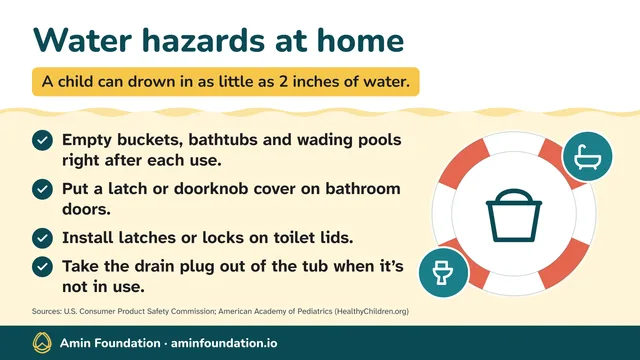
For babies and toddlers, much of the drowning risk is at home, often at moments when nobody planned to be near water. The U.S. Consumer Product Safety Commission says nearly 90 children drown inside the home every year, two-thirds of them in the bathtub (opens in a new tab), and that a child can drown in as little as 2 inches of water (opens in a new tab).
That sounds frightening, but the fixes are simple and most cost little or nothing. They come down to four habits:
Start with a walk through your home, one room at a time, or follow the room-by-room checklist.
Interactive tool
Go room by room to find drowning hazards at home, from bathtubs and buckets to doors and backyard water, and get a printable to-do list with fixes.
Then put it all in writing, so grandparents, sitters and older children follow the same rules you do.
Interactive tool
Make a one-page family water safety plan: who swims how well, Water Watcher turns, family rules, swim lessons and emergency numbers, with a QR code.
Every guide in this section cites the CDC, the American Academy of Pediatrics, the U.S. Consumer Product Safety Commission or another official source, with links you can check. For pools and hot tubs, see Pool and Hot Tub Safety.
Make a family water safety plan in five steps: list your water, name who watches, add barriers, build swim skills, and know what to do in an emergency.
Bathtubs, toilets, buckets, coolers and yard water can all drown a toddler. Find every water hazard in your home, room by room, and the simple fix for each.
What real supervision looks like near water: touch supervision for young children, one named Water Watcher with no other job, clean handoffs, and no phones.
How to bathe a baby or toddler safely: stay within arm's reach, set up before the water runs, and why bath seats and neck floats are not safety devices.
Most young children who drown weren't expected to be near water. How toddlers reach water unseen, the busy moments to plan for, and barriers that help.
Secure doors, sliding doors, windows and pet doors so a toddler can't reach a pool or yard water unseen: high locks, CPSC-style door alarms and habits.
How to make ponds, fountains, rain barrels, ditches and hot tubs safe for small children: what to remove, what to cover or lock, and when to fence it off.
Why a toddler can drown in a bucket, cooler or bin with just a few inches of water, and the simple empty-and-flip habit that removes the risk at home.
How to stay safe when a flash flood threatens your home: move up from basement units early, never walk or drive into floodwater, and sign up for alerts.
The water safety rules to share with any babysitter, nanny or grandparent before they're alone with your kids: bath, pool, phones and emergencies.
Interactive tool
Go room by room to find drowning hazards at home, from bathtubs and buckets to doors and backyard water, and get a printable to-do list with fixes.
Printable
A one-page, room-by-room checklist to find and fix drowning hazards at home: bathtubs, toilets, buckets, coolers, doors, hot tubs and pools.
Infographic
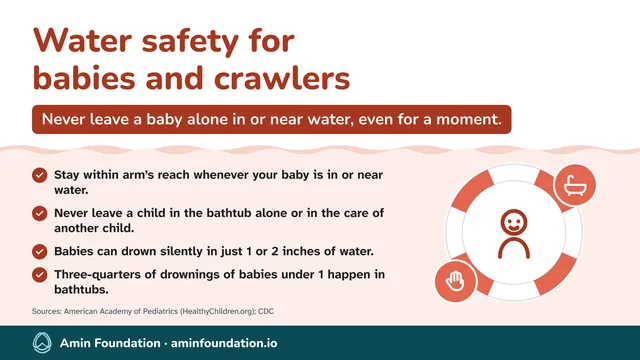
Never leave a baby alone in or near water, even for a moment.
Interactive tool
Check your pool fence and gate against the CPSC barrier guidelines: height, gaps, latches, door alarms and covers. Get a printable list of what to fix.
Infographic
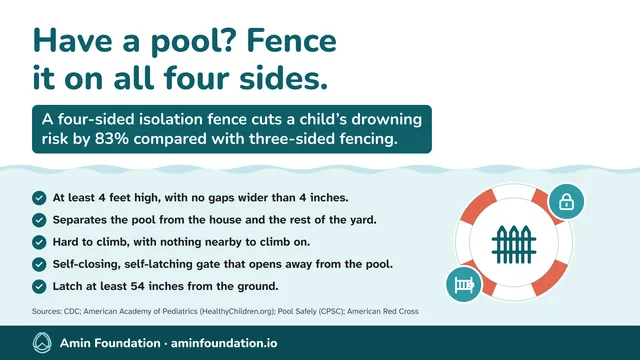
A four-sided isolation fence cuts a child’s drowning risk by 83% compared with three-sided fencing.