
Free tool · Check your home and pool
Home water hazard audit
Most toddler drownings happen at home, when nobody expects a child near water. Find the hazards room by room and fix them.
Audit your home
Private: what you enter stays on this device.
This is the printable version. Turn on JavaScript to use the interactive tool.
Bathroom
Kitchen, laundry and cleaning
Yard and outside
Doors and the way outside
Pool, inflatable pool or hot tub
Skip this part (choose “Doesn’t apply”) if you have none.
Ready to respond
Why start at home
For babies and toddlers, the biggest drowning risk is not the beach. It is water at home that they reach when no one expects them to. The American Academy of Pediatrics calls unexpected, unsupervised access to water (opens in a new tab) the biggest drowning threat facing families with toddlers, and reports that 69% of drownings of children 4 and younger happened during non-swim times.
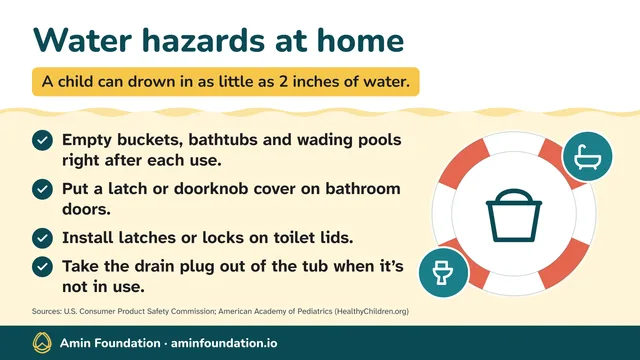
The amounts of water involved can be tiny. The CPSC (opens in a new tab) says nearly 90 children drown inside the home every year, two-thirds of them in bathtubs, and that a child can drown in as little as 2 inches of water. Among babies under 1, the CDC (opens in a new tab) reports that three-quarters of drownings happen in bathtubs.
The good news is that most fixes are cheap and quick: empty it, close it, latch it, watch it.
How the audit works
The audit walks through your home room by room: the bathroom, the kitchen and laundry, the yard, the doors to the outside, any pool or hot tub, and how ready you are to respond. For each item, answer Yes, Not yet or Doesn't apply. When you are done, press See my to-do list to get only the things still to fix, each with what to do and where the advice comes from. Your answers are saved only on this device, so you can come back and tick things off.
Every item comes from an official source:
- Bath time. Stay within arm's reach. The AAP says children should not bathe alone until they are at least 6, and a young sibling should not be the one watching. Baby bath seats can tip over, and babies can slip out (opens in a new tab).
- Bathroom doors and toilets. Keep the bathroom closed with a latch or doorknob cover, add toilet lid locks, and pull the tub's drain plug when it's not in use.
- Buckets and containers. Empty them right after use. The CPSC has warned since 1989 that a large bucket is dangerous even when only partly full (opens in a new tab), because it is heavy enough not to tip when a toddler pulls up on it.
- The yard. Empty containers that collect rainwater, empty and store small inflatable pools, and remove, secure or fence off bird baths, fountains, ponds, ditches and open post holes.
- Doors. Use locks, safety gates or doorknob covers on doors to the outside, and door alarms or your security system's chime. Ask older children to close doors behind them.
- Pools and hot tubs. A four-sided isolation fence (opens in a new tab) cuts a child's drowning risk by 83% compared with three-sided property-line fencing. Cover and lock hot tubs right after use.
Ready to respond
Barriers buy time during the brief lapses in supervision that happen in every family. They don't replace watching. When children are in or near water, name a Water Watcher (opens in a new tab). If a child goes missing, check the water first (opens in a new tab). And learn CPR: the AAP says parents, caregivers and older children should all learn CPR and safe rescue.
For more detail, read water hazards at home, room by room, bath time safety and how to stop toddlers slipping outside unnoticed.
What you can do today
- Go through the audit with your phone in hand, room by room.
- Fix one thing right now: empty a bucket, close the bathroom door, or move a chair away from the pool fence.
- Print your to-do list and share it with anyone who watches your children.
- Have a pool? Check every part of it with the pool barrier check.
Printables, infographics and games
Printable
Home Water Safety Checklist
A one-page, room-by-room checklist to find and fix drowning hazards at home: bathtubs, toilets, buckets, coolers, doors, hot tubs and pools.
Printable
Water Rules for Babysitters
A fill-in sheet to go over with every babysitter, nanny or grandparent: your address for 911, bath rules, hidden water at home, swimming rules and emergencies.
Infographic
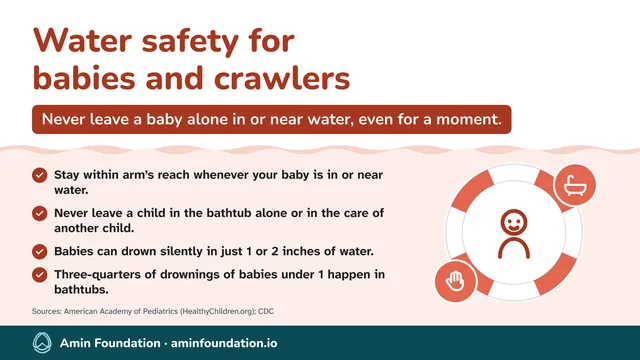
Water safety for babies and crawlers
Never leave a baby alone in or near water, even for a moment.
Related guides
- Water Hazards at Home: A Room-by-Room Checklist
Bathtubs, toilets, buckets, coolers and yard water can all drown a toddler. Find every water hazard in your home, room by room, and the simple fix for each.
- Bath Time Safety: How to Keep Babies and Toddlers Safe in the Tub
How to bathe a baby or toddler safely: stay within arm's reach, set up before the water runs, and why bath seats and neck floats are not safety devices.
- Buckets, Coolers and Containers: Hidden Drowning Risks for Toddlers
Why a toddler can drown in a bucket, cooler or bin with just a few inches of water, and the simple empty-and-flip habit that removes the risk at home.
- Door Alarms and Locks: Stop Toddlers From Slipping Outside Unnoticed
Secure doors, sliding doors, windows and pet doors so a toddler can't reach a pool or yard water unseen: high locks, CPSC-style door alarms and habits.
- Water Safety for Babies and Crawlers
Protect a baby under 12 months from drowning: keep a hand on them at bath time, empty buckets and pet bowls at crawling height, and plan for distractions.
More tools: check your home and pool
Sources
- Drowning Prevention for Curious Toddlers (opens in a new tab) American Academy of Pediatrics (HealthyChildren.org)
- In-Home Drowning (opens in a new tab) U.S. Consumer Product Safety Commission
- Risk Factors for Drowning (opens in a new tab) CDC
- Infant Drowning Prevention & Water Safety (opens in a new tab) American Academy of Pediatrics (HealthyChildren.org)
- Large Buckets Are Drowning Hazards for Young Children (opens in a new tab) U.S. Consumer Product Safety Commission
- Safety Tips (opens in a new tab) Pool Safely (U.S. Consumer Product Safety Commission)
- Water Safety (opens in a new tab) American Red Cross
Updated