
Water Safety for Toddlers: The Highest-Risk Years
Drowning is the leading cause of death for U.S. children ages 1 to 4. The layers that protect toddlers: barriers, touch supervision, lessons, life jackets.
Drowning risk changes with age. Clear, sourced guides for babies, toddlers, school-age kids, teens, young adults, adults and older adults, plus skills by age.
Drowning risk is not the same at every age, and neither is the protection that works. Each guide in this section focuses on the few habits that matter most at one stage of life, using guidance from CDC, the American Academy of Pediatrics (AAP) and the American Red Cross.
Babies and toddlers face the highest risk. More U.S. children ages 1 to 4 die from drowning than from any other cause, according to CDC (opens in a new tab). For them, adults provide almost all of the protection: barriers, touch supervision and life jackets. Start with babies and crawlers or toddlers.
School-age kids start to build real skills and spend more time at public pools, lakes and beaches. See kids ages 5 to 12, skills by age and why kids who swim still need watching.
Teens and young adults are more likely to drown in natural water, often away from adults, and alcohol and dares play a part. Read teens, college students and young adults and why boys and men drown more often.
Adults and older adults drown too. CDC reports that adults 65 and older have the second-highest drowning rate of any age group (opens in a new tab). See adults and older adults.
And for parents and teachers, how to talk to kids about water safety without scaring them.
Every guide ends with steps you can take today. If your family has needs beyond age, such as autism, epilepsy or a disability, see Water Safety for Every Ability.
Drowning is the leading cause of death for U.S. children ages 1 to 4. The layers that protect toddlers: barriers, touch supervision, lessons, life jackets.
Protect a baby under 12 months from drowning: keep a hand on them at bath time, empty buckets and pet bowls at crawling height, and plan for distractions.
School-age kids gain skills and independence near water. Build real swim skills, set rules kids can own, and plan for pools, lakes, camps and sleepovers.
Why teen drowning risk rises in lakes, rivers and the ocean, how overconfidence, dares and alcohol play a part, and the rescue and CPR skills teens can learn.
Calm, age-right ways to teach kids water safety: simple rules for little ones, reasons for school-age kids, practice and games, and the hard questions.
Drowning rates rise after 65. How older adults can bathe, swim and boat more safely, what to ask about medicines and health, and how to watch grandchildren.
Which water safety habits and swim skills fit each age, from toddlers to teens and adults learning later, based on AAP and Red Cross guidance.
Yes, kids who swim still need watching. Why skill isn't safety, the danger of breath-holding games, deep and natural water, and rules older kids accept.
Spring break, graduation trips and lake weekends mean new water. How 18- to 24-year-olds can plan safer outings with sober watchers and lifeguards.
Adults drown too, and many never learned to swim well. Check your skills honestly, wear a life jacket when it counts, watch kids safely and learn at any age.
Nearly 80% of U.S. drowning deaths are male. What the data show, the behaviors and settings behind the gap, and practical steps for boys and men.
Interactive tool
Go room by room to find drowning hazards at home, from bathtubs and buckets to doors and backyard water, and get a printable to-do list with fixes.
Printable
A one-page, room-by-room checklist to find and fix drowning hazards at home: bathtubs, toilets, buckets, coolers, doors, hot tubs and pools.
Printable
A fill-in sheet to go over with every babysitter, nanny or grandparent: your address for 911, bath rules, hidden water at home, swimming rules and emergencies.
Infographic
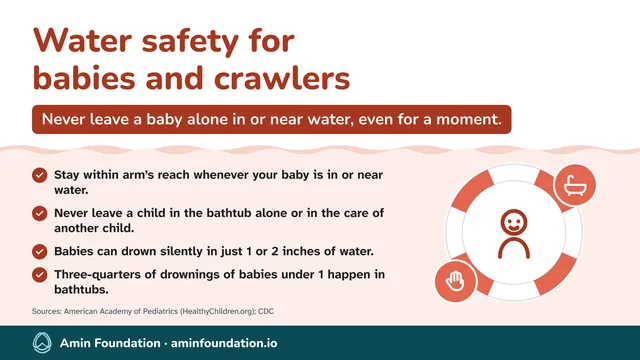
Never leave a baby alone in or near water, even for a moment.
Interactive tool
Answer four questions to see what the American Academy of Pediatrics suggests for your child’s age, and what to look for in a swim lesson program.
Interactive tool
Track swimming and water safety skills for each swimmer in your family, from back floating to the five Red Cross skills. Saved only on your device.