
Buckets, Coolers and Containers: Hidden Drowning Risks for Toddlers
Why a toddler can drown in a bucket, cooler or bin with just a few inches of water, and the simple empty-and-flip habit that removes the risk at home.
Key takeaways
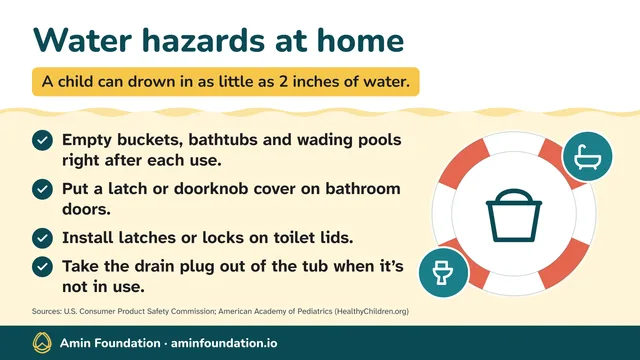
- A child can drown in as little as 2 inches of water, so a mop bucket or a cooler of melted ice is a real hazard.
- Large buckets are the worst: a toddler who tips in headfirst can't push back out against the tall, straight sides.
- Empty every container right after use, then flip it upside down or store it out of reach.
- Watch for water that collects on its own: rain in bins, toys, tarps and empty containers in the yard.
Toddlers can drown in buckets, coolers and other containers because they tip in headfirst and can't push themselves back out, and it takes only a few inches of water. The fix is a habit: empty every container the moment you're done, and turn it upside down.
These risks hide in plain sight because nobody thinks of a mop bucket as "water." This guide shows where containers collect water and how to make emptying them automatic.
Why a toddler can't climb out
2 inches
Young children have big heads and short arms. When a toddler leans over a bucket to splash or grab a toy, their weight carries them forward.
The U.S. Consumer Product Safety Commission (CPSC) explains what happens next. With a 5-gallon bucket, the tall, straight sides combined with its stability make it nearly impossible for top-heavy infants to free themselves when they topple in headfirst (opens in a new tab). CPSC has also warned that a 5-gallon bucket is dangerous even when only partly filled, because its weight makes it unlikely to tip over when a child uses it to pull up (opens in a new tab).
Babies are even more at risk. The AAP says babies can topple headfirst into the toilet bowl and be unable to get themselves out (opens in a new tab), and the same is true of any container at their height.
This is part of why more children ages 1 to 4 die from drowning than any other cause (opens in a new tab) (CDC). The good news: container drownings are among the easiest to prevent.
Containers people forget
The American Academy of Pediatrics (AAP) says to completely empty containers whenever they're not in use (opens in a new tab), and names buckets, wading pools, coolers with melted ice, pet water bowls, and trash or recycling bins that collect rainwater. CPSC adds that drownings also occur in pails, coolers, sinks, fish tanks and landscape ponds (opens in a new tab).
| Container | Where it hides | The fix |
|---|---|---|
| Mop or cleaning bucket | Kitchen, laundry, hallway on cleaning day | Empty it before you put the mop away. Store it upside down. |
| Large hardware bucket | Garage, porch, garden, building work | Empty and flip, or store it indoors so rain can't collect in it. |
| Cooler | Picnics, parties, the trunk of the car | Drain the melted ice as soon as the food is out. Leave the lid open to dry, out of reach. |
| Wading pool | Yard, balcony, patio | Empty and flip after every use. See inflatable and portable pool safety. |
| Pet water bowl | Kitchen floor, back step | Use a small bowl, keep it where a crawler can't reach, or refill only when the baby is elsewhere. |
| Trash and recycling bins | Yard, curb, side of the house | Keep lids closed, and tip out any rain that collects. |
| Sink | Kitchen, bathroom, laundry | Drain it before you walk away. Keep step stools out of reach. |
| Fish tank | Living room, bedroom | Keep the lid on and the tank where a toddler can't climb up to it. |
The empty-and-flip habit
Habits beat memory. Make these three moves automatic:
- Empty it now. CPSC advises that all containers with liquids be emptied immediately after use (opens in a new tab). "In a minute" is when accidents happen.
- Flip it or cover it. CPSC also says not to leave empty containers in yards or around the house where they may collect water and attract young children (opens in a new tab). An upside-down bucket can't fill with rain.
- Put it up or away. Store buckets and coolers on a high shelf or behind a closed door.
The AAP's simplest rule covers everything else: never leave a filled, open-top water container unattended (opens in a new tab).
Make it visible
Tape a small "Empty me" note inside the mop closet door, or hang a hook so the empty bucket lives upside down. Teach older kids the habit too. They love being the family's hazard spotter.
Cleaning days, parties and pets
Some days carry more risk because the routine breaks.
Cleaning days. A full bucket sitting while you move furniture, answer a call or change a diaper is the classic set-up. Finish one room at a time and empty the bucket between rooms. If a young child is awake, keep them in the room with you, or keep the bucket in a room with the door closed.
Parties and picnics. Coolers fill with meltwater over a long afternoon. Drain them as you go, and check the yard for drinks buckets, ice tubs and toy pails before the party ends. Busy, distracted moments are when young children slip away. See drowning when nobody is swimming.
Pets. Large dog bowls, outdoor water troughs and pet pools all count as containers. Keep them where crawlers can't get to them, or behind a gate.
After the rain. Walk the yard after a storm. Tarps, toys, sandboxes, planters and bins all collect water. The backyard water hazards guide covers ponds, barrels and ditches.
What you can do today
- Find every bucket and cooler in your home, garage and car. Empty them and store them upside down.
- Run the home audit. The Home water hazard audit walks you through each room.
- Close the lids on outdoor bins, and bring outdoor buckets inside or store them upside down.
- Tell everyone who cleans or watches your child about the empty-and-flip habit.
- Print the checklist. The Home Water Safety Checklist has every container on one page. For the whole house, use the room-by-room hazard checklist, and for this age group see water safety for toddlers.
Common questions
Why can't a toddler get out of a bucket?
Toddlers are top-heavy. CPSC explains that a 5-gallon bucket's tall, straight sides and stability make it nearly impossible for a top-heavy young child to free themselves after toppling in headfirst. A heavy bucket also doesn't tip over when a child pulls up on it, even when it is only partly full.
Is a partly full bucket still dangerous?
Yes. CPSC has warned that a 5-gallon bucket is dangerous even when only partly filled. A few inches of water is enough, because CPSC says a child can drown in as little as 2 inches.
What containers should I empty right away?
The AAP lists buckets, wading pools, coolers with melted ice, pet water bowls, and trash or recycling bins that collect rainwater. CPSC adds pails, sinks, fish tanks and landscape ponds to the list of places young children have drowned.
Tools and printables for this guide
Interactive tool
Home water hazard audit
Go room by room to find drowning hazards at home, from bathtubs and buckets to doors and backyard water, and get a printable to-do list with fixes.
Printable
Home Water Safety Checklist
A one-page, room-by-room checklist to find and fix drowning hazards at home: bathtubs, toilets, buckets, coolers, doors, hot tubs and pools.
Sources
- In-Home Drowning (Safety Education Center) (opens in a new tab) U.S. Consumer Product Safety Commission
- Prevent Child In-Home Drowning Deaths (Publication 5013) (opens in a new tab) U.S. Consumer Product Safety Commission, 2012
- Large Buckets Are Drowning Hazards For Young Children (opens in a new tab) U.S. Consumer Product Safety Commission, 1989
- Drowning Prevention for Curious Toddlers: What Parents Need to Know (opens in a new tab) American Academy of Pediatrics (HealthyChildren.org), 2026
- Infant Drowning Prevention & Water Safety: How to Protect Your Baby (opens in a new tab) American Academy of Pediatrics (HealthyChildren.org), 2026
- Drowning Facts (opens in a new tab) CDC
More in Water Safety at Home
Bath Time Safety: How to Keep Babies and Toddlers Safe in the Tub
How to bathe a baby or toddler safely: stay within arm's reach, set up before the water runs, and why bath seats and neck floats are not safety devices.
Door Alarms and Locks: Stop Toddlers From Slipping Outside Unnoticed
Secure doors, sliding doors, windows and pet doors so a toddler can't reach a pool or yard water unseen: high locks, CPSC-style door alarms and habits.
Flash Flood Safety at Home: Basements, Streets and Floodwater
How to stay safe when a flash flood threatens your home: move up from basement units early, never walk or drive into floodwater, and sign up for alerts.