
How to Make a Family Water Safety Plan
Make a family water safety plan in five steps: list your water, name who watches, add barriers, build swim skills, and know what to do in an emergency.
Key takeaways
- No single step prevents every drowning, so a good plan stacks several layers: supervision, barriers, swim skills, life jackets and emergency readiness.
- Start by listing every place your family meets water, at home and away.
- Name who watches the children, and how they hand off the job.
- Everyone in the plan should know to call 911, check the water first for a missing child, and reach or throw instead of going in.
- Write it down, share it with every caregiver, and review it each season.
A family water safety plan is a short, written list of the water in your life, who watches the children at each place, the barriers and skills that protect them, and what everyone does in an emergency. You can make one in about 15 minutes with our free planning tool, then share it with everyone who cares for your children.
A plan turns good intentions into habits. It also makes sure grandparents, sitters and older siblings follow the same rules you do.
Interactive tool
Family water safety plan
Make a one-page family water safety plan: who swims how well, Water Watcher turns, family rules, swim lessons and emergency numbers, with a QR code.
What a family water safety plan covers
No. 1
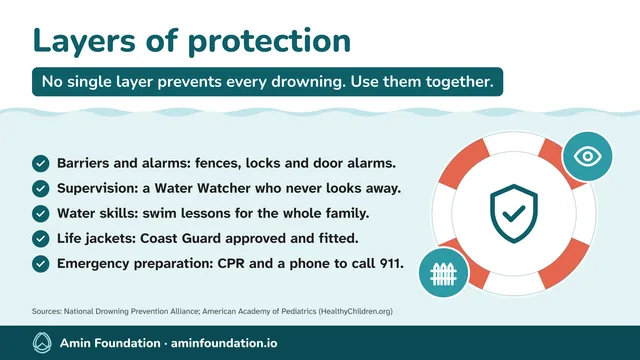
The American Academy of Pediatrics (AAP) recommends using multiple "layers" of water safety protection, since no single method can prevent all drowning (opens in a new tab). The National Drowning Prevention Alliance (NDPA) names five layers and says each layer should be used together (opens in a new tab):
- Barriers and alarms that keep young children away from water when no one is watching.
- Supervision by an adult who is close, constant and not distracted.
- Water competency, meaning real swim and safety skills.
- Life jackets for children and weaker swimmers in the right places.
- Emergency preparation: CPR training, safe rescue skills, and a phone ready to call 911.
Your plan puts a name, a place or a date next to each layer. The five steps below show how.
Step 1: List the water in your life
Write down every place your family meets water in a normal year. Be specific.
- At home: bathtub, toilets, buckets, kiddie pool, pond, hot tub or pool. Use the room-by-room hazard checklist.
- Near home: a neighbor's pool, a relative's house, a community or public pool, a park lake or the beach.
- Away from home: vacations, rental homes, camps, boats and family trips abroad.
For each place, note the biggest risk. A toddler at grandma's house is different from a 10-year-old at a lake.
Step 2: Name who watches, and when
For each place, write who supervises and how.
- Babies, toddlers and weak swimmers need touch supervision. The AAP recommends a supervising adult with swimming skills within arm's length (opens in a new tab).
- Groups and parties need a named Water Watcher. The AAP suggests passing a water watcher card to the next responsible adult every 15 to 20 minutes (opens in a new tab).
- Watchers stay sober and off their phones. CDC says do not drink alcohol while supervising children (opens in a new tab).
Our guide to supervising kids around water explains handoffs in detail. If others care for your child, add them by name and share water safety rules for babysitters.
Step 3: Put barriers in place
Barriers protect children when supervision slips. List each one and who checks it.
For pools, the home pool safety checklist goes layer by layer.
Step 4: Skills, lessons and life jackets
Swim lessons. The AAP recommends beginning swimming classes after a child's first birthday (opens in a new tab). Lessons lower risk, but the AAP adds that swim lessons don't make kids "drown proof" (opens in a new tab). Write down who is in lessons now and who is next, including adults. Start with how to find swim lessons.
Water competency. The Red Cross lists five basic skills: enter water over your head and return to the surface, float or tread for at least 1 minute, turn around, swim at least 25 yards, and get out of the water (opens in a new tab). In a 2020 Red Cross survey, 85% of Americans said they could swim, but only 56% of those self-described swimmers could do all five (opens in a new tab). Check each family member honestly.
Life jackets. CDC says life jackets should be used by children for all activities while in and around natural water (opens in a new tab), and the AAP adds that children without strong swim skills should wear them at a pool or water park. Floaties don't count: CDC warns that air-filled or foam toys are not safety devices (opens in a new tab). Note each child's life jacket size, and check the fit each season with how to choose a life jacket.
Step 5: Emergency basics everyone knows
Every person in your plan, including older children, should know these by heart.
Emergency
Call 911 for any water emergency. If a child is missing, check the water first: the Red Cross says seconds count (opens in a new tab). To help someone in the water, reach or throw something that floats from the edge. Don't go in after them.
- Know the address. Write the address of each place in Step 1, so you can tell 911 where you are.
- Keep a phone close, charged and out of the water.
- Reach or throw, don't go. The Red Cross teaches "reach or throw, don't go" (opens in a new tab) as the safe way to help.
- Learn CPR. CDC says your CPR skills could save someone's life in the time it takes for paramedics to arrive (opens in a new tab). Water Safety USA recommends learning CPR with both chest compressions and rescue breaths (opens in a new tab). Find a class through the Red Cross (opens in a new tab) or where to learn CPR. We don't print CPR steps, because a class teaches them properly.
The Red Cross also offers a free online Water Safety for Parents and Caregivers course (opens in a new tab) in English, Spanish and Haitian Creole. It's a good way for every caregiver in your plan to learn the basics.
Review the plan every season
Plans go stale. Put a reminder in your calendar for the start of spring and summer, and before any trip near water. Update the plan when:
- a baby starts crawling or walking, or a child starts or finishes lessons;
- you move, or a relative or neighbor gets a pool;
- a new sitter, nanny or grandparent starts helping;
- you book a vacation near water. See vacation water safety.
What you can do today
- Open the Family water safety plan tool and fill in Step 1: every place your family meets water.
- Name tonight's Water Watcher and make a card with the Water Watcher card and timer tool.
- Print the Water Emergency Action Plan and put it on the fridge with your address on it.
- Sign up one person for swim lessons or a CPR class this month.
- Take the pledge together. The Family Water Safety Pledge is a simple way to get kids involved.
Common questions
What should a family water safety plan include?
Use the layers of protection that the AAP and the National Drowning Prevention Alliance describe: barriers and alarms, close supervision, swim skills, life jackets, and emergency preparation such as CPR training and a phone ready to call 911. Add the places your family meets water and who watches at each one.
How often should we update our plan?
Review it at least at the start of each season and before any trip near water. Update it whenever something changes: a new baby, a child who is learning to walk or swim, a new home, a new caregiver, or a vacation rental with a pool.
Does the plan replace CPR training?
No. A plan tells everyone what to do first, but CPR is a hands-on skill. CDC says your CPR skills could save a life in the time it takes paramedics to arrive. Take a class from the American Red Cross or the American Heart Association.
Tools and printables for this guide
Interactive tool
Family water safety plan
Make a one-page family water safety plan: who swims how well, Water Watcher turns, family rules, swim lessons and emergency numbers, with a QR code.
Interactive tool
Water Watcher card and timer
Print a Water Watcher card and run a rotation timer so adults take turns watching children in the water, handing over every 15 to 20 minutes.
Printable
Water Emergency Action Plan
A fill-in emergency plan for a home pool, lake house, camp or event: the address for 911, who calls, where the rescue gear is, and the first steps in order.
Printable
Family Water Safety Pledge
A pledge for kids and grown-ups to read, tick and sign together: ask first, swim with a grown-up watching, wear life jackets, and get help without going in.
Sources
- Drowning Facts (opens in a new tab) CDC
- Drowning Prevention for Curious Toddlers: What Parents Need to Know (opens in a new tab) American Academy of Pediatrics (HealthyChildren.org), 2026
- Layers of Protection (opens in a new tab) National Drowning Prevention Alliance
- AAP Releases Updated Drowning Prevention Recommendations (opens in a new tab) American Academy of Pediatrics (HealthyChildren.org), 2026
- Swim Lessons for Children: When to Start & What to Consider (opens in a new tab) American Academy of Pediatrics (HealthyChildren.org), 2026
- Water Safety (opens in a new tab) American Red Cross
- Aquatics Centennial Campaign (opens in a new tab) American Red Cross, 2020
- Preventing Drowning (opens in a new tab) CDC, 2025
- Swimming Safety (opens in a new tab) American Red Cross
- CPR Training & Certification (opens in a new tab) American Red Cross
- Water Competency (opens in a new tab) Water Safety USA
- Learn to Swim and Water Safety Courses (opens in a new tab) American Red Cross
More in Water Safety at Home
Backyard Water Hazards: Ponds, Fountains, Rain Barrels and Spas
How to make ponds, fountains, rain barrels, ditches and hot tubs safe for small children: what to remove, what to cover or lock, and when to fence it off.
Bath Time Safety: How to Keep Babies and Toddlers Safe in the Tub
How to bathe a baby or toddler safely: stay within arm's reach, set up before the water runs, and why bath seats and neck floats are not safety devices.
Buckets, Coolers and Containers: Hidden Drowning Risks for Toddlers
Why a toddler can drown in a bucket, cooler or bin with just a few inches of water, and the simple empty-and-flip habit that removes the risk at home.