
Water Safety for Toddlers: The Highest-Risk Years
Drowning is the leading cause of death for U.S. children ages 1 to 4. The layers that protect toddlers: barriers, touch supervision, lessons, life jackets.
Key takeaways
- More U.S. children ages 1 to 4 die from drowning than from any other cause, and drowning among them rose 28% from 2019 to 2022.
- Most toddler drownings happen when nobody expects the child to be near water, so barriers matter as much as watching.
- During water time, an adult who can swim stays within arm's reach and gives the child full attention.
- Swim lessons can start after the first birthday, depending on readiness. They add protection but never replace supervision.
- Toddlers wear a Coast Guard-approved life jacket in, on or near lakes, rivers and the ocean.
Children ages 1 to 4 have the highest drowning risk of any age group in the United States. Protect your toddler with layers that work together: barriers that keep them away from water when nobody is swimming, an adult within arm's reach whenever they are in or near water, swim lessons once they're ready, and a life jacket near natural water.
No single layer is enough on its own. The American Academy of Pediatrics (AAP) recommends multiple layers of protection, since no single method can prevent all drowning (opens in a new tab).
Why ages 1 to 4 are the riskiest
No. 1
The numbers have been going the wrong way. CDC reports that drowning increased 28% among children ages 1 to 4 in 2022 compared with 2019 (opens in a new tab). Their death rate, 3.1 per 100,000 in 2021 and 2022 (opens in a new tab), was the highest of any age group in every year studied.
Why toddlers? The AAP describes them as curious, active and naturally attracted to water (opens in a new tab), but not old enough to understand danger or to do what is needed when they are in trouble. The AAP's lead author on drowning puts it plainly: toddlers "can escape without notice even under the best of circumstances." (opens in a new tab)
Three facts shape everything below:
- It usually isn't swim time. The AAP reports that 69% of drownings in children 4 and younger happened during non-swim times (opens in a new tab), when nobody expected them to be in the water.
- Home pools matter most. CDC says most drownings among children 1 to 4 happen in home swimming pools (opens in a new tab). In CPSC's latest report, children aged 1 to 3 made up about 66% of reported pool and spa drowning deaths of children under 15 (opens in a new tab) (2021-2023). Overall, 71% of the child deaths in that report happened in residential settings.
- It happens in loving families. The AAP notes that drowning happens every day to children with loving, attentive parents and caregivers (opens in a new tab). Layers are how good parents cover the moments no one can avoid.
Read more about drownings that happen when nobody is swimming.
Barriers at home and away
The AAP explains that barriers help during the inevitable, brief lapses in supervision that are a normal part of every day (opens in a new tab). The AAP says preventing unsupervised access is proven to be one of the most effective ways to reduce drowning deaths among young children (opens in a new tab).
Pool fences. The AAP says every pool, including large inflatable and other temporary pools (opens in a new tab), needs a fence on all four sides that:
- is at least 4 feet high, with no gap under it or between slats wider than 4 inches
- completely separates the pool from the home and the rest of the yard
- has a self-closing, self-latching gate that opens away from the pool, with the latch at least 54 inches from the ground
CDC reports that a four-sided isolation fence reduces a child's risk of drowning by 83% compared with three-sided property-line fencing (opens in a new tab). See what makes a pool fence and gate work.
Doors. The AAP recommends safety gates, door locks or doorknob covers (opens in a new tab) so a toddler can't get outside or into the garage without you knowing, plus door alarms where you can. Teach older children to close doors behind them. Our guide to stopping toddlers from slipping outside has the details.
Inside the home. Latch the bathroom, lock toilet lids and empty every bucket and cooler right after use. Use the room-by-room hazard checklist or the audit tool:
Interactive tool
Home water hazard audit
Go room by room to find drowning hazards at home, from bathtubs and buckets to doors and backyard water, and get a printable to-do list with fixes.
Away from home. The AAP says many drownings among young children take place at the home of a friend, relative or neighbor (opens in a new tab). Before you relax at someone else's house, look for a pool, a gate that is propped open, or a hot tub without a locked cover. Rentals need the same check: CPSC knows of at least 64 fatal and nonfatal pool drownings of children under 15 at vacation rental homes since 2021 (opens in a new tab). See vacation rental pool safety.
Touch supervision and Water Watchers
When your toddler is in or near water, the AAP recommends an adult with swimming skills within arm's length, giving "touch supervision" (opens in a new tab). That applies at bath time, at the pool and at the beach.
- Get in with them. The AAP says during swim time, get in the water with your toddler; if you need to get out, take your child with you, even if lifeguards are present (opens in a new tab).
- Give full attention. Avoid using your cell phone, doing yard work or drinking alcohol (opens in a new tab) while you watch.
- Name a Water Watcher. Pool Safely describes a Water Watcher as an adult whose only task is supervising children in the water (opens in a new tab). At parties, the AAP suggests passing a water watcher card to the next adult every 15-20 minutes (opens in a new tab).
- Don't hand off to a child. The AAP says not to leave a baby or young child in or near water in the care of another child (opens in a new tab).
- Lifeguards help, but you still watch. Pool Safely says parents should still be the designated Water Watcher even if a lifeguard is present (opens in a new tab).
Interactive tool
Water Watcher card and timer
Print a Water Watcher card and run a rotation timer so adults take turns watching children in the water, handing over every 15 to 20 minutes.
The full how-to, including how to hand off the job, is in how to supervise kids around water.
Swim lessons from age 1
The AAP says children can begin swim lessons after their first birthday, depending on readiness (opens in a new tab). It suggests weighing how often your child is around water, their emotional maturity, their physical and developmental abilities, their interest and how comfortable they are in the water. Your pediatrician can help.
Parent-child classes for toddlers can introduce water safety habits and start building basic water survival skills, such as back floating (opens in a new tab). An NIH-led study found that formal lessons were linked to an 88% lower drowning risk for children aged 1 to 4 (opens in a new tab), though the authors note the estimate was imprecise (the likely range ran from 3% to 99%).
Lessons are a layer, not a guarantee. The AAP is direct: swim lessons don't make kids "drown proof." (opens in a new tab) Keep every other layer in place. For timing and what to look for, read what age to start swim lessons.
Life jackets near natural water
The AAP says children should always wear life jackets when in, on or near natural bodies of water, such as lakes or rivers (opens in a new tab), and that the jacket should fit and be approved by the U.S. Coast Guard. Children who lack strong swim skills should also wear one at a pool or water park.
- Choose a jacket built for small children. Water Safety USA says infants and young children need both a collar for head support and a strap between the legs (opens in a new tab).
- Skip the floaties. The AAP warns that floaties, water wings and inflatable toys can deflate and do not prevent drowning (opens in a new tab).
See life jackets for babies and children for sizes and fit.
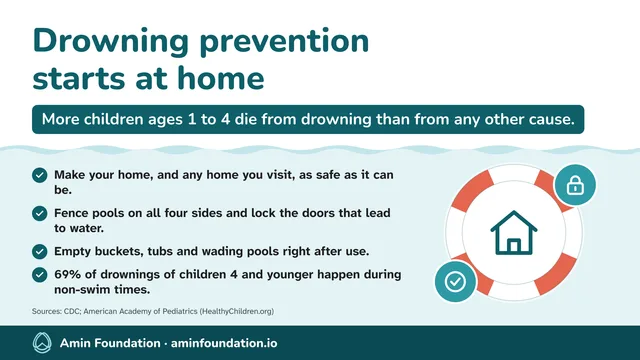
Infographic
Drowning prevention starts at home
More children ages 1 to 4 die from drowning than from any other cause.
If your toddler is missing
Emergency
Call 911 if you find a child in the water. If your child is missing, check the water first: the pool, hot tub, bathtub, ponds and any bucket or cooler. The Red Cross says seconds count (opens in a new tab).
CPSC found that most children who drowned in pools or spas had been missing for 5 minutes or less (opens in a new tab). The AAP says everyone, including parents, caregivers and older children, should learn CPR (opens in a new tab) and safe rescue. Find a class through where to learn CPR.
What you can do today
- Test your pool gate. Open it and let go. It should swing shut and latch by itself. Use the Pool Safety Checklist for the rest of the barrier.
- Lock the way out. Add a high latch or a door alarm to any door that leads to a pool, yard or garage.
- Make a Water Watcher card and agree with the other adults in your family on how you'll hand it off.
- Walk through your home with the Home water hazard audit and empty every container you find.
- Ask your pediatrician at the next visit whether your child is ready for swim lessons.
- Book a CPR class for you and any other regular caregiver.
Has your child just started crawling? See water safety for babies and crawlers. Starting school soon? Read water safety for kids ages 5 to 12.
Common questions
Why are toddlers at such high risk of drowning?
Toddlers are curious, quick and drawn to water, but they don't understand that it can be dangerous. The AAP's lead author on drowning says toddlers 'can escape without notice even under the best of circumstances.' The AAP also reports that 69% of drownings in children 4 and younger happened during non-swim times.
When should my toddler start swim lessons?
The AAP says children can begin swim lessons after their first birthday, depending on readiness. Readiness depends on how often your child is around water, their maturity, their physical and developmental abilities and how comfortable they are in the water. Your pediatrician can help you decide.
Do water wings or floaties keep a toddler safe?
No. The AAP says floaties, water wings and inflatable toys can deflate and do not prevent drowning. Use a U.S. Coast Guard-approved life jacket that fits, and stay within arm's reach.
What should I do if my toddler goes missing?
Check the water first: the pool, hot tub, tub, ponds and buckets. The Red Cross says seconds count, and CPSC found most children who drowned in pools or spas had been missing for 5 minutes or less. Call 911 if you find a child in the water.
Tools and printables for this guide
Interactive tool
Home water hazard audit
Go room by room to find drowning hazards at home, from bathtubs and buckets to doors and backyard water, and get a printable to-do list with fixes.
Interactive tool
Water Watcher card and timer
Print a Water Watcher card and run a rotation timer so adults take turns watching children in the water, handing over every 15 to 20 minutes.
Printable
Pool Safety Checklist
A one-page checklist for pool and hot tub owners: four-sided fencing, self-latching gates, alarms, covers, drains, Water Watchers and rescue gear.
Printable
Water Watcher Card
A cut-out card to pass between adults at the pool, beach or lake: whoever holds it watches the water, with no phone and no other job, for 15-20 minutes.
Infographic
Drowning prevention starts at home
More children ages 1 to 4 die from drowning than from any other cause.
Sources
- Drowning Facts (opens in a new tab) CDC
- Drowning Increases in the U.S. (Vital Signs) (opens in a new tab) CDC, 2024
- Vital Signs: Drowning Death Rates, Self-Reported Swimming Skill, Swimming Lesson Participation, and Recreational Water Exposure, United States, 2019-2023 (MMWR 2024;73(20)) (opens in a new tab) CDC (MMWR), 2024
- Risk Factors for Drowning (opens in a new tab) CDC, 2026
- Drowning Prevention for Curious Toddlers: What Parents Need to Know (opens in a new tab) American Academy of Pediatrics (HealthyChildren.org), 2026
- AAP Releases Updated Drowning Prevention Recommendations (opens in a new tab) American Academy of Pediatrics (HealthyChildren.org), 2026
- Swim Lessons for Children: When to Start & What to Consider (opens in a new tab) American Academy of Pediatrics (HealthyChildren.org), 2026
- Pool Dangers and Drowning Prevention: When It's Not Swimming Time (opens in a new tab) American Academy of Pediatrics (HealthyChildren.org), 2026
- Pool or Spa Submersion: Estimated Nonfatal Drowning Injuries and Reported Drownings, 2026 Report (opens in a new tab) U.S. Consumer Product Safety Commission, 2026
- In-Home Drowning (Safety Education Center) (opens in a new tab) U.S. Consumer Product Safety Commission
- Safety Tips (opens in a new tab) Pool Safely (CPSC)
- Know Before You Go: Pool Safety and Vacation Rentals (opens in a new tab) Pool Safely (CPSC), 2026
- Association between swimming lessons and drowning in childhood: a case-control study (Arch Pediatr Adolesc Med 2009;163(3):203-210) (opens in a new tab) Brenner RA et al., NICHD (NIH), 2009
- Water Safety (opens in a new tab) American Red Cross
- Life Jackets Save Lives (opens in a new tab) Water Safety USA
More in Water Safety by Age
Water Safety Skills by Age: A Milestone Guide
Which water safety habits and swim skills fit each age, from toddlers to teens and adults learning later, based on AAP and Red Cross guidance.
Water Safety for Kids Ages 5 to 12
School-age kids gain skills and independence near water. Build real swim skills, set rules kids can own, and plan for pools, lakes, camps and sleepovers.
My Child Can Swim. Do They Still Need Watching?
Yes, kids who swim still need watching. Why skill isn't safety, the danger of breath-holding games, deep and natural water, and rules older kids accept.