
Drowning When Nobody Is Swimming: The Everyday Moments That Matter
Most young children who drown weren't expected to be near water. How toddlers reach water unseen, the busy moments to plan for, and barriers that help.
Key takeaways
- 69% of drownings of children 4 and under happened during non-swim times, when they weren't expected to be in the water.
- In one CPSC study, 46% of young children who drowned in pools were last seen inside their home.
- Busy, changing moments carry the most risk: the end of swim time, meals, guests and visits.
- Barriers such as locked doors, door alarms and four-sided pool fences work when attention slips.
- If a child is missing, check the water first.
Most young children who drown were not supposed to be near water at that moment. They got there during an ordinary part of the day, often in seconds, while the adults thought they were inside. Planning for those everyday moments, with barriers that work even when your attention slips, is one of the most important things you can do.
This is not about blame. Every parent looks away. The aim is a home where looking away for a moment doesn't lead to water.
How a toddler reaches water unseen
69%
The American Academy of Pediatrics (AAP) describes a U.S. Consumer Product Safety Commission (CPSC) study of young children who drowned in pools in Arizona, California and Florida. It found that nearly 70% of the children were not expected to be at or in the pool, and 46% were last seen inside their home (opens in a new tab).
How did they get out? The AAP says children slipped out a door, climbed out a window, or even crawled through a doggy door (opens in a new tab). Most young children who drowned this way wandered outside and fell into a swimming pool that was not fenced off from the house (opens in a new tab).
Time is short. The Red Cross notes that children were often out of sight for less than 5 minutes and in the care of one or both parents at the time (opens in a new tab). And CPSC's latest data show that in 59% of pool and spa drowning deaths of children under 5, an adult had lost track of where the child was (opens in a new tab) (2021-2023).
High-risk moments to plan for
Risk rises when routines change and adults are busy. Plan ahead for these:
- The end of swim time. The Red Cross warns that many home-pool drownings happen as the swimming activity was coming to an end and everyone was thought to be out of the water (opens in a new tab). Count every child out of the water, then close the gate or door behind you.
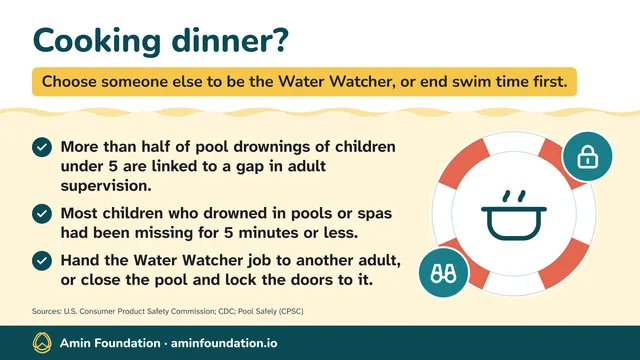
- Meal times. Cooking pulls the main caregiver's eyes away. Name someone else to watch the children, or keep them in the kitchen with you.
- Parties and gatherings. The AAP says to be especially careful during parties or picnics at the pool or lake, when it's easy to get distracted (opens in a new tab). With many adults around, each assumes someone else is watching.
- Visits to other homes. The AAP notes that many drownings among young children take place at the home of a friend, relative or neighbor (opens in a new tab). A new place means new doors and new water.
- Busy or unusual days. Moving house, holidays, visitors, a sick sibling, or a delivery at the door all break the usual routine. On those days, check doors and gates more often.
Barriers that work when attention slips
Supervision is the first layer, but nobody can watch every second of every day. Barriers protect a child during the gaps.
- A four-sided pool fence. The AAP calls fences the most effective, proven way to prevent drowning of young children (opens in a new tab). The fence should separate the pool from the house, not just the yard from the street. See pool fences and gates.
- Locked doors to water. CDC advises that after swim time you shut and lock doors that give access to water (opens in a new tab).
- Door and window alarms. The AAP suggests door alarms and turning on the door chime on a home security system. Our guide to stopping toddlers from slipping outside covers locks, alarms, windows and pet doors.
- No toys near the pool. CDC says to remove all toys from the pool area that might attract children (opens in a new tab) when the pool is not in use.
- Empty containers. Inside the home, the same idea applies to tubs, buckets and toilets. See the room-by-room hazard checklist.
Layers, not one fix
No single step prevents every drowning. The AAP recommends multiple layers of protection (opens in a new tab), because each layer covers for the moments another one fails.
A quick "where is the child?" habit
Small habits close the gaps between layers:
- Say it out loud. When you hand a child to another adult, say "You have her now," and wait for a "Got it."
- Count at every change. Count heads when you go inside, start a meal, or answer the door.
- Close as you go. Make "door shut, gate latched" part of leaving any room or yard.
- Ask your older children to close doors behind them. The AAP suggests teaching them to always close the door behind them so younger children don't follow them out (opens in a new tab).
If a child is missing
Emergency
Call 911 the moment you find a child in the water, and get them out if you can do it safely. If a child is missing, check the pool, spa and any nearby water first, including neighbors'. CPSC says most victims of pool and spa drownings had been missing for 5 minutes or less when they were found (opens in a new tab), and time spent looking elsewhere first is often wasted (opens in a new tab).
The Red Cross puts it the same way: if a child is missing, check the water first: seconds count (opens in a new tab). Make sure everyone in your home, including sitters and grandparents, knows this rule.
What you can do today
- Walk the route a toddler could take from each room to the nearest water. Lock, latch or alarm each door on the way.
- Pick tonight's watcher. If you're cooking, ask someone else to watch, and give them a card from the Water Watcher card and timer tool.
- Check the fence and gate. Does the gate close and latch by itself every time?
- Teach the "check the water first" rule to every adult who cares for your child.
- Run the Home water hazard audit to find water you might have missed, and read how to supervise kids around water.
Common questions
What does non-swim time mean?
It means any time a child is not expected to be in or near the water. The AAP reports that 69% of drownings of children 4 and younger happened during non-swim times. The child got to the water when adults thought they were inside, napping or playing somewhere else.
How do toddlers get to the pool without anyone seeing?
According to the AAP, young children have slipped out a door, climbed out a window or crawled through a pet door to reach a pool. That is why locked doors, door alarms and a four-sided fence matter even when no one plans to swim.
Where should I look first if my child is missing?
Check the water first. The Red Cross says seconds count, and CPSC reports that most children who drowned in pools or spas had been missing for 5 minutes or less. Look in the pool, spa and any nearby water, including neighbors', then search the rest of the home.
Tools and printables for this guide
Interactive tool
Home water hazard audit
Go room by room to find drowning hazards at home, from bathtubs and buckets to doors and backyard water, and get a printable to-do list with fixes.
Interactive tool
Water Watcher card and timer
Print a Water Watcher card and run a rotation timer so adults take turns watching children in the water, handing over every 15 to 20 minutes.
Sources
- Drowning Prevention for Curious Toddlers: What Parents Need to Know (opens in a new tab) American Academy of Pediatrics (HealthyChildren.org), 2026
- Pool Dangers and Drowning Prevention: When It's Not Swimming Time (opens in a new tab) American Academy of Pediatrics (HealthyChildren.org), 2026
- Swimming Safety (opens in a new tab) American Red Cross
- In-Home Drowning (Safety Education Center) (opens in a new tab) U.S. Consumer Product Safety Commission
- Preventing Drowning (opens in a new tab) CDC, 2025
- Swim Lessons for Children: When to Start & What to Consider (opens in a new tab) American Academy of Pediatrics (HealthyChildren.org), 2026
- Pool or Spa Submersion: Estimated Nonfatal Drowning Injuries and Reported Drownings, 2026 Report (opens in a new tab) U.S. Consumer Product Safety Commission, 2026
More in Water Safety at Home
Backyard Water Hazards: Ponds, Fountains, Rain Barrels and Spas
How to make ponds, fountains, rain barrels, ditches and hot tubs safe for small children: what to remove, what to cover or lock, and when to fence it off.
Bath Time Safety: How to Keep Babies and Toddlers Safe in the Tub
How to bathe a baby or toddler safely: stay within arm's reach, set up before the water runs, and why bath seats and neck floats are not safety devices.
Buckets, Coolers and Containers: Hidden Drowning Risks for Toddlers
Why a toddler can drown in a bucket, cooler or bin with just a few inches of water, and the simple empty-and-flip habit that removes the risk at home.