
Bath Time Safety: How to Keep Babies and Toddlers Safe in the Tub
How to bathe a baby or toddler safely: stay within arm's reach, set up before the water runs, and why bath seats and neck floats are not safety devices.
Key takeaways
- Among U.S. babies under 1, three out of four drownings happen in bathtubs.
- Stay within arm's reach for the whole bath. Keep a hand on your baby, and never leave, not even for a moment.
- Set out everything before the water runs. If you must answer the door or phone, wrap your baby in a towel and take them with you.
- An older brother or sister is not a bath supervisor. The AAP says children shouldn't bathe alone until at least age 6.
- Bath seats, bath rings and neck floats are not safety devices. Babies can tip or slip out of them.
The safest bath is one where an adult stays within arm's reach the entire time, with a hand on the baby. Get everything ready before the water runs. If something pulls you away, wrap your baby in a towel and take them with you.
That one rule matters more than any product you can buy. This guide shows how to make it easy to follow, every bath.
The one rule: stay within arm's reach
3 in 4
Babies can drown in as little as 1 or 2 inches of water, silently and within seconds (opens in a new tab), because they don't yet have much neck and muscle control (AAP). There is no splash or cry to warn you.
That is why the American Academy of Pediatrics (AAP) recommends staying within arm's length and giving constant "touch supervision," whether it's bath time or swim time (opens in a new tab). Touch supervision means you are close enough to grab your child at any moment. With a baby, it means a hand on them.
The AAP says that in many cases, bathtub drownings happen during a lapse in adult supervision (opens in a new tab). Lapses are human. The goal is to plan the bath so you never need to step away.
Before you run the water
Set up first, so the bath itself has nothing to interrupt it. The AAP says to have a towel and other bath supplies within reach so you can keep a hand on your baby at all times (opens in a new tab).
Water temperature is a separate risk from drowning. The AAP says the hottest water at the faucet should be no more than 120 degrees Fahrenheit (opens in a new tab), because tap water that is too hot can burn quickly.
During the bath: phones, doorbells and handoffs
Most interruptions feel urgent and take "just a second." Decide now what you will do.
- The doorbell or a forgotten item. The AAP's advice is direct: if you forgot something or need to answer the door, bring your baby with you (opens in a new tab).
- The phone. Let it ring. CDC lists phone use among the distractions to avoid while you supervise closely and constantly when children are in or near water, including bathtubs (opens in a new tab).
- Handing off. If another adult takes over, say it out loud: "You've got the baby in the bath." Don't leave until they are at the tub with a hand on the baby.
Not even for a moment
CPSC says: never leave a baby alone, or with young siblings, in a bathtub even for a second (opens in a new tab). A quick trip for a towel is long enough for a baby to slip under.
Older siblings are not supervisors
Big brothers and sisters love to help, and they can. But they can't be in charge of the bath.
The AAP recommends that children not be allowed to bathe alone until they are at least 6 years old, and that another young sibling not supervise children under this age (opens in a new tab). Its infant page adds: never leave your baby in the care of another young child in or near water (opens in a new tab).
Give older children real jobs that keep you in place: handing you the towel, singing a bath song, or choosing the toy. If two children bathe together, the same rule applies to both: an adult within arm's reach.
Bath seats, bath rings and neck floats
Many parents ask whether a bath seat makes the tub safer. A seat can help you hold a slippery baby, but it is a bathing aid, not a safety device.
- Bath seats and rings can fail. The AAP warns that infant bath seats can tip over and children can slip out of them and drown in even a few inches of water (opens in a new tab). CPSC reports that some bathtub drowning deaths happened when children were in bath seats or rings (opens in a new tab).
- There is a federal standard. Infant bath seats sold in the U.S. must meet a mandatory CPSC rule. CPSC says it seeks to prevent deaths and injuries, particularly drowning, when a bath seat is used with an infant (opens in a new tab). A standard lowers the risk of a seat tipping or trapping a baby. It does not make it safe to step away.
- Register what you buy. CPSC requires durable infant products such as bath seats to come with a product registration card (opens in a new tab). Fill it in so the maker can reach you if there is a recall. Before using a hand-me-down seat, search CPSC's recall list (opens in a new tab).
- Neck floats are not safety devices. CPSC received reports of 115 incidents involving infant neck floats from January 2019 to January 2024, including two infant deaths (opens in a new tab), and it warns that drowning can happen quickly and silently even when a baby seems supported.
Whatever you use, the rule doesn't change. The AAP says arm's-reach supervision is important even if you are using a supportive infant tub or bath seat (opens in a new tab).
After the bath: drain it right away
Pull the plug before you lift your baby out, or as soon as they are wrapped in a towel. CPSC advises that all containers with liquids be emptied immediately after use (opens in a new tab), and a tub is the biggest one in the house.
Then close the bathroom. The AAP suggests safety latches or doorknob covers to keep bathrooms closed when they're not in use (opens in a new tab), and removing the drain plug when the tub isn't in use (opens in a new tab) so it can't fill if a child turns on the faucet. Toilets need a lid lock too. The room-by-room hazard checklist covers the rest of the bathroom.
What you can do today
- Make a bath kit: a basket with towel, diaper, soap and clothes that sits by the tub.
- Agree on one rule with everyone who bathes your child: hands on, phone away, take the baby if you leave.
- Brief grandparents and sitters. Share water safety rules for babysitters.
- Put a latch on the bathroom door and a lock on the toilet lid.
- Learn more about supervision in how to supervise kids around water, and about this age in water safety for babies and crawlers.
Common questions
How long can you leave a baby alone in the bath?
Not at all. The American Academy of Pediatrics says never leave your baby alone or in the care of another young child in or near water, not even for a moment. Babies can drown in 1 or 2 inches of water, silently and within seconds. If you need to step away, take your baby with you.
Are baby bath seats safe?
A bath seat can help you hold a baby in place, but it does not keep a baby safe on its own. The AAP warns that infant bath seats can tip over and that babies can slip out of them and drown. Keep a hand on your baby the whole time, with or without a seat.
Can my older child watch the baby in the bath?
No. The AAP recommends that children not bathe alone until they are at least 6, and that another young sibling never supervise them. CPSC says never leave a baby alone, or with young siblings, in a bathtub even for a second. An adult needs to be within arm's reach.
Tools and printables for this guide
Printable
Home Water Safety Checklist
A one-page, room-by-room checklist to find and fix drowning hazards at home: bathtubs, toilets, buckets, coolers, doors, hot tubs and pools.
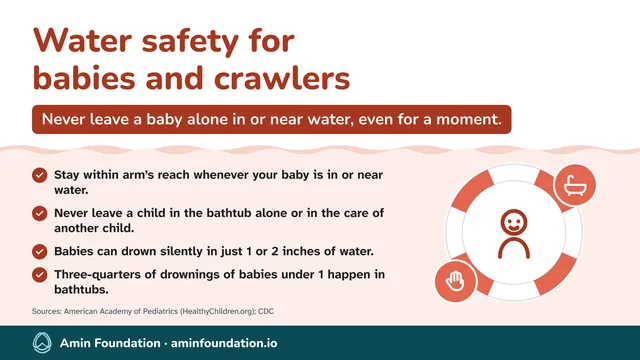
Infographic
Water safety for babies and crawlers
Never leave a baby alone in or near water, even for a moment.
Sources
- Risk Factors for Drowning (opens in a new tab) CDC
- Infant Drowning Prevention & Water Safety: How to Protect Your Baby (opens in a new tab) American Academy of Pediatrics (HealthyChildren.org), 2026
- Drowning Prevention for Curious Toddlers: What Parents Need to Know (opens in a new tab) American Academy of Pediatrics (HealthyChildren.org), 2026
- Prevent Child In-Home Drowning Deaths (Publication 5013) (opens in a new tab) U.S. Consumer Product Safety Commission, 2012
- Infant Bath Seats (FAQ) (opens in a new tab) U.S. Consumer Product Safety Commission
- As CPSC's First Federal Neck Floats Safety Standard Takes Effect, Agency Renews "Do Not Use" Warnings (opens in a new tab) U.S. Consumer Product Safety Commission, 2026
- Preventing Drowning (opens in a new tab) CDC, 2025
- Recalls (opens in a new tab) U.S. Consumer Product Safety Commission
More in Water Safety at Home
Backyard Water Hazards: Ponds, Fountains, Rain Barrels and Spas
How to make ponds, fountains, rain barrels, ditches and hot tubs safe for small children: what to remove, what to cover or lock, and when to fence it off.
Buckets, Coolers and Containers: Hidden Drowning Risks for Toddlers
Why a toddler can drown in a bucket, cooler or bin with just a few inches of water, and the simple empty-and-flip habit that removes the risk at home.
Door Alarms and Locks: Stop Toddlers From Slipping Outside Unnoticed
Secure doors, sliding doors, windows and pet doors so a toddler can't reach a pool or yard water unseen: high locks, CPSC-style door alarms and habits.