
Door Alarms and Locks: Stop Toddlers From Slipping Outside Unnoticed
Secure doors, sliding doors, windows and pet doors so a toddler can't reach a pool or yard water unseen: high locks, CPSC-style door alarms and habits.
Key takeaways
- In one CPSC study, 46% of young children who drowned in pools were last seen inside their home.
- Lock every door a child could use to reach water, with the lock or latch out of a child's reach.
- Door alarms add a layer. CPSC says a pool door alarm should sound within 7 seconds and be loud enough to hear across the house.
- Never have a pet door that leads straight to a pool or other backyard water.
- Locks and alarms only work when they are used every time, by everyone.
To stop a toddler from slipping outside to water, lock every door and window that leads toward water with a latch they can't reach, and add a door alarm that sounds the moment a door opens. Then make closing and locking those doors a habit for everyone in the house.
Exits matter because young children rarely go to water when adults expect it. They go when they find a door open.
Why exits matter for drowning prevention
46%
The American Academy of Pediatrics (AAP) describes how young children reached pools in that study: they slipped out a door, climbed out a window, or even crawled through a doggy door (opens in a new tab). Read more about these moments in drowning when nobody is swimming.
The AAP's first step is simple: use safety gates, door locks or doorknob covers to prevent your toddler from going outside (opens in a new tab). Its pool guidance adds that house doors should be locked if a child could get to the pool through them (opens in a new tab).
Locks and latches a toddler can't reach
Toddlers learn to turn knobs, push chairs and open sliding doors quickly. Put the lock where they can't get to it.
- Exterior doors. Add a latch or lock high up, out of a child's reach. The Red Cross recommends door alarms and locks that are out of the reach of a child on all doors and windows with direct access to the pool or spa area (opens in a new tab).
- Sliding doors. Use a second lock or bar at adult height, and keep the screen door closed too.
- Self-closing doors. CPSC's barrier guidelines say doors that lead to a pool should have self-closing and self-latching devices or locks that are beyond the reach of children (opens in a new tab).
- Doorknob covers and safety gates. Inside the house, these keep a toddler away from the doors that lead out, and out of the bathroom.
- Windows. The AAP says window guards can be especially helpful for windows on the house that face the pool (opens in a new tab). Keep furniture away from windows so they're harder to climb.
Door and window alarms
An alarm tells you a door opened, even when you're in another room. The AAP lists door alarms (opens in a new tab) as an added protection, and says that if you have a home security system, make sure the door alert sound is turned on (opens in a new tab).
When the house forms one side of a pool barrier, the U.S. Consumer Product Safety Commission (CPSC) recommends an audible alarm on all doors that allow access to a swimming pool (opens in a new tab). Its guidelines describe what a good pool door alarm does:
| Feature | CPSC guideline |
|---|---|
| How fast | Starts within 7 seconds after the door opens |
| How long | Sounds for 30 seconds or more |
| How loud | At least 85 decibels, measured 10 feet away |
| What it sounds like | Different from the phone, doorbell and smoke alarm |
| Adult pass-through | Pauses for up to 15 seconds, then resets itself |
| Pause switch | At least 54 inches above the doorstep, out of children's reach |
The guidelines also say alarms should meet UL 2017, a safety standard for signaling devices. Look for that on the package. The AAP notes that door and gate alarms can have touchpads (opens in a new tab) so adults can pass through without setting them off.
Alarms are a backup, not a fence. For alarms on the pool itself, see pool alarms, gate alarms and wearable alarms.
Pet doors and other gaps
Pet doors are easy to forget. CPSC is clear: never have a pet or doggy door if the door leads directly to a pool or other backyard water (opens in a new tab). It warns that locking a pet door is not enough, and that an isolation fence around the pool is the best defense if you have one.
Check other routes too: a door through the garage, a gap in a side fence, or a basement door to the yard. If a toddler can fit through it, treat it as a door.
Visitors, deliveries and busy days
Doors get left open when routines change. Plan for:
- Guests. Ask visitors to close and lock the door behind them. Put a small sign on the inside of the door.
- Deliveries and workers. Keep children in another room or in your arms while the door is open.
- Older children. The AAP suggests teaching them to always close the door behind them so younger children don't follow them out (opens in a new tab).
- After swim time. CDC says to shut and lock doors that give access to water (opens in a new tab) when swimming is over.
Children who wander
Some children are more likely to wander or bolt, including many children with autism. In a 2012 survey of parents, 49% said their child with autism had tried to wander at least once after age 4 (opens in a new tab). For these families, alarms, high locks and a written plan are especially important. Our guide to wandering and water goes further.
What you can do today
- Walk every exit. List each door, sliding door, window and pet door that leads toward water.
- Add one high lock to the door your child uses most to get outside.
- Turn on the door chime on your security system, or add a simple door alarm.
- Check your pool barrier with the Pool barrier check, and the rest of the house with the Home water hazard audit.
- Agree on "close and lock" as a family rule, and explain it to guests and sitters. Pair it with a room-by-room hazard check.
Common questions
Do door alarms really help prevent drowning?
They are a backup layer, not a replacement for a fence or supervision. CPSC recommends an audible alarm on every door that leads to a pool when the house forms one side of the pool barrier, and the AAP lists door alarms among the protections that help keep toddlers from going outside unnoticed.
How loud should a pool door alarm be?
CPSC's barrier guidelines say the alarm should be at least 85 decibels measured 10 feet away, start within 7 seconds of the door opening, sound for 30 seconds or more, and sound different from the phone, doorbell and smoke alarm.
Is it safe to have a dog door if we have a pool?
CPSC says never have a pet door that leads directly to a pool or other backyard water, and that locking a pet door is not enough. A fence that separates the pool from the house is the best defense if you have a pet door.
Tools and printables for this guide
Interactive tool
Home water hazard audit
Go room by room to find drowning hazards at home, from bathtubs and buckets to doors and backyard water, and get a printable to-do list with fixes.
Interactive tool
Pool barrier check
Check your pool fence and gate against the CPSC barrier guidelines: height, gaps, latches, door alarms and covers. Get a printable list of what to fix.
Infographic
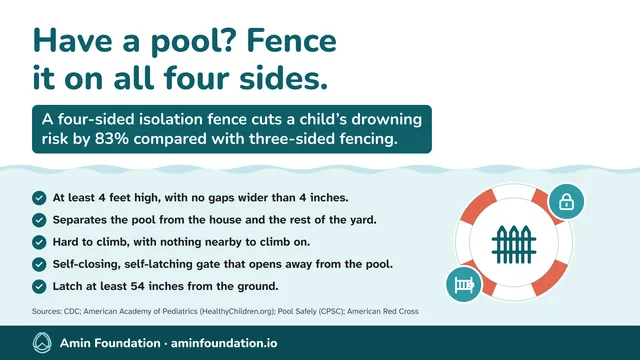
Have a pool? Fence it on all four sides.
A four-sided isolation fence cuts a child’s drowning risk by 83% compared with three-sided fencing.
Sources
- Pool Dangers and Drowning Prevention: When It's Not Swimming Time (opens in a new tab) American Academy of Pediatrics (HealthyChildren.org), 2026
- Drowning Prevention for Curious Toddlers: What Parents Need to Know (opens in a new tab) American Academy of Pediatrics (HealthyChildren.org), 2026
- Safety Barrier Guidelines for Residential Pools (Publication 362) (opens in a new tab) U.S. Consumer Product Safety Commission, 2023
- Home Pool & Hot Tub Safety (opens in a new tab) American Red Cross
- Preventing Drowning (opens in a new tab) CDC, 2025
- Occurrence and family impact of elopement in children with autism spectrum disorders (Pediatrics 2012;130(5):870-877) (opens in a new tab) Anderson C et al., Kennedy Krieger Institute, 2012
More in Water Safety at Home
Backyard Water Hazards: Ponds, Fountains, Rain Barrels and Spas
How to make ponds, fountains, rain barrels, ditches and hot tubs safe for small children: what to remove, what to cover or lock, and when to fence it off.
Bath Time Safety: How to Keep Babies and Toddlers Safe in the Tub
How to bathe a baby or toddler safely: stay within arm's reach, set up before the water runs, and why bath seats and neck floats are not safety devices.
Buckets, Coolers and Containers: Hidden Drowning Risks for Toddlers
Why a toddler can drown in a bucket, cooler or bin with just a few inches of water, and the simple empty-and-flip habit that removes the risk at home.