
Inflatable and Portable Pool Safety
Kiddie, inflatable and portable pools can drown a toddler. Empty small pools after every use, fence larger ones, and watch every minute of splash time.
Key takeaways
- Portable pools range from small blow-up pools to large ones holding thousands of gallons. CPSC says they present a real danger to young children.
- Empty small pools after every use and turn them over. A few inches of water left behind is enough to drown a toddler.
- Larger portable and inflatable pools that stay filled need a fence on all four sides, like any pool.
- Remove or lock ladders and steps, and move anything a child could climb.
- Splash time needs an adult within arm's reach. Floaties don't count as protection.
Inflatable and portable pools are safe to enjoy only with three habits: an adult within arm's reach during every minute of splash time, emptying small pools right after use, and fencing any larger pool that stays filled. Even a small kiddie pool holds more than enough water to drown a toddler.
These pools are cheap, quick to set up and fun. They also appear in backyards that weren't planned around a pool, without fences, alarms or locked gates. This guide closes those gaps.
Small pools, real risk
5%
The U.S. Consumer Product Safety Commission (CPSC) says portable pools vary in size and height, from tiny blow-up pools to larger designs that can hold thousands of gallons of water (opens in a new tab), and that they present a real danger to young children (opens in a new tab). In its 2026 report, CPSC defines a portable pool as any pool that can be set up, taken down or moved with relative ease (opens in a new tab).
Size doesn't decide the risk. CPSC says a child can drown in as little as 2 inches of water (opens in a new tab), and a toddler who leans in to reach a toy can tip in headfirst.
Empty and flip after every use
For small kiddie and wading pools, the safest pool is an empty one.
- Empty it as soon as swim time ends. The AAP lists wading pools among the containers to completely empty whenever they're not in use (opens in a new tab).
- Turn it upside down or stand it on its side so rain can't refill it.
- Put it away. Pool Safely advises you put away the inflatable pool when not in use (opens in a new tab).
- Check after storms. A forgotten pool, toy bucket or tarp can collect rainwater overnight.
Make it part of the routine
Make "towels, toys, tip the pool" the last step of every splash session, before anyone goes inside. Children can help tip a small pool, which teaches them the habit too.
Larger portable pools need barriers
Bigger inflatable and frame pools are often left filled all summer. Then they need the same protection as any pool.
- Fence all four sides. The AAP says swimming pools, including large, inflatable above-ground pools and other temporary pools, should be completely surrounded by a fence on all 4 sides (opens in a new tab). CPSC's checklist says to install a 4-foot non-climbable fence around the perimeter of the pool and spa, including portable pools (opens in a new tab).
- If you can't fence it, empty it. CPSC says portable pools should be fenced, covered, or emptied and stored away when not in use (opens in a new tab).
- Lock the doors to the yard. Most toddlers reach backyard water through a door. See door alarms and locks.
- Tell people. CPSC suggests you tell neighbors, friends, and caregivers that you have a portable pool and advise them of the potential dangers (opens in a new tab). A neighbor's child may find it, too.
Fence details, including height, gaps and gates, are in pool fences and gates.
Ladders, steps and climbing
Taller portable pools are usually entered by a ladder or steps, and children use whatever they can find to climb.
- Remove or lock the ladder when no adult is supervising. The Red Cross says to secure, lock or remove steps, ladders and anything that can be used for access (such as outdoor furniture and toys) (opens in a new tab).
- Move climbable things away: chairs, coolers, toy boxes and the pump.
- Check the pool's outer wall. In 2025, CPSC announced a recall of about 5 million above-ground pools 48 inches and taller (opens in a new tab) whose outside compression straps could give a child a foothold. See above-ground pool safety for what to do if you have one.
Supervision for splash time
Shallow water fools adults into relaxing. Watch as closely as you would at a deep pool.
- Touch supervision. The AAP recommends a supervising adult with swimming skills within arm's length (opens in a new tab) for babies, toddlers and weak swimmers.
- Stay for the whole time. If you need to leave, take the children with you or empty the pool first.
- No phone, no cooking. CDC lists phone use and alcohol among the distractions to avoid, because drowning happens quickly and quietly (opens in a new tab).
- No floaties as safety gear. The AAP says to avoid floaties, water wings or inflatable toys. These can deflate and do not prevent drowning (opens in a new tab).
- Follow the maker's instructions. Pool Safely advises you follow the manufacturer's safety guidelines (opens in a new tab) for setup, water depth and use.
What you can do today
- Empty and tip any kiddie pool in your yard right now.
- Decide on the big pool: fence it on four sides, or empty and store it after use.
- Remove the ladder and move climbable items away from any pool that stays filled.
- Check your barrier with the Pool barrier check, and your yard with the Home water hazard audit.
- Read more in backyard water hazards and water safety for toddlers.
Common questions
Do I need to empty a kiddie pool every day?
Yes, after every use. The AAP lists wading pools among the containers to completely empty whenever they're not in use, and CPSC says portable pools should be fenced, covered, or emptied and stored when not in use. Turn small pools upside down so rain can't refill them.
Does an inflatable pool need a fence?
If it stays filled, yes. The AAP says pools, including large inflatable above-ground pools and other temporary pools, should be completely surrounded by a fence on all 4 sides. Small pools you empty after every use don't need one.
Are inflatable pools safe for kids?
They can be used safely with close supervision. Pool Safely advises always watching children around inflatable pools, following the maker's safety guidelines, and putting the pool away when not in use. In CPSC's data, portable pools were part of 5% of pool and spa drowning deaths of children under 5 (2021-2023).
Tools and printables for this guide
Interactive tool
Pool barrier check
Check your pool fence and gate against the CPSC barrier guidelines: height, gaps, latches, door alarms and covers. Get a printable list of what to fix.
Interactive tool
Home water hazard audit
Go room by room to find drowning hazards at home, from bathtubs and buckets to doors and backyard water, and get a printable to-do list with fixes.
Printable
Pool Safety Checklist
A one-page checklist for pool and hot tub owners: four-sided fencing, self-latching gates, alarms, covers, drains, Water Watchers and rescue gear.
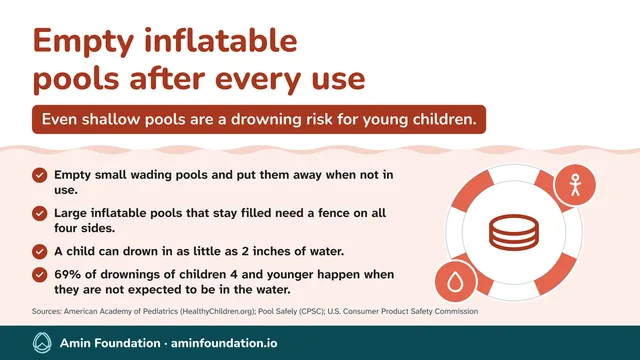
Infographic
Empty inflatable pools after every use
Even shallow pools are a drowning risk for young children.
Sources
- Safety Barrier Guidelines for Residential Pools (Publication 362) (opens in a new tab) U.S. Consumer Product Safety Commission, 2023
- Drowning Prevention for Curious Toddlers: What Parents Need to Know (opens in a new tab) American Academy of Pediatrics (HealthyChildren.org), 2026
- FAQs (opens in a new tab) Pool Safely (CPSC)
- Pool or Spa Submersion: Estimated Nonfatal Drowning Injuries and Reported Drownings, 2026 Report (opens in a new tab) U.S. Consumer Product Safety Commission, 2026
- In-Home Drowning (Safety Education Center) (opens in a new tab) U.S. Consumer Product Safety Commission
- Home Pool & Hot Tub Safety (opens in a new tab) American Red Cross
- AAP Releases Updated Drowning Prevention Recommendations (opens in a new tab) American Academy of Pediatrics (HealthyChildren.org), 2026
- Preventing Drowning (opens in a new tab) CDC, 2025
- Recall: above-ground pools 48 inches and taller with external compression straps (drowning hazard) (opens in a new tab) U.S. Consumer Product Safety Commission, 2025
More in Pool and Hot Tub Safety
Home Pool Safety Checklist: Layers of Protection
Check your home pool against every layer of protection: supervision, a four-sided fence and gate, alarms, swim skills, rescue gear and CPR. Printable list.
Hot Tub and Spa Safety for Kids and Adults
Use a hot tub or spa safely: lock the cover after every use, keep children under 5 out, stay at 104°F or below, avoid alcohol, and keep away from drains.
How to Host a Safe Pool Party
Plan a safe pool party: Water Watcher shifts with a card, life jackets for weak swimmers, sober supervision, rescue gear, and a locked gate when it ends.