
Free tool · Plan and supervise
Family water safety plan
Build a one-page plan for your family in about five minutes, then print it for the fridge, the back door or the pool gate.
Make your family’s plan
Private: what you enter stays on this device.
This is the printable version. Turn on JavaScript to use the interactive tool.
Family water safety plan
Family:
Who swims how well
| Name | Can’t swim yet | Learning | Can swim | Strong swimmer |
|---|---|---|---|---|
| ☐ | ☐ | ☐ | ☐ | |
| ☐ | ☐ | ☐ | ☐ | |
| ☐ | ☐ | ☐ | ☐ | |
| ☐ | ☐ | ☐ | ☐ | |
| ☐ | ☐ | ☐ | ☐ |
Water around us
Water Watchers (take turns every 15 to 20 minutes)
Our rules
Swim lessons
Who needs lessons, and where:
In an emergency
- If a child is missing, check the water first.
- Call 911. Give the address below.
- Reach or throw something that floats. Don’t go in.
- If you are trained, start CPR.
Emergency: 911. Our address:
Other numbers:
CPR: who is trained, or when we will take a class:
Scan to update this plan
Why a written plan helps
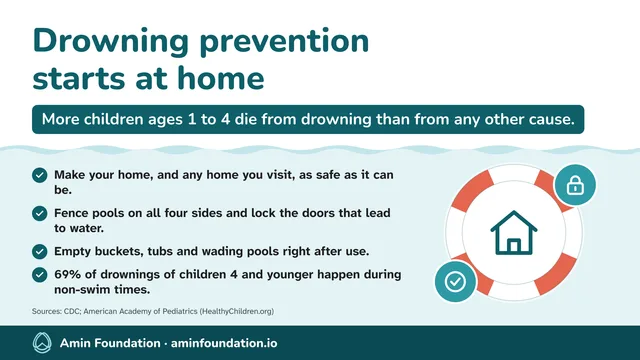
A family water safety plan puts the decisions you would otherwise make in a hurry on one page, before anyone is near the water. More children ages 1 to 4 die from drowning than from any other cause in the United States, according to the CDC (opens in a new tab). Most of those deaths don't happen during a planned swim. The American Academy of Pediatrics reports that 69% of drownings of children 4 and younger happened during non-swim times (opens in a new tab), when nobody expected the child to be in the water.
That is why a plan covers the whole day, not just pool time. It also gives babysitters, grandparents and older cousins the same rules you use, in writing.
What goes in your plan
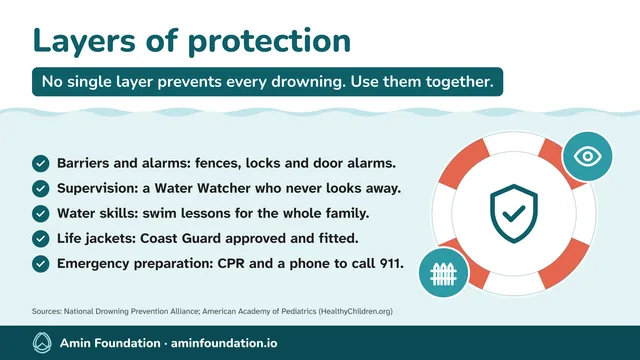
The National Drowning Prevention Alliance describes five layers of protection (opens in a new tab): barriers and alarms, supervision, water competency, life jackets and emergency preparation. No single layer prevents every drowning, so the plan uses all five.
- Who swims how well. List everyone at home. Anyone who can't swim yet, or is still learning, goes on your swim lessons list.
- The water around you. Bathtubs, buckets, kiddie pools, a backyard pool, a nearby pond, beach and lake trips. Each one needs its own habits.
- Water Watchers. A Water Watcher is an adult whose only job is watching children in the water, with no phone, reading or games (Pool Safely (opens in a new tab)). The AAP suggests taking turns and passing a water watcher card every 15 to 20 minutes (opens in a new tab). For babies, toddlers and weak swimmers, an adult stays within arm's reach.
- Family rules. Short rules everyone can repeat: ask before going near water, nobody swims alone, life jackets on boats.
- Swim lessons. The AAP says lessons can begin for many children at age 1, depending on readiness. Lessons are a layer of protection, but they don't make a child "drown proof."
- Emergency numbers and steps. Your address, written out for 911, and the steps the American Red Cross (opens in a new tab) teaches: if a child is missing, check the water first; call 911; reach or throw, don't go.
How to use the plan
Fill in what you can. Every part is optional, and the plan is saved only in this browser on this device. When you press Make our plan, the tool turns your answers into a one-page plan and suggests ways to make it stronger. Print it and put it where everyone sees it: on the fridge, by the back door, or by the pool gate.
The printed page has a QR code that brings you back to this tool, so you can update the plan when something changes. If JavaScript is off, print the blank version of the plan and fill it in by hand.
Talk the plan through with everyone who looks after your children. Ask who has learned CPR. The CDC (opens in a new tab) notes that CPR skills can save a life in the time it takes paramedics to arrive, and both the Red Cross and the American Heart Association offer classes. Learn where to take a CPR class and why it matters for drowning.
Keep it current
Children change fast. A baby who couldn't crawl last month can reach the bathroom this month. Look at the plan again after a birthday, a move, a new pool, or before a trip. Our guide to making a family water safety plan goes room by room, and how to supervise kids around water explains touch supervision and Water Watchers in more depth.
What you can do today
- Make your plan with the tool above and print it.
- Name two adults who will take turns as Water Watcher this week.
- Walk through your home with the home water hazard audit, and if you have a pool, the pool barrier check.
- Find lessons for anyone who can't swim yet with the swim lesson finder.
Printables, infographics and games
Printable
Water Emergency Action Plan
A fill-in emergency plan for a home pool, lake house, camp or event: the address for 911, who calls, where the rescue gear is, and the first steps in order.
Printable
Home Water Safety Checklist
A one-page, room-by-room checklist to find and fix drowning hazards at home: bathtubs, toilets, buckets, coolers, doors, hot tubs and pools.
Printable
Family Water Safety Pledge
A pledge for kids and grown-ups to read, tick and sign together: ask first, swim with a grown-up watching, wear life jackets, and get help without going in.
Infographic
Drowning prevention starts at home
More children ages 1 to 4 die from drowning than from any other cause.
Related guides
- How to Make a Family Water Safety Plan
Make a family water safety plan in five steps: list your water, name who watches, add barriers, build swim skills, and know what to do in an emergency.
- How to Supervise Kids Around Water: Touch Supervision and Water Watchers
What real supervision looks like near water: touch supervision for young children, one named Water Watcher with no other job, clean handoffs, and no phones.
- How to Write a Water Emergency Action Plan for a Pool, Camp or Event
Write a simple water emergency action plan for a home pool, camp, school trip or event: who calls 911, who reaches, who meets responders, and drills.
- Wandering (Elopement) and Water: A Safety Plan for Families
A wandering prevention and response plan for a child or adult drawn to water: secure the home, tell neighbors and responders, and search water first.
- How to Find Swim Lessons Near You, Including Free and Low-Cost Options
Find swim lessons near you for kids or adults with official YMCA, Red Cross, USA Swimming and city parks locators, plus ways to find free or low-cost classes.
- Where to Learn CPR and Why It Matters for Drowning
Where to find CPR classes from the Red Cross and American Heart Association, free FDNY classes in NYC, and why drowning calls for CPR with rescue breaths.
More tools: plan and supervise
Sources
- Drowning Facts (opens in a new tab) CDC
- Drowning Prevention for Curious Toddlers (opens in a new tab) American Academy of Pediatrics (HealthyChildren.org)
- Layers of Protection (opens in a new tab) National Drowning Prevention Alliance
- Safety Tips (opens in a new tab) Pool Safely (U.S. Consumer Product Safety Commission)
- Swim Lessons for Children: When to Start & What to Consider (opens in a new tab) American Academy of Pediatrics (HealthyChildren.org)
- Water Safety (opens in a new tab) American Red Cross
- Preventing Drowning (opens in a new tab) CDC
Updated