
How to Supervise Kids Around Water: Touch Supervision and Water Watchers
What real supervision looks like near water: touch supervision for young children, one named Water Watcher with no other job, clean handoffs, and no phones.
Key takeaways
- Drowning is fast and usually silent, so supervision means eyes on the water the whole time, not glancing up now and then.
- For babies, toddlers and weak swimmers, use touch supervision: an adult who can swim, within arm's reach.
- Name one Water Watcher whose only job is watching. No phone, no book, no cooking, no alcohol.
- Hand off the job out loud, with a Water Watcher card, every 15 to 20 minutes.
- Lifeguards and swim lessons help, but they don't replace a watching adult.
Supervising children around water means one adult watching the water the whole time, with nothing else to do. For babies, toddlers and weak swimmers, that adult stays within arm's reach. Everyone else gets a named Water Watcher who doesn't look away until they hand the job to someone else.
This sounds obvious, but it's easy to get wrong. Many adults at a pool are "watching" while they talk, cook or scroll. This guide shows what real supervision looks like and how to make it work at a bath, a pool, a beach or a party.
What "watching" really means
59%
CDC says drowning happens in seconds and is often silent (opens in a new tab). The U.S. Consumer Product Safety Commission (CPSC) adds that children often slip under the water silently, and even people near or in the pool have reported hearing nothing unusual (opens in a new tab). So you can't rely on hearing a problem. You have to see it.
CDC's advice is to designate a responsible adult to supervise closely and constantly when children are in or near water, including bathtubs (opens in a new tab). Close means near enough to act. Constant means no breaks without a handoff.
It helps to know what trouble looks like. A child who is drowning often can't shout or wave. Learn the signs in what drowning looks like.
Touch supervision for babies, toddlers and new swimmers
The American Academy of Pediatrics (AAP) recommends that a supervising adult with swimming skills stay within arm's length and provide "touch supervision" for an infant, toddler or weak swimmer (opens in a new tab) who is in or around water.
What touch supervision looks like:
- In the bath: a hand on the baby, the whole time. See bath time safety.
- In the pool: you are in the water with your child, close enough to grab them. The AAP says that even if you're not swimming but a pool or body of water is nearby, always keep children within arm's reach (opens in a new tab).
- When you leave: the child comes with you. The AAP's rule: if you must leave, take the child with you (opens in a new tab).
Swim lessons don't change this for young children. CDC says children who have had swimming lessons still need close and constant supervision (opens in a new tab), and Water Safety USA notes that children who finish entry-level lessons may still not be water competent (opens in a new tab).
The Water Watcher: one adult, one job
When several children are in the water, or a group of adults is around, name a Water Watcher.
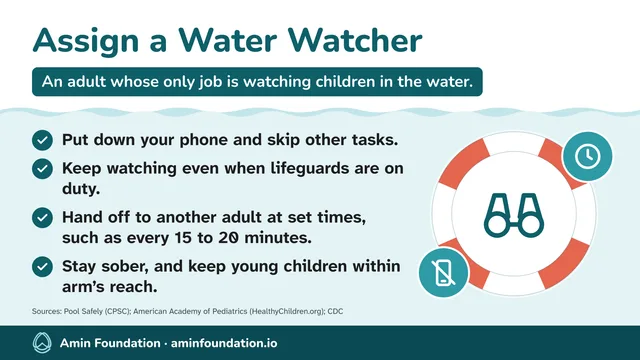
Pool Safely, the CPSC campaign, describes it this way: designate an official Water Watcher, an adult tasked with supervising children in the water. That should be their only task (opens in a new tab), with no reading, texting or phone games.
A good Water Watcher:
CDC also suggests you can assign a specific adult to supervise each child (opens in a new tab) when they have access to water. That works well for babies and toddlers at busy events.
Interactive tool
Water Watcher card and timer
Print a Water Watcher card and run a rotation timer so adults take turns watching children in the water, handing over every 15 to 20 minutes.
Handing off the job
Most gaps happen during a change of watcher, or when everyone assumes someone else is watching.
The AAP suggests that adults take turns, passing along a water watcher card to the next responsible adult after a set time, such as every 15 to 20 minutes (opens in a new tab). Make each handoff clear:
- The next watcher comes to the water's edge.
- The current watcher points out every child: "Three in the pool, one on the steps."
- The card changes hands, and the new watcher says, "I've got it."
- Only then does the first watcher leave.
If you need to step away and no one can take over, everyone gets out of the water.
Distractions that break supervision
The AAP lists the usual culprits: reading, playing games, using the cellphone, or mowing the lawn (opens in a new tab), even when lifeguards are present. Cooking, chatting with other parents and caring for a younger child are just as distracting.
Plan around them:
- Phones: silent, face down, or with someone else.
- Cooking or grilling: someone else is the watcher, or swim time waits until after the meal.
- A baby who needs care: hand off the watcher card first.
- Alcohol: the AAP says to avoid using alcohol or drugs around the water, especially when supervising others (opens in a new tab).
The Red Cross adds a rule that applies at home, too: never leave a young child unattended near water, and do not trust a child's life to another child (opens in a new tab).
Lifeguards help, but they don't replace you
Pool Safely says that even if a lifeguard is present, parents and caregivers should still take the responsibility of being a designated Water Watcher (opens in a new tab). Lifeguards watch a crowd, and their view can be blocked by people in the pool (opens in a new tab) when they sit in low chairs.
The Red Cross agrees: provide close and constant attention to children you are supervising, even when a lifeguard is present, no matter how well the child can swim or how shallow the water (opens in a new tab).
For older children who already swim, supervision changes shape but doesn't stop. See supervising confident swimmers.
What you can do today
- Make a Water Watcher card with the Water Watcher card and timer tool, or print the Water Watcher Card. Keep it in your pool bag.
- Agree on the rules with your partner, family or sitter: who watches, how long, and how you hand off.
- Plan your next party with Water Watcher shifts. See how to host a safe pool party.
- Practice with your kids. The Water Watcher Memory game is a fun way for children to learn why someone always watches.
- Learn CPR so the watcher can act, not just see. Find a class in where to learn CPR.
Common questions
What is a Water Watcher?
A Water Watcher is an adult whose only job is to watch children in or near the water. Pool Safely, a CPSC campaign, says that should be their only task: no reading, texting or playing games on a phone. Many families use a card or lanyard to show who is on duty.
What is touch supervision?
Touch supervision means a supervising adult who can swim stays within arm's length of an infant, toddler or weak swimmer in or around water. The American Academy of Pediatrics recommends it for bath time and swim time.
Do I still need to watch my child if there is a lifeguard?
Yes. Pool Safely says parents and caregivers should still act as a designated Water Watcher even when a lifeguard is present. Lifeguards watch a whole crowd, and their view can be blocked.
How often should Water Watchers switch?
The AAP suggests taking turns and passing a Water Watcher card to the next responsible adult after a set time, such as every 15 to 20 minutes. Short shifts help the watcher stay focused.
Tools and printables for this guide
Interactive tool
Water Watcher card and timer
Print a Water Watcher card and run a rotation timer so adults take turns watching children in the water, handing over every 15 to 20 minutes.
Printable
Water Watcher Card
A cut-out card to pass between adults at the pool, beach or lake: whoever holds it watches the water, with no phone and no other job, for 15-20 minutes.

Sources
- Preventing Drowning (opens in a new tab) CDC, 2025
- AAP Releases Updated Drowning Prevention Recommendations (opens in a new tab) American Academy of Pediatrics (HealthyChildren.org), 2026
- Swim Lessons for Children: When to Start & What to Consider (opens in a new tab) American Academy of Pediatrics (HealthyChildren.org), 2026
- Safety Tips (opens in a new tab) Pool Safely (CPSC)
- Swimming Safety (opens in a new tab) American Red Cross
- Pool or Spa Submersion: Estimated Nonfatal Drowning Injuries and Reported Drownings, 2026 Report (opens in a new tab) U.S. Consumer Product Safety Commission, 2026
- In-Home Drowning (Safety Education Center) (opens in a new tab) U.S. Consumer Product Safety Commission
- Water Competency (opens in a new tab) Water Safety USA
More in Water Safety at Home
Backyard Water Hazards: Ponds, Fountains, Rain Barrels and Spas
How to make ponds, fountains, rain barrels, ditches and hot tubs safe for small children: what to remove, what to cover or lock, and when to fence it off.
Bath Time Safety: How to Keep Babies and Toddlers Safe in the Tub
How to bathe a baby or toddler safely: stay within arm's reach, set up before the water runs, and why bath seats and neck floats are not safety devices.
Buckets, Coolers and Containers: Hidden Drowning Risks for Toddlers
Why a toddler can drown in a bucket, cooler or bin with just a few inches of water, and the simple empty-and-flip habit that removes the risk at home.