
Free tool · Check your home and pool
Pool barrier check
A good barrier stops a child getting over, under or through it. Grab a tape measure and check yours point by point.
Check your pool barrier
Private: what you enter stays on this device.
This is the printable version. Turn on JavaScript to use the interactive tool.
All the way around
Can a child get over it?
Can a child get under it?
Can a child get through it?
The gate
Doors and windows from the house
If any door or window opens onto the pool area, it is part of the barrier.
Extra layers
What a pool barrier has to do
A pool barrier gives you time. The U.S. Consumer Product Safety Commission's Safety Barrier Guidelines for Residential Pools (opens in a new tab) say barriers are not child proof, but they protect a child when there is a lapse in adult supervision. A barrier that works stops a young child from getting over it, under it or through it.
Fences work. The American Academy of Pediatrics says fencing can prevent more than half of swimming pool drownings of young children (opens in a new tab), and the CDC (opens in a new tab) reports that a four-sided isolation fence, which separates the pool from the house and yard, cuts a child's drowning risk by 83% compared with three-sided property-line fencing. The AAP says all pools need one, including above-ground pools, large inflatable pools and hot tubs.
What this check covers
The check follows the CPSC guidelines point by point, with the AAP's advice added. Answer Yes, Not yet or Doesn't apply for each one. You'll need a tape measure.
- All the way around. The fence surrounds the pool on all four sides, so the house is not one side of it.
- Over. The top is at least 48 inches above the ground, measured on the side away from the pool. The CPSC says 5 feet or more is preferable, and some places require 60 inches. Nothing climbable sits next to it. If horizontal rails are less than 45 inches apart, they go on the pool side and vertical slats are no more than 1¾ inches apart. Chain-link mesh is no larger than 1¼ inches.
- Under. The gap at the bottom is no more than 4 inches, or 2 inches over grass or gravel.
- Through. No opening lets a 4-inch ball pass, a size based on a young child's head and chest.
- The gate. It opens out, away from the pool, and closes and latches by itself. The latch release is at least 54 inches up, or on the pool side at least 3 inches below the top, with no opening bigger than ½ inch within 18 inches of it. The CPSC calls a gate that fails to close and latch completely the weak link in the strongest fence.
- Doors, windows and pet doors. Any door to the pool area has a loud alarm (at least 85 decibels at 10 feet) that sounds different from other household sounds, and closes and latches by itself or locks out of reach. The Red Cross (opens in a new tab) adds windows with direct access. The CPSC says never to have a pet door that leads to a pool.
- Extra layers. A power safety cover can add protection, but floating solar and winter covers are not safety covers (opens in a new tab): a child can slip under one and be hidden from view. The AAP also notes that wave-sensing pool alarms may not go off for a small child. On above-ground pools, lock, secure or remove the ladder whenever an adult is not watching.
Check your local code too
The CPSC says its guidelines are not a CPSC standard. There is no national pool fence law in the U.S., and states and towns set their own rules, some stricter. Ask your local building department before you build or change a fence.
Barriers are one layer
The National Drowning Prevention Alliance lists five layers of protection (opens in a new tab): barriers and alarms, supervision, water competency, life jackets and emergency preparation. A good fence protects children between swims. During swim time, close, constant supervision by a Water Watcher becomes essential.
Read more in pool fences and gates, safety covers versus solar covers and above-ground pool safety.
What you can do today
- Walk the fence with a tape measure and answer every item.
- Test the gate ten times: does it close and latch on its own every time?
- Move anything climbable away from the fence.
- Print your to-do list and fix the biggest gap first.
Printables, infographics and games
Printable
Pool Safety Checklist
A one-page checklist for pool and hot tub owners: four-sided fencing, self-latching gates, alarms, covers, drains, Water Watchers and rescue gear.
Infographic
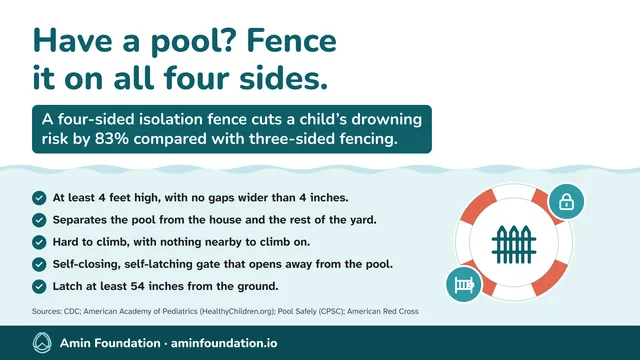
Have a pool? Fence it on all four sides.
A four-sided isolation fence cuts a child’s drowning risk by 83% compared with three-sided fencing.
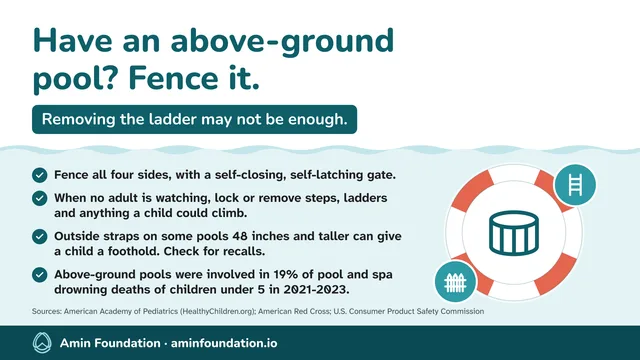
Infographic
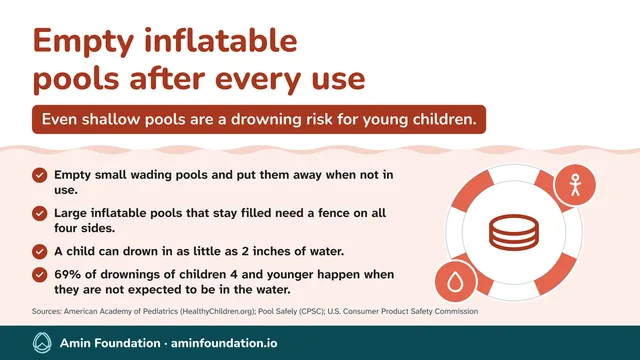
Empty inflatable pools after every use
Even shallow pools are a drowning risk for young children.
Related guides
- Pool Fences and Gates: What Makes a Barrier Work
What makes a pool fence work: four sides, at least 4 feet high, no gaps or footholds, and a gate that closes and latches itself. Based on CPSC and AAP advice.
- Home Pool Safety Checklist: Layers of Protection
Check your home pool against every layer of protection: supervision, a four-sided fence and gate, alarms, swim skills, rescue gear and CPR. Printable list.
- Pool Alarms, Gate Alarms and Wearable Alarms: How They Help
How door, gate, in-pool and wearable pool alarms work, where each fits as a backup layer, and why none replaces a four-sided fence or a watching adult.
- Pool Safety Covers vs. Solar Covers: What Keeps Kids Safe
Only a true safety cover is a barrier. Why floating solar and winter covers can hide a child, how to stop water pooling on top, and how to use covers well.
- Above-Ground Pool Safety: Ladders, Barriers and Rules
Secure an above-ground pool: remove or lock the ladder, clear anything a child can climb, add a barrier, check for recalled strap models, and never dive in.
- Inflatable and Portable Pool Safety
Kiddie, inflatable and portable pools can drown a toddler. Empty small pools after every use, fence larger ones, and watch every minute of splash time.
More tools: check your home and pool
Sources
- Safety Barrier Guidelines for Residential Pools (Publication 362) (opens in a new tab) U.S. Consumer Product Safety Commission
- Drowning Prevention for Curious Toddlers (opens in a new tab) American Academy of Pediatrics (HealthyChildren.org)
- Risk Factors for Drowning (opens in a new tab) CDC
- Home Pool & Hot Tub Safety (opens in a new tab) American Red Cross
- Pool Dangers and Drowning Prevention: When It’s Not Swimming Time (opens in a new tab) American Academy of Pediatrics (HealthyChildren.org)
- Layers of Protection (opens in a new tab) National Drowning Prevention Alliance
Updated