
Free tool · Plan and supervise
Water Watcher card and timer
One adult watches the water at a time, with no phone. This timer tells you when to hand over, and the card makes the handover clear.
Set up your Water Watcher turns
Private: what you enter stays on this device.
This is the printable version. Turn on JavaScript to use the interactive tool.
WATER WATCHER
I’m watching the water.
- Watch the water the whole time you hold this card.
- No phone, no reading, no games. Stay sober.
- Stay close. Young children and weak swimmers: within arm’s reach.
- Watch for quiet trouble: drowning is quick and silent.
- Don’t leave until you hand this card to the next adult.
Hand over every 15 to 20 minutes · aminfoundation.io
IN AN EMERGENCY
- Call 911.
- Reach or throw something that floats. Don’t go in.
- If a child is missing, check the water first.
| From | To | Water Watcher |
|---|---|---|
What a Water Watcher does
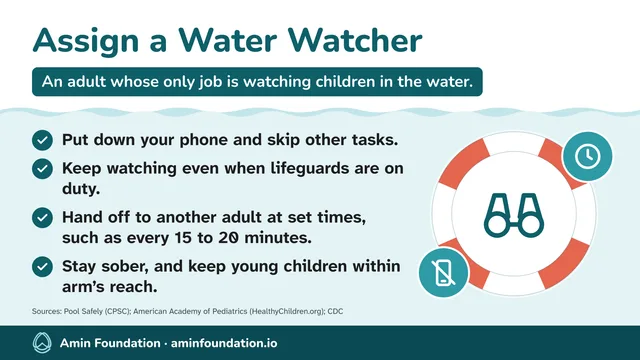
A Water Watcher is an adult whose only job is to watch children in the water. Pool Safely, the U.S. Consumer Product Safety Commission's campaign, says that means no reading, texting or playing games on your phone (opens in a new tab) while you are on duty. The job matters even when a lifeguard is there, because lifeguards may not see the whole pool.
Drowning rarely looks like the splashing and shouting people expect. The CDC (opens in a new tab) says it happens in seconds and is often silent, and the CPSC notes that most young children who drowned in pools had been missing for 5 minutes or less (opens in a new tab). A named watcher closes the gap that opens when every adult assumes someone else is looking.
Why the card gets passed around
Watching water closely is tiring, and attention slips. The American Academy of Pediatrics suggests that during parties and picnics, when it is easy to get distracted, adults take turns and pass a water watcher card to the next responsible adult after a set time, such as every 15 to 20 minutes (opens in a new tab). A physical card makes the handover clear: whoever holds it is watching, and nobody puts it down without handing it on.
For babies, toddlers and weak swimmers, watching from a chair is not enough. The AAP recommends touch supervision (opens in a new tab): an adult in the water, within arm's reach. Plan for both: a Water Watcher on the edge and an adult close to the youngest swimmers.
How to use this tool
- Add the adults who will take turns. Their names stay on this device.
- Choose the length of a turn. It starts at 15 minutes, the short end of the AAP's 15 to 20.
- Start the timer when the first watcher takes the card. You will get a one-minute warning, and when time is up the page says who is next, beeps and vibrates if you turned that on.
- Hand over in person. The current watcher keeps watching until the next adult takes over. Then press Handed over to start the next turn.
- Print the card and the rota to pass around. The back of the card has the emergency steps.
Keep the page open while the timer runs. Some phones pause timers when the screen locks, so glance at the clock too. If JavaScript is off, print the card below and use any kitchen timer.
The rules on the card
The card's front reminds the watcher to keep their eyes on the water, put the phone away, stay sober and stay close. The AAP (opens in a new tab) specifically warns against using a cell phone, doing yard work or drinking alcohol while supervising. The back covers what to do if something goes wrong, following the American Red Cross (opens in a new tab): if a child is missing, check the water first; call 911; reach or throw something that floats, and don't go in.
Learn more in our guides to supervising kids around water, hosting a safe pool party and watching children who can already swim.
What you can do today
- Print two cards and keep them with your pool or beach bag.
- Before the next swim, ask out loud: "Who is watching first?"
- Planning a party? Use the pool party plan to build a full rota and set-up checklist.
Printables, infographics and games
Printable
Water Watcher Card
A cut-out card to pass between adults at the pool, beach or lake: whoever holds it watches the water, with no phone and no other job, for 15-20 minutes.
Printable
Pool Party Safety Checklist
A one-page checklist for hosting a pool party: a Water Watcher schedule, sober supervision, life jackets, rescue gear, and ending swim time safely.

Related guides
- How to Supervise Kids Around Water: Touch Supervision and Water Watchers
What real supervision looks like near water: touch supervision for young children, one named Water Watcher with no other job, clean handoffs, and no phones.
- How to Host a Safe Pool Party
Plan a safe pool party: Water Watcher shifts with a card, life jackets for weak swimmers, sober supervision, rescue gear, and a locked gate when it ends.
- My Child Can Swim. Do They Still Need Watching?
Yes, kids who swim still need watching. Why skill isn't safety, the danger of breath-holding games, deep and natural water, and rules older kids accept.
- Water Safety for Toddlers: The Highest-Risk Years
Drowning is the leading cause of death for U.S. children ages 1 to 4. The layers that protect toddlers: barriers, touch supervision, lessons, life jackets.
- What Drowning Looks Like: The Quiet Signs
Drowning is usually quiet and fast. Learn the real signs of drowning in children and adults, how distress differs from drowning, and what to do right away.
More tools: plan and supervise
Sources
- Safety Tips (opens in a new tab) Pool Safely (U.S. Consumer Product Safety Commission)
- Preventing Drowning (opens in a new tab) CDC
- In-Home Drowning (opens in a new tab) U.S. Consumer Product Safety Commission
- Swim Lessons for Children: When to Start & What to Consider (opens in a new tab) American Academy of Pediatrics (HealthyChildren.org)
- Drowning Prevention for Curious Toddlers (opens in a new tab) American Academy of Pediatrics (HealthyChildren.org)
- Water Safety (opens in a new tab) American Red Cross
Updated