
Pool Fences and Gates: What Makes a Barrier Work
What makes a pool fence work: four sides, at least 4 feet high, no gaps or footholds, and a gate that closes and latches itself. Based on CPSC and AAP advice.
Key takeaways
- A four-sided fence that separates the pool from the house and yard cuts a child's drowning risk by 83% compared with a three-sided property-line fence (CDC).
- CPSC guidelines: at least 48 inches high, no opening a 4-inch ball could pass through, and no handholds or footholds.
- The gate should open away from the pool, close and latch by itself, and have its latch out of a child's reach.
- A gate that doesn't close every time is the weak link. Test it often.
- Rules differ by state and town. Check with your local building department.
A pool fence works when it goes all the way around the pool, separates it from the house, is at least 4 feet high with no gaps or footholds a child could use, and has a gate that opens away from the pool and closes and latches by itself every time. Those details are what stop a curious toddler from getting over, under or through.
Fences matter most during the moments no one is watching, which is when most young children reach a pool.
Why a four-sided fence matters
83%
Many yards are fenced around the edge, with the house as the fourth side. That keeps neighbors' children out, but not your own. CDC reports that a four-sided isolation fence, which separates the pool area from the house and yard, reduces a child's risk of drowning by 83% compared to three-sided property-line fencing (opens in a new tab).
The American Academy of Pediatrics (AAP) says research suggests that fencing can prevent more than half of all swimming pool drownings of young children (opens in a new tab), and that pool fences are for ALL pools, including in-ground pools, above-ground pools and hot tubs (opens in a new tab).
Height, gaps and climbing: over, under and through
The U.S. Consumer Product Safety Commission's (CPSC) barrier guidelines describe a good barrier as one that keeps a child from going over, under or through it (opens in a new tab). Here are the key numbers:
| Check | CPSC guideline |
|---|---|
| Height | At least 48 inches above the ground. CPSC says 5 feet or higher is preferable, and some places require 60 inches. |
| Gap at the bottom | No more than 4 inches; no more than 2 inches over grass or gravel. |
| Any opening | Too small for a 4-inch sphere to pass through, about the size of a young child's head. |
| Vertical bars, with horizontal rails less than 45 inches apart | Rails on the pool side, and bars no more than 1¾ inches apart, so there is no foothold. |
| Vertical bars, with horizontal rails 45 inches or more apart | Bars no more than 4 inches apart. |
| Chain-link mesh | Openings no more than 1¼ inches, or slats that reduce them to 1¾ inches. |
| Lattice | Openings no more than 1¾ inches. |
| Solid walls | No ledges, holes or bumps a child could climb. |
All of these come from CPSC's Safety Barrier Guidelines for Residential Pools (opens in a new tab). CDC's short version: a four-sided fence that is at least four feet in height and fully encloses the pool (opens in a new tab), with self-closing, self-latching gates.
A few more points:
- Chain link is easy to climb. The AAP says chain-link fences are very easy to climb and are not recommended as pool fences (opens in a new tab).
- Watch what's next to the fence. CPSC says barriers should be placed so children can't use permanent structures, equipment or similar objects to climb them (opens in a new tab). Move chairs, planters, grills and toys away.
- Removable mesh fences should be at least 48 inches high, and the safest ones lock into the pool deck so the fence can't be removed without tools (opens in a new tab).
Gates that close and latch themselves
CPSC puts it plainly: the weak link in the strongest and highest fence is a gate that fails to close and latch completely (opens in a new tab).
A good pool gate:
- Opens outward, away from the pool. If it isn't fully shut, a young child pushing on the gate to get in will actually be closing it (opens in a new tab), so it can latch.
- Closes and latches by itself every time, from any position.
- Has its latch out of reach. The AAP says at least 54 inches from the ground (opens in a new tab). If the latch is lower, CPSC says it should be on the pool side, at least 3 inches below the top, with no opening bigger than ½ inch within 18 inches of the latch, so a child can't reach through.
- Stays locked when the pool isn't in use. The AAP says to keep the gate locked at all times and check it frequently (opens in a new tab).
Never prop the gate open
A gate held open for a party, a delivery or a hose turns the whole fence off. In CPSC's latest report, 10% of pool and spa drowning deaths of children under 5 involved a barrier that failed or was gotten around (opens in a new tab) (2021-2023).
When the house is one side of the barrier
A four-sided fence is best. CPSC says a barrier that completely surrounds the pool is better than a fence with the house serving as the fourth side (opens in a new tab). If your house must form one side, CPSC recommends at least one of these:
- Door alarms on every door that leads to the pool. See door alarms and locks for what a good alarm does.
- Self-closing, self-latching doors or locks that are out of a child's reach.
- A power safety cover on the pool. See pool safety covers vs. solar covers.
Never have a pet door that opens to the pool area. CPSC says locking a pet door is not enough (opens in a new tab).
Checking your fence every season
Fences loosen, gates sag and plants grow. Check yours at the start of each swim season and after storms.
The AAP also says to keep toys out of the pool area when not in use (opens in a new tab), so children aren't tempted to go after them.
Not legal advice
CPSC's guidelines are not a CPSC standard and not mandatory (opens in a new tab), and the AAP notes there is no national pool fence law (opens in a new tab). Your state or town may have its own rules. Check with your local building department before you build or change a fence.
What you can do today
- Test your gate ten times from different angles. Fix it today if it fails even once.
- Run the Pool barrier check to go through height, gaps, gates and doors step by step.
- Clear the fence line of anything a child could climb.
- Call your building department to ask what your local code requires.
- Use the full Pool Safety Checklist for the other layers, and read the home pool safety checklist. Above-ground pool? See above-ground pool safety.
Common questions
How high should a pool fence be?
CPSC's barrier guidelines say at least 48 inches (4 feet), and note that 5 feet or higher is preferable. The AAP and CDC also say at least 4 feet. Some states and towns require 60 inches, so check your local code.
Is a chain-link fence OK for a pool?
The AAP says chain-link fences are very easy to climb and are not recommended as pool fences. If one is used, CPSC's guidelines say the mesh openings should be no more than 1¼ inches, or slats should reduce them to 1¾ inches.
Can my house be one side of the pool fence?
A fence on all four sides that separates the pool from the house is much safer. If the house must form one side, CPSC recommends alarms on every door to the pool, doors that close and latch by themselves, or a power safety cover on the pool.
Which way should a pool gate open?
Outward, away from the pool. CPSC explains that if the gate isn't fully closed, a child pushing on it to get in will actually push it shut, so it can latch.
Tools and printables for this guide
Interactive tool
Pool barrier check
Check your pool fence and gate against the CPSC barrier guidelines: height, gaps, latches, door alarms and covers. Get a printable list of what to fix.
Printable
Pool Safety Checklist
A one-page checklist for pool and hot tub owners: four-sided fencing, self-latching gates, alarms, covers, drains, Water Watchers and rescue gear.
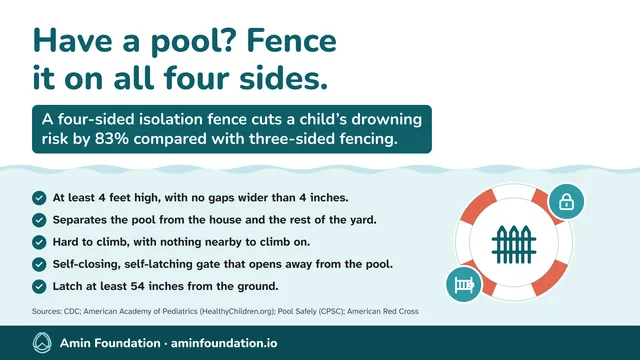
Infographic
Have a pool? Fence it on all four sides.
A four-sided isolation fence cuts a child’s drowning risk by 83% compared with three-sided fencing.
Sources
- Risk Factors for Drowning (opens in a new tab) CDC
- Safety Barrier Guidelines for Residential Pools (Publication 362) (opens in a new tab) U.S. Consumer Product Safety Commission, 2023
- Drowning Prevention for Curious Toddlers: What Parents Need to Know (opens in a new tab) American Academy of Pediatrics (HealthyChildren.org), 2026
- Pool Dangers and Drowning Prevention: When It's Not Swimming Time (opens in a new tab) American Academy of Pediatrics (HealthyChildren.org), 2026
- Preventing Drowning (opens in a new tab) CDC, 2025
- Pool or Spa Submersion: Estimated Nonfatal Drowning Injuries and Reported Drownings, 2026 Report (opens in a new tab) U.S. Consumer Product Safety Commission, 2026
More in Pool and Hot Tub Safety
Hot Tub and Spa Safety for Kids and Adults
Use a hot tub or spa safely: lock the cover after every use, keep children under 5 out, stay at 104°F or below, avoid alcohol, and keep away from drains.
How to Host a Safe Pool Party
Plan a safe pool party: Water Watcher shifts with a card, life jackets for weak swimmers, sober supervision, rescue gear, and a locked gate when it ends.
Inflatable and Portable Pool Safety
Kiddie, inflatable and portable pools can drown a toddler. Empty small pools after every use, fence larger ones, and watch every minute of splash time.