
Vacation Water Safety: New Places, New Water
Plan a safer family trip near water: check the destination, pack life jackets, name Water Watchers, and learn the risks of lakes, beaches and pools abroad.
Key takeaways
- Trips put families near water they don't know, often without lifeguards, fences or the usual routines.
- Before you book, find out what water is at or near the place you'll stay, and where the nearest lifeguarded beach or pool is.
- Pack properly fitted life jackets for children and weaker swimmers, and plan to use them in all natural water.
- When you arrive, walk the property, name a Water Watcher for every swim, and save the address for 911.
- Abroad, expect fewer lifeguards and fences. The CDC suggests learning CPR and safe rescue skills before you travel.
A safe trip near water starts before you leave home. Find out what water is at and around the place you'll stay, check everyone's swimming skills, pack properly fitted life jackets, and decide who will watch the water each time anyone swims. Trips are risky because the water is new to you: the CDC says lack of familiarity with local water currents and conditions, inability to swim and the absence of lifeguards (opens in a new tab) likely contribute to drowning deaths among travelers.
Use our Vacation water safety check to make a plan for your trip in a few minutes.
Why trips raise the risk
At home, you know which doors lock, where the pool fence is and how deep the local lake gets. On vacation, all of that changes at once.
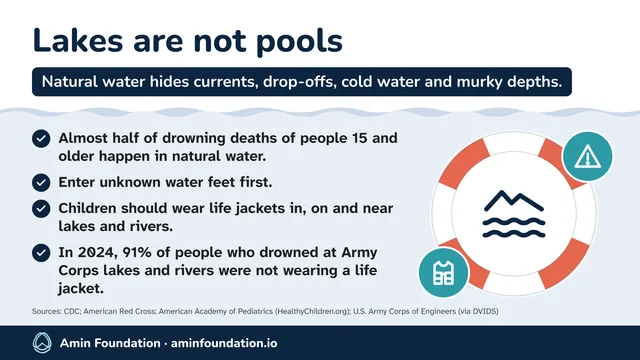
- Natural water is different. The CDC says almost half of fatal drownings among people 15 and older happen in natural water such as lakes, rivers or oceans (opens in a new tab). For children 5 to 14, over 40% of drownings happen in natural water.
- Lakes and oceans hide hazards. The CDC lists currents, waves, rocks, vegetation and limited visibility (opens in a new tab).
- Lifeguards and fences may be missing. Rental homes don't have lifeguards, and the CDC warns that swimming pools and ponds might not have fences (opens in a new tab) to keep children safe.
- Routines slip. Many adults, a new place and a relaxed mood make it easy to assume someone else is watching.
Before you book
- Ask what water is on or near the property. Pool, hot tub, pond, lake, dock, river or beach? If there's a pool, read what to check before you book a rental with a pool.
- Find the nearest lifeguarded swimming spot. The National Weather Service says to swim only at a beach with lifeguards (opens in a new tab), and the CDC says to choose swimming sites with lifeguards when possible.
- Check everyone's skills honestly. The Red Cross describes five water competency skills (opens in a new tab): enter water over your head and return to the surface, float or tread water for a minute, turn around, swim 25 yards and get out. Pool skills don't fully carry over to open water.
- Plan life jackets. The CDC says children should use life jackets for all activities in and around natural water. For planned boating or water sports, it suggests travelers consider bringing their own life jackets (opens in a new tab), U.S. Coast Guard-approved or comparable and sized correctly.
- Take a CPR class. The CDC suggests travelers take CPR classes and learn safe rescue techniques before they go. See where to learn CPR.
When you arrive
Spend 10 minutes on these before anyone swims:
Name a Water Watcher, every time
The AAP suggests taking turns as the Water Watcher (opens in a new tab), handing a card to the next adult every 15 to 20 minutes. The CDC's travel guidance says an adult with swimming skills should be within arm's length of infants and toddlers in or around pools or other water, and that even with older children and better swimmers, the supervising adult should focus on the child and not do anything distracting.
Alcohol and supervision don't mix. The CDC says do not drink alcohol while supervising children (opens in a new tab), and avoid it before or during swimming and boating.
Lakes, beaches and pools you don't know
Lakes and rivers. The Red Cross advises entering unknown or shallow water feet first (opens in a new tab), and diving only where it is clearly marked safe and at least 9 feet deep. Watch for fast currents, dams, underwater obstacles and sudden drop-offs. At U.S. Army Corps of Engineers lakes and rivers in 2024, 91% of people who drowned were not wearing life jackets (opens in a new tab). Read why lakes are not pools before a lake trip.
Beaches. The National Weather Service says warning flags aren't used at every beach and their meaning can vary (opens in a new tab), so read the signs at the entrance. Surf beaches are not like pools: waves, wind and currents can use up your energy fast. Rip currents often form on calm, sunny days (opens in a new tab). Our beach safety checklist covers the rest.
Pools at hotels and rentals. Pool Safely reminds families that vacation rentals don't have lifeguards (opens in a new tab). Check the fence, gate and drain covers, and supervise without distractions.
Boats, tours and water sports
The CDC says many boating deaths result from inexperience or failure to wear a life jacket (opens in a new tab). Its advice for travelers:
- Children and weak swimmers should always wear a life jacket when boating, and there should be enough life jackets for everyone on board.
- Don't ride in boats run by obviously inexperienced, uncertified or intoxicated drivers.
- Avoid diving and swimming off the back of boats, where exhaust fumes usually come out.
- Diving into shallow water can cause head and spinal cord injuries.
Traveling abroad
The CDC says drowning is a leading cause of injury death (opens in a new tab) for U.S. citizens visiting countries where water recreation is a major activity. Rules, signs and lifeguard coverage can be very different from home.
- Don't swim alone or in unfamiliar waters.
- Expect fewer fences around pools and ponds, and stay within arm's reach of young children.
- Bring life jackets you trust if you plan to boat or paddle.
- Visiting family overseas? The World Health Organization says more than 90% of drowning deaths (opens in a new tab) occur in rivers, lakes, wells, domestic water storage vessels and swimming pools in low- and middle-income countries. Ask relatives about ponds, wells, tanks and rivers near the home before children go exploring.
Teens and young adults
Group trips, spring break and graduation travel bring their own risks: new friends, dares, jumping from heights and alcohol. Talk before the trip, not during it. Our guide to water safety for college students and young adults has a checklist they can actually use.
What you can do today
Printable
Vacation Rental Checklist
A one-page checklist for rental homes with a pool, hot tub, lake or beach: what to ask before you book, what to check on arrival, and daily habits.
Printable
Lake, River and Open Water Safety Checklist
A one-page checklist for lake, river and pond days: where to swim, life jackets, feet-first entry, currents, alcohol, storms and getting help.
Common questions
Why are drownings more common on vacation?
The CDC's travel guidance says lack of familiarity with local water currents and conditions, inability to swim and the absence of lifeguards likely contribute to drowning deaths among travelers. Add new routines, busy adults and alcohol, and it's easy for supervision to slip.
Should I bring life jackets on vacation?
If your trip includes boats or natural water, yes. The CDC says children and weak swimmers should always wear a life jacket when boating, and that travelers planning water activities should consider bringing their own life jackets, sized correctly and U.S. Coast Guard-approved or comparable.
Is it safe to swim at a beach with no lifeguard?
It's riskier. The National Weather Service says to swim only at a beach with lifeguards. If there is no lifeguard, it suggests naming a water watcher who can call 911, following posted signs, keeping children within arm's reach and bringing a flotation device. 'When in doubt, don't go out.'
Tools and printables for this guide
Interactive tool
Vacation water safety check
Check a vacation rental pool before you book, and get ready for lakes and beaches: fences, drain covers, life jackets, flags and lifeguards.
Printable
Vacation Rental Checklist
A one-page checklist for rental homes with a pool, hot tub, lake or beach: what to ask before you book, what to check on arrival, and daily habits.
Printable
Lake, River and Open Water Safety Checklist
A one-page checklist for lake, river and pond days: where to swim, life jackets, feet-first entry, currents, alcohol, storms and getting help.
Sources
- Injury and Death During Travel (CDC Yellow Book) (opens in a new tab) CDC
- Risk Factors for Drowning (opens in a new tab) CDC
- Preventing Drowning (opens in a new tab) CDC
- Social Media: Rip Currents & Beach Hazards (opens in a new tab) National Weather Service
- Know BEFORE you go in the water! (opens in a new tab) National Weather Service
- How to Avoid Getting Caught in a Rip Current (opens in a new tab) National Weather Service
- Swimming Safely in Lakes, Rivers & Streams (opens in a new tab) American Red Cross
- Water Safety (opens in a new tab) American Red Cross
- As temps rise, officials implore recreators wear simple life-saving device (opens in a new tab) U.S. Army Corps of Engineers via DVIDS
- Know Before You Go: Pool Safety and Vacation Rentals (opens in a new tab) Pool Safely (CPSC)
- World Drowning Prevention Day (opens in a new tab) World Health Organization
- Swim Lessons for Children: When to Start & What to Consider (opens in a new tab) American Academy of Pediatrics (HealthyChildren.org)
More in Community Water Safety
Summer Camp Water Safety: Questions Parents Should Ask
What to ask a camp, day camp or child care program about swimming: swim tests, buddy checks, lifeguards, field trips and staff training, with New York rules.
Free Water Safety Lesson Plans for Schools (K-12)
Free, printable water safety lesson plans for grades K-2, 3-5, 6-8 and 9-12, each one class period long and aligned to National Health Education Standards.
Water Safety for Mosques, Temples, Churches and Faith Groups
A free water safety toolkit for mosques, temples, churches, gurdwaras and cultural centers: safer picnics and trips, a ready-made talk, modest swim options.