
How to Choose the Right Life Jacket
Pick a life jacket that suits the wearer and the activity: Coast Guard approval, the right style for boating, paddling or fishing, sizing and comfort.
Key takeaways
- Choose a U.S. Coast Guard-approved life jacket. Check the label for the approval, the size and any limits on use.
- Match the style to the activity: paddling, fishing, water sports and offshore boating each have designs made for them.
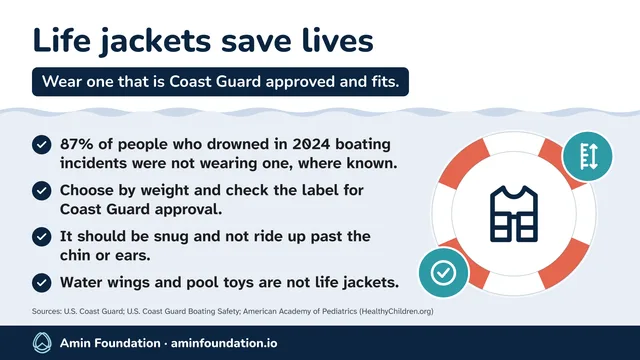
- Size by the weight and chest range on the label, and make sure it fits snugly. Adult jackets don't work for children.
- The best life jacket is the one you'll wear. Most boating drownings happen to people who weren't wearing one.
The right life jacket is a U.S. Coast Guard-approved one that fits the wearer's weight and chest size, suits the activity, and is comfortable enough to wear the whole time. The Coast Guard's own advice is simple: the best USCG Approved lifejacket or buoyancy aid is the one you will wear (opens in a new tab).
This guide helps you choose one for boating, paddling, fishing or swimming. The Life jacket finder tool asks a few questions and suggests what to look for.
Why the right life jacket matters
Life jackets work. CDC says life jackets reduce the risk of drowning while boating for people of all ages and swimming abilities (opens in a new tab). But they only work if they are worn.
87%
The same pattern shows up at lakes and rivers. The U.S. Army Corps of Engineers says that in 2024, 91 percent of drowning victims (opens in a new tab) at its lakes and rivers were not wearing life jackets.
The Coast Guard explains why "I'll grab it if I need it" doesn't work: accidents can and do happen with terrifying speed on the water. There's rarely time to reach for a stowed lifejacket (opens in a new tab). It also notes that most boating related drownings happen on nice days (opens in a new tab).
Step 1: Look for the approval label
Every life jacket you rely on should be U.S. Coast Guard-approved. The Safe Boating Campaign says all life jackets that are U.S. Coast Guard approved have an approval number (opens in a new tab). Look for it on the label inside the jacket.
The label also tells you:
- The size and weight range the jacket is made for.
- The performance Level or Type, which tells you how much it floats and whether it turns an unconscious person face up.
- Any limits, such as "not for personal watercraft" or a minimum age.
Swim toys, water wings and many "swim aids" are not approved life jackets. See water wings, floaties and swim vests. For a full walk through the label, read life jacket labels and types explained.
Step 2: Match the jacket to the activity
The Coast Guard's How to Choose the Right Life Jacket (opens in a new tab) guide shows different designs for different uses. Here is a summary:
| Activity | Styles the Coast Guard shows | Things to know |
|---|---|---|
| General boating | Foam vests, inflatable vests and belt packs | Foam vests are good for non-swimmers. Inflatables are not for children under 16 or non-swimmers. |
| Canoeing, kayaking, rafting | Touring and whitewater paddling jackets | Cut for freedom of arm movement. May not turn an unconscious wearer face up. |
| Personal watercraft, waterskiing, towed sports | Rugged vest-type flotation aids | Designed for high-impact, high-speed activities. Check the label says it's approved for your sport. |
| Fishing | Inflatable fishing vests with pockets | Same limits as other inflatables. |
| Waterfowl hunting | Mesh camo vests and float coats | Float coats may help prevent hypothermia. |
| Offshore and open water | Offshore vests | Most flotation, designed to turn an unconscious person face up. Bulky. |
Some extra rules from the Coast Guard:
- For water skiing and other towed sports, use a life jacket and buoyancy aid marked for water skiing (opens in a new tab).
- For personal watercraft, use one marked for water skiing or PWC use.
- Inflatable jackets are not for sports where immersion is expected (opens in a new tab), such as whitewater paddling or waterskiing.
For swimming in lakes, rivers and the ocean, CDC says life jackets should be used by children for all activities while in and around natural water (opens in a new tab), and can be used by weaker swimmers of all ages. Choose a foam jacket. The Coast Guard says inflatable life jackets and buoyancy aids are not appropriate for weak or non-swimmers (opens in a new tab). Read more in lake swimming safety.
Be honest about your swimming. The Safe Boating Campaign says poor swimmers may need a higher level (opens in a new tab) to stay upright and easily tread water, and that a higher level is needed where rescue could be hours away, even close to shore.
Step 3: Size by weight and chest
The Coast Guard says to check the label for user weight and chest size (opens in a new tab). Life jackets come in four broad weight categories:
- Infant: up to 33 pounds
- Child: over 33 and up to 55 pounds
- Youth: over 55 and up to 88 pounds
- Adult: over 88 pounds
Source: U.S. Coast Guard (opens in a new tab).
The Coast Guard warns that adult-sized lifejackets and buoyancy aids may not work for children (opens in a new tab). The Safe Boating Campaign says to never buy a life jacket for a child to grow into (opens in a new tab). See life jackets for babies and children.
A jacket that fits is snug. The Coast Guard says a foam jacket worn correctly will not allow the lifejacket or buoyancy aid to rise above the wearer's chin or ears (opens in a new tab). Test it with the life jacket fit test.
Step 4: Comfort means it gets worn
A jacket left under a seat can't help you. Pick one you'll actually keep on:
Modern designs help. The Coast Guard says approved jackets are available in a wide variety of shapes, colors, and sizes (opens in a new tab), and many are thin and flexible.
Check what the law requires
The Coast Guard says a recreational boat must have a U.S. Coast Guard Approved Wearable PFD for each person onboard (opens in a new tab). Federal law also requires children under 13 to wear one on a moving boat, except below deck or in an enclosed cabin, and state rules can differ. We explain the rules, and where to check your state's, in our boating safety checklist.
What you can do today
- Try the Life jacket finder for each person in your family.
- Check the jackets you own for the approval label, the weight range and any damage.
- Do the fit test on every child. Print the Does Your Life Jacket Fit? as a reminder.
- Make "jackets on before we leave the dock" a family rule, for adults too.
- Learn the labels in life jacket labels and types explained.
Common questions
What type of life jacket is best for swimming?
For a weak swimmer or child in a lake, ocean or pool, choose a U.S. Coast Guard-approved foam (inherently buoyant) life jacket that fits their weight. The Coast Guard says inflatable life jackets are not appropriate for weak or non-swimmers. Young children need a collar for head support and a strap between the legs.
What life jacket should I wear for kayaking?
The Coast Guard's life jacket guide shows touring and whitewater paddling jackets made for canoeing, kayaking and rafting, with a cut that lets you move your arms freely. Its guide says inflatable life jackets are not for sports where immersion is expected, such as whitewater paddling. Check the label for paddling use.
How do I know if a life jacket is Coast Guard approved?
Look on the label. The Safe Boating Campaign says every U.S. Coast Guard-approved life jacket has an approval number. The Coast Guard says newer jackets show a performance Level (50, 70, 100, 150 or 275), and older ones a Type (I to V). Both are still legal if the jacket is in good condition and suits the activity.
How much buoyancy do I need?
The Coast Guard says most adults only need 7 to 12 pounds of buoyancy to keep their heads above water. Life jackets provide more than that. Higher performance levels give more flotation and are made for rougher water, where rescue may take longer.
Tools and printables for this guide
Interactive tool
Life jacket finder
Find the right life jacket size, style and label level by weight, age, swimming ability and activity, based on U.S. Coast Guard guidance, plus a fit check.
Printable
Does Your Life Jacket Fit?
A poster of the life jacket fit check: Coast Guard label, right weight, buckled, arms up, lift at the shoulders, plus rules for children and inflatables.
Sources
- Life Jacket Wear / Wearing Your Life Jacket (opens in a new tab) U.S. Coast Guard Boating Safety
- How to Choose the Right Life Jacket (brochure, PDF) (opens in a new tab) U.S. Coast Guard
- A Boater's Guide to the Federal Requirements for Recreational Boats (PDF) (opens in a new tab) U.S. Coast Guard
- Recreational Boating Statistics 2024 (opens in a new tab) U.S. Coast Guard, 2024
- Recreational Boaters (opens in a new tab) U.S. Coast Guard Boating Safety
- Life Jackets (opens in a new tab) Safe Boating Campaign (National Safe Boating Council)
- Preventing Drowning (opens in a new tab) CDC, 2025
- Life Jackets Save Lives (opens in a new tab) Water Safety USA
- As temps rise, officials implore recreators wear simple life-saving device (opens in a new tab) U.S. Army Corps of Engineers (via DVIDS), 2025
More in Boating and Life Jackets
Boating Safety Checklist: Before You Leave the Dock
A pre-departure boating checklist: life jackets for all, weather, a float plan, Coast Guard-required gear, the engine cut-off switch and a passenger briefing.
Boating Safety Courses in New York: Who Needs One
New York's Brianna's Law requires a state-approved safety course for all operators of motorized boats. Who it covers, how to take one, and free options.
Boating Under the Influence: The Risks
Why alcohol and drugs make boating so dangerous for operators and passengers, what the Coast Guard's numbers show, and how to plan a sober skipper.