
What Age Should Kids Start Swim Lessons?
The AAP says many children can start swim lessons at age 1, depending on readiness. Learn what to expect at each age and how to tell if your child is ready.
Key takeaways
- The American Academy of Pediatrics (AAP) says many children can begin swim lessons at age 1, depending on readiness. Its 2026 policy recommends swimming classes after a child's first birthday.
- By their fourth birthday, most children are ready for lessons. By age 5 or 6, most children in lessons can master the front crawl.
- The AAP does not recommend infant swim programs for babies under 1, because there is no evidence they lower drowning risk.
- Readiness depends on your child's emotional maturity, physical and developmental abilities, and comfort in the water. It's never too late to start.
- Lessons don't make children drown proof. Keep supervising closely, even after lessons.
Many children can start swim lessons at age 1, depending on readiness, according to the American Academy of Pediatrics (AAP). Most children are ready by their fourth birthday, and the AAP does not recommend formal infant swim programs for babies under 1.
There is no single perfect age. The right time depends on your child, and it's never too late to start. This guide walks through what the AAP recommends, how to judge readiness, and what lessons look like at each age.
What the AAP recommends
The AAP updated its drowning prevention policy in 2026. Its advice to families is to "begin swimming classes in children after their first birthday." (opens in a new tab) As the policy's lead author put it, "Swimming can be a child's first sport."
The AAP's parent guide on swim lessons for children (opens in a new tab) adds three key points:
- Swim lessons are a layer of protection against drowning that can begin for many children starting at age 1.
- By their fourth birthday, if they haven't already started, most children are ready for swim lessons.
- There is no evidence that infant swim programs for babies under 1 lower their drowning risk, so the AAP doesn't recommend them.
Why start early? Young children face the highest risk. CDC says more children ages 1 to 4 die from drowning than from any other cause of death (opens in a new tab).
3.1 per 100,000
Is your child ready?
The AAP doesn't give a checklist or a test. It says to consider your child's emotional maturity, their physical and developmental abilities and limitations, and their comfort level in the water. In practice, that means asking yourself questions like these:
- Comfort. Does your child enjoy bath time or splashing with you, or do they get very upset in water?
- Emotional maturity. Can your child cope with a new place, a new adult and a group of other children for a whole class? In parent-child classes, you'll be in the water with them.
- Abilities. Does your child have any physical, developmental or medical needs that an instructor should plan for?
If the answers are mostly "not yet," that's fine. Try a relaxed parent-child class, or wait a few months and try again. If your child has a medical or developmental condition, talk with your pediatrician first. The AAP notes that lessons can be adapted (opens in a new tab) for children with special health needs and developmental disabilities, such as autism. See adaptive swim lessons.
Use our readiness tool to think it through:
Interactive tool
Is my child ready for swim lessons?
Answer four questions to see what the American Academy of Pediatrics suggests for your child’s age, and what to look for in a swim lesson program.
Ages 1 to 4: parent-child and early lessons
For toddlers and preschoolers, the AAP says studies suggest that water competency and survival skills training through swim lessons can help reduce drowning risk for children ages 1 to 4. Parent-child classes are also a good way for families to build water safety habits and basic skills such as floating on the back.
One well-known study, led by researchers at the National Institutes of Health and published in 2009, found that formal swimming lessons were associated with an 88% lower risk of drowning in children ages 1 to 4 (opens in a new tab). The authors noted that the estimate was imprecise, and the true reduction could have been anywhere from 3% to 99%. Lessons help, but the authors stressed that lessons alone will not prevent drowning.
What to look for in a class for children under 4, according to the AAP (opens in a new tab):
At this age the goals are comfort in the water, safe habits and first skills like back floating.
Ages 4 and up: skills, strokes and safety
By age 4, most children can learn more than back floating. The AAP says they can work on skills such as treading water and getting to an exit. By age 5 or 6, most children in lessons can master the front crawl.
Whatever the age, the AAP says all children should learn to:
- Get back to the surface from underwater
- Propel themselves at least 25 yards
- Get out of the water
These match the water competency skills that the Red Cross and other groups teach. See the five water competency skills and how swim lesson levels work.
Older children and teens who never learned
It's never too late. Programs that use levels let an older beginner start where they are. The Red Cross, for example, has six Learn-to-Swim levels (opens in a new tab) for children ages 6 to 12, starting with Introduction to Water Skills. Teens have their own risks: the AAP says adolescents may overestimate their swimming skills and misjudge water hazards. Lessons, plus honest talk about limits, help. See water safety for teens.
Before age 1
The AAP doesn't recommend infant swim programs for babies under 1. Babies this age may show reflex "swimming" movements, but they can't yet raise their heads out of the water well enough to breathe. A parent-child water play class is fine for helping your baby get used to the pool. Read swim classes for babies for what these classes can and can't do.
Lessons never replace supervision
The AAP is clear: swim lessons don't make kids "drown proof." (opens in a new tab) CDC adds that children who have had lessons still need close and constant supervision (opens in a new tab).
For infants, toddlers and weak swimmers, the AAP recommends that a supervising adult who can swim stays within arm's length. And because 69% of drownings in children 4 and younger (opens in a new tab) happened during non-swim times, when they weren't expected to be in the water, fences, locked doors and other barriers matter too. Learn more in water safety for toddlers and do swim lessons prevent drowning?
What you can do today
- Think about your child's comfort, maturity and any special needs. Use the readiness tool above.
- If your child is 1 or older and seems ready, look for a parent-child or beginner class. Start with finding swim lessons near you.
- If your child is 4 or older and hasn't started, sign them up for the next session.
- Before you enroll, ask the questions in how to choose a swim lesson program.
- Keep watching closely around water, whatever your child's age or skill.
Common questions
Can a 1-year-old take swim lessons?
Yes, if they seem ready. The AAP says swim lessons can begin for many children starting at age 1. For children under 4, look for parent-child classes, an adult within arm's reach (touch supervision), well-disinfected water and water heated to 87 to 94°F.
Is it too late to start swim lessons at 6, 10 or 14?
No. It's never too late to learn. If your child is older and has never learned, sign them up now. Programs that use levels, such as the Red Cross Learn-to-Swim levels for ages 6 to 12, let a beginner start at the first level.
Should my baby take swim lessons before age 1?
The AAP does not recommend infant swim programs for babies under 1, because there is no evidence they lower drowning risk. A parent-child water play class is fine for helping a baby get used to the water. Talk to your pediatrician about other options.
My child has autism or another health condition. When should they start?
Talk with your pediatrician. The AAP says swim lessons can be adapted for children with special health needs and developmental disabilities, such as autism. Look for an adaptive class with instructors trained to teach children with similar needs.
Tools and printables for this guide
Interactive tool
Is my child ready for swim lessons?
Answer four questions to see what the American Academy of Pediatrics suggests for your child’s age, and what to look for in a swim lesson program.
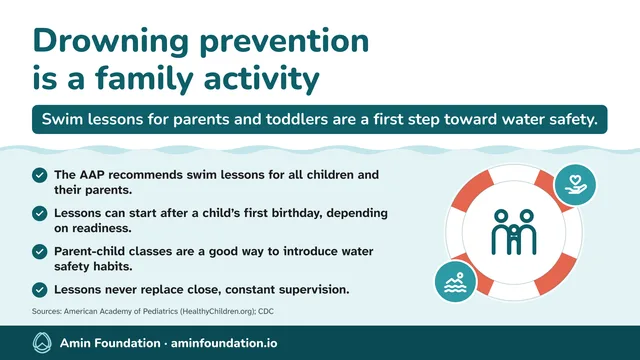
Infographic
Drowning prevention is a family activity
Swim lessons for parents and toddlers are a first step toward water safety.
Sources
- Swim Lessons for Children: When to Start & What to Consider (opens in a new tab) American Academy of Pediatrics (HealthyChildren.org)
- AAP Releases Updated Drowning Prevention Recommendations (opens in a new tab) American Academy of Pediatrics (HealthyChildren.org)
- Drowning Prevention for Curious Toddlers: What Parents Need to Know (opens in a new tab) American Academy of Pediatrics (HealthyChildren.org)
- Drowning Facts (opens in a new tab) CDC
- Preventing Drowning (opens in a new tab) CDC
- Vital Signs: Drowning Death Rates, Self-Reported Swimming Skill, Swimming Lesson Participation, and Recreational Water Exposure, United States, 2019-2023 (MMWR 2024;73(20)) (opens in a new tab) CDC
- Kids Swim Lessons (opens in a new tab) American Red Cross
- Association between swimming lessons and drowning in childhood: a case-control study (Arch Pediatr Adolesc Med 2009;163(3):203-210) (opens in a new tab) Brenner RA et al., National Institute of Child Health and Human Development (NIH)
More in Swimming Lessons
How to Find Swim Lessons Near You, Including Free and Low-Cost Options
Find swim lessons near you for kids or adults with official YMCA, Red Cross, USA Swimming and city parks locators, plus ways to find free or low-cost classes.
Free Swim Lessons in NYC: Parks, Swim for Life and More
Every free and low-cost swim program in New York City we could verify: NYC Parks Learn to Swim, summer pools, school programs, YMCA, adaptive swim and Queens.
How Much Do Swim Lessons Cost? Ways to Pay Less
Why swim lesson prices vary, what free public programs and financial aid exist, real published prices, and how to get the most from every lesson you pay for.