
Water Safety for Babies and Crawlers
Protect a baby under 12 months from drowning: keep a hand on them at bath time, empty buckets and pet bowls at crawling height, and plan for distractions.
Key takeaways
- A baby can drown in 1 or 2 inches of water, silently and within seconds.
- Three in four drownings of babies under 1 happen in bathtubs, so keep a hand on your baby for the whole bath.
- Bath seats and neck floats are not safety devices. Never leave a baby in or near water alone or with another young child.
- Once your baby crawls, empty buckets, coolers, pet bowls and kiddie pools right after you use them.
- Learn infant CPR. The Red Cross, the American Heart Association and local fire departments offer classes with infant-specific training.
To keep a baby safe around water, keep a hand on them whenever they are in water, never leave them alone or with another young child near water, and empty every container a crawling baby could reach. Babies can drown in just 1 or 2 inches of water, silently and within seconds.
This page covers the first year: bath time, the new hazards that appear once your baby starts to move, and the moments when adults get pulled away.
Why babies are at risk
The American Academy of Pediatrics (AAP) explains that babies can drown in as little as 1 or 2 inches of water, silently and within seconds (opens in a new tab). Infants don't have much neck and muscle control. If even a little water covers their nose and mouth, they can't lift their head to breathe.
3 in 4
The AAP adds that most child drownings inside the home happen in bathtubs, and more than half of bathtub deaths involve children under 1 (opens in a new tab). In many cases they happen during a short lapse in adult supervision.
Babies also change fast. The AAP notes that it's hard to know exactly when a baby will start to reach, roll, crawl or pull up, so the key is to stay one step ahead (opens in a new tab). Fix the hazards before your baby can reach them, not after.
Bath time: a hand on your baby, always
For a baby, water safety starts with the first bath. The AAP's rule is touch supervision (opens in a new tab): have the towel and bath supplies within reach before you start, so you can keep one hand on your baby at all times.
- Set up first. Lay out the towel, soap, diaper and clothes before the water runs.
- Take your baby with you. If you forget something or the doorbell rings, the AAP says to bring your baby with you (opens in a new tab), even if you're using an infant tub or bath seat.
- Don't trust a bath seat. The AAP warns that infant bath seats can tip over and babies can slip out of them and drown in a few inches of water (opens in a new tab). A seat helps your hands; it doesn't replace them.
- Drain the tub right away. Then the water is gone before anyone can come back to it.
Neck floats are not safety devices
CPSC received 115 reports of incidents involving infant neck floats between January 2019 and January 2024, including two infant deaths (opens in a new tab), and it warns that drowning can happen quickly and silently even when a baby seems supported. The AAP explains that a baby can slip through the ring (opens in a new tab) if it leaks or gets slippery, and that the FDA warned parents in 2022 not to use them.
For the full bath routine, see our bath time safety guide.
Water hazards at crawling height
Once your baby can crawl and pull up, every container of water becomes a hazard. Get down on the floor and look at your home from their height.
Containers. The AAP says never leave a filled, open-top water container unattended (opens in a new tab). Empty these right after use:
- buckets and pails used for cleaning or painting
- wading pools
- coolers with melted ice
- large water bowls for pets
- trash cans or recycling bins that collect rainwater
Buckets need extra care. CPSC explains that the tall, straight sides and stability of a 5-gallon bucket make it nearly impossible for top-heavy infants to free themselves when they topple in headfirst (opens in a new tab). Empty them and store them upside down.
Toilets and the bathroom. Babies can topple headfirst into a toilet and be unable to get out. The AAP suggests safety latches on toilet lids, removing the tub's drain plug when it's not in use, and latches or doorknob covers to keep the bathroom closed (opens in a new tab).
The yard. Before your baby crawls, check outside for wells, ditches, open post holes, bird baths, fountains and ponds. The AAP suggests holding off on installing or using bird baths, fountains and ponds until your baby is older (opens in a new tab). Any pool, including a large inflatable one, needs a fence on all four sides.
We don't repeat the full house tour here. Use the room-by-room home hazard checklist, or work through the interactive audit:
Interactive tool
Home water hazard audit
Go room by room to find drowning hazards at home, from bathtubs and buckets to doors and backyard water, and get a printable to-do list with fixes.
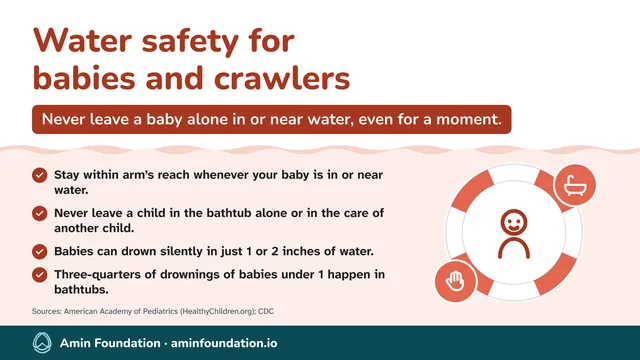
Infographic
Water safety for babies and crawlers
Never leave a baby alone in or near water, even for a moment.
Siblings and pets
Siblings love to help, but they can't supervise. The AAP is clear: never leave your baby alone or in the care of another young child in or near water, not even for a moment (opens in a new tab). Give older brothers and sisters jobs that really help:
- close the bathroom door behind them
- tell a grown-up when they see a bucket or a full tub
- fetch the towel before bath time starts
Pets add water at floor level. A large water bowl sits exactly where a crawling baby plays. Empty it when it's not in use, as the AAP suggests, or put it where your baby can't reach. The same goes for pet pools and outdoor water troughs.
Caregivers and distractions
The AAP notes that bathtub drownings often happen during a lapse in adult supervision (opens in a new tab). Plan ahead for the moments that pull you away.
- Put the phone down. CDC says adults watching children in or near water, including bathtubs (opens in a new tab), should avoid distracting activities like reading or using the phone. Let calls go to voicemail during bath time.
- No alcohol while supervising. CDC says do not drink alcohol while supervising children (opens in a new tab).
- Brief every caregiver. Grandparents, babysitters and relatives may have learned different rules. Share yours, and print the Water Rules for Babysitters for the fridge. Our guide to water safety rules for babysitters and grandparents covers what to share with them.
- Check new places. The AAP reminds families to think about water safety where friends, relatives and caregivers live, and places you stay during family trips (opens in a new tab).
Near lakes, the ocean or a boat, a baby needs a properly fitted, U.S. Coast Guard-approved life jacket. Water Safety USA says infants and young children should wear one with both a collar for head support and a strap between the legs (opens in a new tab). See life jackets for babies and children for sizes.
About baby swim classes. The AAP does not recommend infant swim programs for babies under 1 (opens in a new tab), because there is no evidence they lower drowning risk. A parent-child water play class is fine as a fun activity. Read what parent-and-baby classes can and can't do.
Learn infant CPR
The AAP says parents and caregivers should know CPR and basic rescue skills (opens in a new tab), and that classes with infant-specific training are offered through the American Red Cross, the American Heart Association, and local fire departments and park districts. Find one through where to learn CPR.
What you can do today
When your baby starts walking, read water safety for toddlers: the toddler years bring the highest drowning risk of any age.
Common questions
Should my baby take swim lessons before age 1?
The American Academy of Pediatrics (AAP) does not recommend infant swim programs for babies under 1, because there is no evidence they lower drowning risk. A parent-child water play class can be a fun way to get used to the pool. Ask your pediatrician, and keep a hand on your baby either way.
Is a baby bath seat safe to use?
A bath seat helps you hold your baby, but it is not a safety device. The AAP warns that infant bath seats can tip over, and babies can slip out and drown in a few inches of water. Keep a hand on your baby the whole time, seat or no seat.
Are baby neck floats safe?
No. The U.S. Consumer Product Safety Commission (CPSC) says neck floats are not safety devices. It received 115 incident reports involving them from January 2019 to January 2024, including two infant deaths. The AAP adds that the FDA warned parents in 2022 not to use them.
Can my older child watch the baby in the bath for a minute?
No. The AAP says never leave your baby alone or in the care of another young child in or near water, not even for a moment. If you need to step away, wrap your baby in a towel and take them with you.
Tools and printables for this guide
Interactive tool
Home water hazard audit
Go room by room to find drowning hazards at home, from bathtubs and buckets to doors and backyard water, and get a printable to-do list with fixes.
Printable
Home Water Safety Checklist
A one-page, room-by-room checklist to find and fix drowning hazards at home: bathtubs, toilets, buckets, coolers, doors, hot tubs and pools.
Printable
Water Rules for Babysitters
A fill-in sheet to go over with every babysitter, nanny or grandparent: your address for 911, bath rules, hidden water at home, swimming rules and emergencies.
Infographic
Water safety for babies and crawlers
Never leave a baby alone in or near water, even for a moment.
Sources
- Infant Drowning Prevention & Water Safety: How to Protect Your Baby (opens in a new tab) American Academy of Pediatrics (HealthyChildren.org), 2026
- Risk Factors for Drowning (opens in a new tab) CDC, 2026
- Preventing Drowning (opens in a new tab) CDC, 2025
- Drowning Prevention for Curious Toddlers: What Parents Need to Know (opens in a new tab) American Academy of Pediatrics (HealthyChildren.org), 2026
- Swim Lessons for Children: When to Start & What to Consider (opens in a new tab) American Academy of Pediatrics (HealthyChildren.org), 2026
- Ask the Pediatrician: Are Baby Neck Floats Safe to Use in the Tub or Pool? (opens in a new tab) American Academy of Pediatrics (HealthyChildren.org), 2026
- As CPSC's First Federal Neck Floats Safety Standard Takes Effect, Agency Renews "Do Not Use" Warnings (opens in a new tab) U.S. Consumer Product Safety Commission, 2026
- Prevent Child In-Home Drowning Deaths (Publication 5013) (opens in a new tab) U.S. Consumer Product Safety Commission, 2012
- Life Jackets Save Lives (opens in a new tab) Water Safety USA
More in Water Safety by Age
Water Safety Skills by Age: A Milestone Guide
Which water safety habits and swim skills fit each age, from toddlers to teens and adults learning later, based on AAP and Red Cross guidance.
Water Safety for Kids Ages 5 to 12
School-age kids gain skills and independence near water. Build real swim skills, set rules kids can own, and plan for pools, lakes, camps and sleepovers.
My Child Can Swim. Do They Still Need Watching?
Yes, kids who swim still need watching. Why skill isn't safety, the danger of breath-holding games, deep and natural water, and rules older kids accept.