
Lake Swimming Safety: Why Lakes Are Not Pools
Lakes are not pools: drop-offs, cold water, weeds and no lifeguard. A family plan for a lake day or lake house, with life jackets and a sober Water Watcher.
Key takeaways
- A lake is not a pool. The bottom can drop off without warning, the water is dark and often colder than it looks, and help is usually far away.
- Children should wear a properly fitted, U.S. Coast Guard-approved life jacket for every activity in and around natural water. Teens and adults who are weaker swimmers should wear one too.
- Swim in a designated area, with a lifeguard when you can, and always go in feet first.
- Name one sober Water Watcher who watches only the water, even when a lifeguard is on duty.
- If someone is in trouble, call 911 and reach or throw something that floats. Don't go in after them.
Swimming in a lake is safest when you treat it as natural water with hidden hazards, not as a big pool. That means a life jacket for every child and every weaker swimmer, a designated swimming area, going in feet first, and one sober adult who watches the water the whole time.
Lakes are some of the best places a family can spend a summer day. This guide is for that day: the lake trip with cousins, the cabin weekend, the rental house with a dock. It is written for families where some adults grew up without swim lessons, where teens are confident, and where there are more people than anyone can count at once.
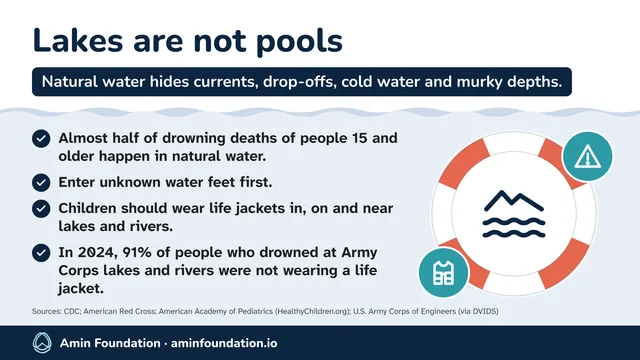
Almost half
How a lake is different from a pool
The American Red Cross puts it plainly: be sure you are water competent for natural environments before swimming, because this is not your home pool (opens in a new tab). The U.S. Army Corps of Engineers, which manages many U.S. lakes and rivers, adds that swimming in natural water is different from swimming in a pool, and your swimming ability decreases with age (opens in a new tab).
| Pool | Lake | |
|---|---|---|
| The bottom | You can see it, and it slopes evenly | Dark water, with drop-offs that can suddenly change the depth (opens in a new tab) |
| What's underneath | A smooth floor | Rocks, plants and limited visibility (opens in a new tab), plus logs and debris |
| Movement | Still water | Currents and waves, even in shallow water (opens in a new tab), wind, and boats |
| Temperature | Usually heated | Warm air doesn't always mean warm water (opens in a new tab), especially early in summer |
| Help | Often a lifeguard and a wall to grab | Often no lifeguard, no wall, and a longer wait for rescuers |
Dark water matters more than people expect. In a clear pool, you can often see a child who slips under. In a lake, a swimmer who goes under can disappear from view in a moment, in water only a little deeper than they are tall.
Cold matters too. The National Weather Service says sudden immersion can trigger gasping and fast breathing in water as warm as 77°F (opens in a new tab), and that this gasp raises the risk of drowning even for confident swimmers in calm water (opens in a new tab). Read more in cold water shock.
Before you go: check the place and the conditions
A few minutes of planning does more than any rule at the water's edge.
- Pick the spot. Choose a beach or swimming area set aside for swimming, ideally with a lifeguard. See how to choose a safe place to swim.
- Check the weather. CDC advises you to check the forecast before activities in, on or near water (opens in a new tab). If you hear thunder, the Red Cross says to leave the water immediately and stay inside an enclosed area for at least 30 minutes after the last thunder (opens in a new tab).
- Check the water itself. Look for posted advisories and water that is scummy, discolored or smells bad. See algae blooms and water quality.
- Pack life jackets. Bring one for each child, in their size. The Coast Guard warns that adult-size life jackets may not work for children (opens in a new tab).
- Know your address. Write down the exact location of the beach, park entrance or house, and keep a charged phone nearby, out of the water.
Printable
Lake, River and Open Water Safety Checklist
A one-page checklist for lake, river and pond days: where to swim, life jackets, feet-first entry, currents, alcohol, storms and getting help.
Life jackets for children and weaker swimmers
CDC is clear: life jackets should be used by children for all activities while in and around natural water (opens in a new tab). That includes wading, playing on the shore and fishing from the dock, not only boating. CDC adds that weaker swimmers of all ages can use life jackets in and around natural water (opens in a new tab).
91%
How to get it right:
- Choose a U.S. Coast Guard-approved life jacket, not a swim toy. CDC says do not rely on air-filled or foam toys, as these are not safety devices (opens in a new tab).
- Check the fit. A foam life jacket that fits is snug and doesn't ride up above the chin or ears (opens in a new tab). For babies and young children, Water Safety USA recommends a collar for head support and a strap between the legs (opens in a new tab).
- Skip inflatable life jackets for weak swimmers. The Coast Guard says inflatable life jackets are not appropriate for weak swimmers or non-swimmers (opens in a new tab).
Learn more in how to choose the right life jacket.
A word for the grown-ups. Many adults never had the chance to learn to swim. In a 2023 CDC survey, about 40 million U.S. adults said they do not know how to swim (opens in a new tab). There is no shame in that. Wearing a life jacket at the lake is a smart, normal choice, and it is never too late to learn: see learning to swim as an adult.
Swim in designated, lifeguarded areas
CDC advises: choose swimming sites that have lifeguards when possible (opens in a new tab). The AAP counts lifeguard standards and safe natural-water designations among the proven tools that reduce drowning deaths (opens in a new tab). Still, CDC says adults should supervise children closely even when lifeguards are present (opens in a new tab).
Inside the swimming area:
- Go in feet first. The Red Cross says to always enter unknown or shallow water feet first (opens in a new tab).
- Dive only where it's marked safe for diving, at least 9 feet deep with no obstacles. Don't jump from a bridge or a boat. See jumping and diving safety.
- Stay clear of boats and docks. The Red Cross lists other people's activities in the same water, such as boating (opens in a new tab), as a hazard. Never swim near a dock or marina with electrical power: see electric shock drowning.
- Swim with a buddy, and stay where you can stand if you are still learning.
Rules for kids, teens and adults
Everyone needs a plan, not only the children.
Young children. The American Academy of Pediatrics (AAP) recommends that a supervising adult who can swim stays within arm's length of an infant, toddler or weak swimmer (opens in a new tab). The AAP also says never leave a baby or young child near water in the care of another child (opens in a new tab).
The Water Watcher. With many adults around, everyone can assume someone else is watching. Name one Water Watcher whose only job is the water, and pass the job on out loud. The AAP suggests passing a Water Watcher card to the next adult every 15 to 20 minutes (opens in a new tab). More in how to supervise kids around water.
Teens. The AAP says teens may overestimate their swimming skills, misjudge the seriousness of water hazards or take impulsive risks (opens in a new tab). Agree on the boundaries before anyone gets in: where they can swim, with whom, and no swimming out of sight.
Adults. Grown-ups are at risk too. At Corps of Engineers lakes and rivers in 2024, 87% of people who drowned were adults and 94% were male (opens in a new tab). Swim sober: among teens and adults, alcohol is involved in up to 70% of deaths linked to water recreation (opens in a new tab). See alcohol and swimming.
Vacation lakes, cabins and rentals
A new place means new water. Nobody in the group knows where the bottom drops off, which rocks are slippery, or how cold the water is below the surface. And a rental house has no lifeguard. Pool Safely says it simply: vacation rentals don't have lifeguards present (opens in a new tab).
Before you book:
When you arrive:
Interactive tool
Vacation water safety check
Check a vacation rental pool before you book, and get ready for lakes and beaches: fences, drain covers, life jackets, flags and lifeguards.
For planning the rest of the trip, see vacation water safety.
If someone is in trouble
Emergency
Call 911, or send someone to call. Then reach or throw. Reach toward the person with a pole, branch or towel while you stay on land, or throw them something that floats. Don't go in after them.
Drowning often doesn't look the way people expect. CDC says drowning happens in seconds and is often silent (opens in a new tab). The Red Cross says a swimmer needs help right away if they are upright in the water but unable to move forward or tread water (opens in a new tab). Learn the signs in what drowning looks like and the rescue rule in reach or throw, don't go.
A CPR class is one of the best things a family can do before summer. Water Safety USA recommends learning CPR with both chest compressions and rescue breaths (opens in a new tab). Find a class in where to learn CPR.
What you can do today
The Amin Foundation shares free guides like this one so more families come home safe. Read why we do this work.
Common questions
Is it safe to swim in a lake?
It can be, with a plan. Choose a designated swimming area, ideally with a lifeguard. Check posted signs and water-quality advisories. Put life jackets on children and weaker swimmers, go in feet first, and keep one sober adult watching the water the whole time. Natural water has hidden hazards that pools don't, so pool skills don't fully carry over.
Do kids need a life jacket at the lake if they can swim?
Yes. CDC says children should wear life jackets for all activities in and around natural water. Swim lessons lower the risk but don't make anyone drown-proof, and cold water, drop-offs and tiredness can overwhelm good swimmers. Choose a U.S. Coast Guard-approved life jacket that fits your child now, not one to grow into.
Why are lakes more dangerous than pools?
Lakes can have sudden drop-offs, rocks and logs under the surface, weeds, currents near inlets and dams, boats, and dark water that hides a swimmer who slips under. There is often no lifeguard, no wall to grab and no fence. Emergency help can take longer to arrive.
Are water wings or pool noodles OK in a lake?
No. CDC says not to rely on air-filled or foam toys, because they are not safety devices. They can slip off, lose air or drift away. Use a properly fitted U.S. Coast Guard-approved life jacket instead, and stay within arm's reach of young children.
What should we check at a lake house or rental?
Before you book, ask about the waterfront: a dock, the depth off the end of it, boats, and whether life jackets in your children's sizes are there (bring your own if not). On arrival, walk the shoreline as a group, agree on where swimming is allowed, and save the full address so you can give it to 911.
Tools and printables for this guide
Interactive tool
Vacation water safety check
Check a vacation rental pool before you book, and get ready for lakes and beaches: fences, drain covers, life jackets, flags and lifeguards.
Printable
Lake, River and Open Water Safety Checklist
A one-page checklist for lake, river and pond days: where to swim, life jackets, feet-first entry, currents, alcohol, storms and getting help.
Sources
- Preventing Drowning (opens in a new tab) CDC, 2025
- Risk Factors for Drowning (opens in a new tab) CDC, 2024
- Vital Signs: Drowning Death Rates, Self-Reported Swimming Skill, Swimming Lesson Participation, and Recreational Water Exposure (MMWR 2024;73(20)) (opens in a new tab) CDC (MMWR), 2024
- Swimming Safely in Lakes, Rivers & Streams (opens in a new tab) American Red Cross
- Water Safety (opens in a new tab) American Red Cross
- As temps rise, officials implore recreators wear simple life-saving device (opens in a new tab) U.S. Army Corps of Engineers (via DVIDS), 2025
- Life Jacket Wear / Wearing Your Life Jacket (opens in a new tab) U.S. Coast Guard Boating Safety
- AAP Releases Updated Drowning Prevention Recommendations (opens in a new tab) American Academy of Pediatrics (HealthyChildren.org), 2026
- Swim Lessons for Children: When to Start & What to Consider (opens in a new tab) American Academy of Pediatrics (HealthyChildren.org), 2026
- Life Jackets Save Lives (opens in a new tab) Water Safety USA
- Cold Water Hazards and Safety (opens in a new tab) National Weather Service
- Know BEFORE you go in the water! (opens in a new tab) National Weather Service
- Know Before You Go: Pool Safety and Vacation Rentals (opens in a new tab) Pool Safely (CPSC), 2026
More in Lakes, Rivers and Open Water
Alcohol and Swimming: Why They Don't Mix
How alcohol raises drowning risk for swimmers, boaters and the adults watching children, with CDC figures, and how to plan a sober Water Watcher.
Electric Shock Drowning: The Hidden Danger Near Docks and Marinas
How electricity leaking from docks and boats can paralyze swimmers, where it happens, what tingling in the water means, and how to help without going in.
Fishing Safety: Shorelines, Docks, Wading and Boats
Why anglers fall in and drown, and how to fish safely from shorelines, docks, waders and small boats, with life jacket advice for adults and children.