
Drowning Emergencies and Rescue
What Drowning Looks Like: The Quiet Signs
Drowning is usually quiet and fast. Learn the real signs of drowning in children and adults, how distress differs from drowning, and what to do right away.
Key takeaways
- Drowning is usually quiet. A person who is drowning often can't shout or wave, and a child can slip under without a sound.
- Watch for a head low in the water with the mouth at the surface, an upright body with no kick, glassy eyes, gasping, or no forward progress.
- Someone yelling and thrashing is in distress and still needs help now, while they can still grab something that floats.
- Children playing in water make noise. If they go quiet, go and check right away.
- If you see the signs, shout for help, call 911 and reach or throw something that floats. Don't go in.
Emergency
Call 911 if someone in the water can't keep their face above the surface, isn't moving forward or is floating face down. Shout for help, alert a lifeguard if there is one, and reach or throw something that floats. Don't go in after them.
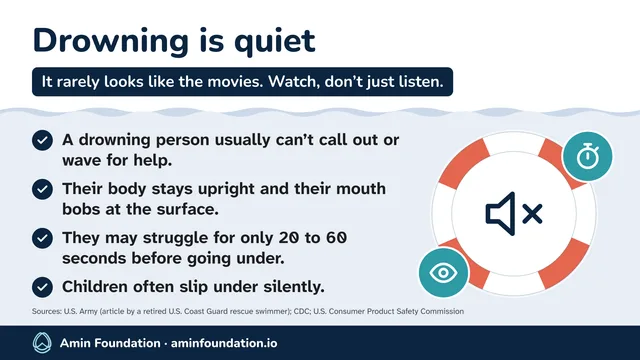
Drowning rarely looks like it does in movies. A person who is drowning usually can't shout or wave: their head is low in the water with the mouth at the surface, their body is upright, their arms press down at their sides, and they can slip under in less than a minute. As the CDC puts it, drowning happens in seconds and is often silent (opens in a new tab).
This guide shows you what to look for, so you can spot trouble early and act while there is still time.
Drowning is usually quiet
Most of us expect splashing and shouting. Real drowning is different.
- Children often slip under without a sound. The U.S. Consumer Product Safety Commission says that even people near or in the pool have reported hearing nothing out of the ordinary (opens in a new tab) during drowning incidents.
- People who are drowning can't call out. Retired Coast Guard rescue swimmer Mario Vittone, writing for the U.S. Army (opens in a new tab), explains the "instinctive drowning response" described by Dr. Francesco Pia. Except in rare cases, a drowning person is physically unable to call for help, because "breathing must be fulfilled before speech occurs."
- It happens fast. The same article says a person in this response can struggle at the surface for only 20 to 60 seconds before going under.
20-60 seconds
The signs of drowning
The American Red Cross says a swimmer needs help right away (opens in a new tab) if they:
- are not making forward progress in the water;
- are upright in the water but can't move or tread water;
- are motionless and face down in the water.
Vittone's article lists other signs to watch for:
- head low in the water, mouth at water level;
- head tilted back with mouth open;
- eyes glassy and empty, unable to focus, or eyes closed;
- hair over the forehead or eyes;
- body upright, not using the legs;
- hyperventilating or gasping;
- trying to swim in one direction but not getting anywhere;
- trying to roll over onto the back;
- looking like they are climbing an invisible ladder.
During the instinctive drowning response, the person's mouth sinks below and comes back above the surface. They can't wave, because their arms push out to the sides and press down on the water. They can't reach for a rope or a rescuer, and there is no supporting kick.
One simple check from the same article is to ask, "Are you all right?" If they can answer at all, they are probably OK. If they give you a blank stare, you may have less than 30 seconds to get them to safety.
Distress comes before drowning
Not everyone in trouble is silent at first. A person who is yelling and thrashing is in what Vittone calls aquatic distress. They are still in real danger. The difference is that, for a short time, they can often still help with their own rescue, for example by grabbing a rope, a ring buoy or a pool noodle you throw to them.
That makes distress the moment to act. Don't wait to see whether a struggling swimmer settles down. Shout for help, call 911 and reach or throw something that floats. Our guide to helping without going in explains how.
Children, teens and adults
Young children. Babies and toddlers can drown in very little water: the CPSC says a child can drown in as little as 2 inches (opens in a new tab), quickly and silently. The same page says most children who drowned in pools or spas had been missing for 5 minutes or less. That is why the Red Cross says that if a child is missing, check the water first (opens in a new tab): seconds count.
Vittone gives parents one more rule: children playing in the water make noise. When they get quiet, go to them and find out why.
Teens. The American Academy of Pediatrics says teens are at higher risk because they may overestimate their swimming skills, misjudge hazards or take impulsive risks (opens in a new tab). A strong swimmer can still get into trouble in a lake, a river or the ocean.
Adults. The CDC says alcohol is involved in up to 70% of deaths linked to water recreation (opens in a new tab) among teens and adults. Cold water adds another danger: the National Weather Service explains that sudden immersion causes involuntary gasping and rapid breathing (opens in a new tab) in the first minutes, which can quickly lead to drowning if water is inhaled.
Watch, don't just listen
Because drowning is quiet, you have to see it to stop it. That means someone has to be watching.
- Name a Water Watcher. Pool Safely describes a Water Watcher (opens in a new tab) as an adult whose only job is to watch children in the water, with no reading, texting or phone games.
- Keep watching when a lifeguard is on duty. Pool Safely notes that lifeguards may not see the whole pool, so parents should still act as Water Watchers.
- Stay close to young or weak swimmers. The AAP recommends that a supervising adult who can swim stay within arm's length (opens in a new tab) of infants, toddlers and weak swimmers.
- Take turns. At gatherings, the AAP suggests handing a water watcher card (opens in a new tab) to the next adult every 15 to 20 minutes.
Our guide on how to supervise kids around water covers touch supervision and handoffs in detail.
Printable
Water Watcher Card
A cut-out card to pass between adults at the pool, beach or lake: whoever holds it watches the water, with no phone and no other job, for 15-20 minutes.
If you see these signs
- Shout for help and alert the lifeguard if there is one.
- Call 911, or point at one person and tell them to call.
- Reach or throw something that floats from the edge. Don't go in. See Reach or Throw, Don't Go: How to Help Someone Who Is Drowning.
- Once the person is out of the water, follow the steps in what to do in the first minutes. If they are not breathing, start CPR if you are trained.
- Get them checked. Water Safety USA says anyone with symptoms after a drowning, such as coughing that won't stop, any loss of consciousness, chest pain, shortness of breath or confusion (opens in a new tab), should be seen by a medical professional.
What you can do today
Printable
Drowning Is Quiet
A poster of the quiet signs of drowning for pools, beaches, camps and classrooms, with what to do: call 911, reach or throw, don't go in.
Common questions
Do drowning people yell for help?
Usually not. A retired Coast Guard rescue swimmer writing for the U.S. Army explains that, except in rare cases, people who are drowning are physically unable to call out, because breathing has to come before speech. They also can't wave, because their arms press down on the water to keep their mouth up.
How long does it take to drown?
It can be very fast. The CDC says drowning happens in seconds and is often silent. The same Army article says a person in the instinctive drowning response may struggle at the surface for only 20 to 60 seconds before going under.
What is the instinctive drowning response?
It is the body's automatic reaction to suffocating in water, first described by Dr. Francesco Pia. The person stays upright with no supporting kick, their mouth bobs at the surface, and their arms push down at their sides. They can't call out, wave or reach for a rescuer.
What should I do if I think someone is drowning?
Shout for help, alert a lifeguard if there is one and call 911 or have someone call. Reach or throw something that floats from the edge, and don't go in yourself. Once the person is out, anyone who needed help in the water should be checked by a medical professional.
Tools and printables for this guide
Interactive tool
Drowning myths quiz
Myth or fact? Test 14 common beliefs about drowning, from floaties to dry drowning, with every answer checked against official sources.
Printable
Drowning Is Quiet
A poster of the quiet signs of drowning for pools, beaches, camps and classrooms, with what to do: call 911, reach or throw, don't go in.
Printable
Water Watcher Card
A cut-out card to pass between adults at the pool, beach or lake: whoever holds it watches the water, with no phone and no other job, for 15-20 minutes.
Sources
- Preventing Drowning (opens in a new tab) CDC
- In-Home Drowning (Safety Education Center) (opens in a new tab) U.S. Consumer Product Safety Commission
- Drowning Doesn't Look Like Drowning (opens in a new tab) U.S. Army (army.mil), by retired USCG rescue swimmer Mario Vittone
- Water Safety (opens in a new tab) American Red Cross
- Safety Tips (opens in a new tab) Pool Safely (CPSC)
- AAP Releases Updated Drowning Prevention Recommendations (opens in a new tab) American Academy of Pediatrics (HealthyChildren.org)
- Swim Lessons for Children: When to Start & What to Consider (opens in a new tab) American Academy of Pediatrics (HealthyChildren.org)
- Cold Water Hazards and Safety (opens in a new tab) National Weather Service
- Risk Factors for Drowning (opens in a new tab) CDC
- Mythical Drowning Terms (opens in a new tab) Water Safety USA
More in Drowning Emergencies and Rescue
How to Throw a Ring Buoy or Throw Bag
How to use rescue equipment at pools, docks and beaches: throw bags, ring buoys and reaching poles, what to throw if there's none, and pulling someone in.
Where to Learn CPR and Why It Matters for Drowning
Where to find CPR classes from the Red Cross and American Heart Association, free FDNY classes in NYC, and why drowning calls for CPR with rescue breaths.
'Dry Drowning' and 'Secondary Drowning': What Parents Need to Know
'Dry drowning' and 'secondary drowning' aren't medical terms. Learn which symptoms after a water incident need medical care, and when a child is fine.