
Cold Water Shock and the 1-10-1 Rule
What cold water shock does to your breathing and heart, why it drowns strong swimmers, and what the 1-10-1 rule means and where it falls short.
Key takeaways
- Cold water shock is the body's automatic reaction to sudden immersion: a huge gasp, then fast breathing you can't control. If your face is in the water, you can breathe in water and drown.
- It isn't only ice water. Gasping can start in water as warm as 77°F, and cold shock is as severe at 50-60°F as at 35°F.
- The 1-10-1 rule is a rough memory aid, not a countdown. Strength can fade within minutes, and the National Center for Cold Water Safety calls the rule misleading.
- Most people who die after falling into cold water drown long before hypothermia sets in.
- The two habits that matter most: wear a life jacket, and dress for the water temperature, not the air.
Cold water shock is your body's automatic reaction to sudden immersion in cold water: a huge gasp, then fast breathing you can't control, which can make you breathe in water and drown within the first minutes, even if you swim well. The 1-10-1 rule is a rough memory aid for what comes next, but the safest takeaway is simpler: wear a life jacket and dress for the water temperature.
Cold water catches people on warm days. A spring paddle, an early-summer jump off a dock, a slip from a rock on the shore. This guide explains what happens in those first minutes and how to protect yourself.
77°F
What cold water shock is
The National Weather Service (NWS) explains that when your body hits cold water, cold shock can cause dramatic changes in breathing, heart rate and blood pressure (opens in a new tab). It has three parts:
- Gasping and fast breathing. NWS says cold water can trigger involuntary gasping, rapid breathing or hyperventilating (opens in a new tab), during the first 2-3 minutes or more (opens in a new tab). If you inhale water and can't stay afloat, it quickly becomes a drowning emergency.
- Heart strain. Cold water can cause a sudden spike in heart rate and blood pressure, which can cause heart failure and stroke for vulnerable people (opens in a new tab).
- Panic. Cold shock can cause an immediate panic, fear or stress reaction that impairs clear thinking and decision making (opens in a new tab).
You can't stop it by willpower. The National Center for Cold Water Safety (NCCWS) says these responses are intense and completely involuntary (opens in a new tab). It also notes that in water below 60°F, an average person can hold their breath only one-third as long as in warmer water (opens in a new tab).
How cold is cold?
Colder than most people think. NWS says cold shock can be just as severe and dangerous in water of 50-60°F as in water at 35°F (opens in a new tab). NCCWS advises that you should treat any water temperature below 70°F with caution (opens in a new tab), and it points out that water conducts heat away from your body 25 times faster than air (opens in a new tab).
| Water temperature | What NCCWS says happens |
|---|---|
| Below 77°F (25°C) | Breathing is adversely affected (opens in a new tab) |
| 70°F to 60°F (21-15°C) | Controlling your breathing and holding your breath become progressively more difficult (opens in a new tab) |
| 60°F to 50°F (15-10°C) | Maximum-intensity cold shock, total loss of breathing control (opens in a new tab) for most people who aren't used to cold water |
| Below 40°F (5°C) | Maximum cold shock plus severe pain (opens in a new tab) |
The 1-10-1 principle
You may have seen "1-10-1" on a boating poster. The Canadian Safe Boating Council describes it as a simple way to remember the first three phases of cold water immersion and the approximate time each phase takes (opens in a new tab):
- About 1 minute: cold shock. The council says that during this time you should concentrate on avoiding panic and getting control of your breathing (opens in a new tab), and that a life jacket is critically important to keep you afloat.
- About 10 minutes: meaningful movement. Over roughly the next 10 minutes, you will lose the effective use of your fingers, arms and legs (opens in a new tab).
- About 1 hour: until unconsciousness. Even in ice water, it could take approximately 1 hour before becoming unconscious due to hypothermia (opens in a new tab).
Treat those times as rough, not as a promise. NCCWS calls the 1-10-1 one of the most widely known cold water myths (opens in a new tab). It notes that the physiologist who introduced it, Gordon Giesbrecht, himself wrote that in water near 32°F, incapacitation can occur within two to ten minutes (opens in a new tab). And NWS says the gasping phase can last 2-3 minutes or more (opens in a new tab), not just one.
What everyone agrees on: your ability to help yourself starts fading the moment you hit the water. NCCWS says that in very cold water, it's possible to lose the use of your hands in under a minute (opens in a new tab), and that children cool faster than adults (opens in a new tab).
Interactive tool
Cold water and the 1-10-1
Enter a water temperature to see the cold water risk, and learn the 1-10-1 memory aid with the National Center for Cold Water Safety’s caution.
Why strong swimmers drown in cold water
Swimming ability doesn't protect you from the gasp. NCCWS says that while hyperventilating from cold shock, swimming as short a distance as 6-10 feet is often impossible, even for good swimmers (opens in a new tab). It adds that many cold-water victims drown within 6-10 feet of where they entered the water, even though they know how to swim (opens in a new tab).
The U.S. Army Corps of Engineers describes the people it loses on its lakes as fathers, sons, brothers and friends who may even be good swimmers (opens in a new tab), many of whom never intended to be in the water (opens in a new tab).
Hypothermia, the slow loss of body heat, is usually not what kills first. NCCWS says most victims die from cold shock and incapacitation long before hypothermia becomes an issue (opens in a new tab). In Minnesota, the state DNR reports that of 269 ice-related deaths since 1976, only 5 were from hypothermia (opens in a new tab); most were drownings.
2x
Dress for the water, not the air
Two habits protect you from cold shock better than anything else.
1. Wear a life jacket before you need it. NWS says wearing a life jacket significantly increases chances of survival (opens in a new tab). It keeps your head up during the gasp, when you can't swim. Put it on before you go out: NCCWS notes that most people find it very difficult or impossible to put on their PFD after they wind up in the water (opens in a new tab). See how to choose the right life jacket.
2. Dress for immersion. NWS advises: always dress for water temperature, not for air temperature (opens in a new tab). NCCWS recommends appropriate thermal protection, such as a wetsuit or drysuit, if the water temperature is below 70°F (opens in a new tab), adding that the colder the water, the more protection you need (opens in a new tab). More in cold-water paddling and early-season boating.
Where cold water catches people
NWS lists the common ways people end up in cold water by surprise:
- Kayaking, canoeing, rafting, paddleboarding and lake boating (opens in a new tab).
- Falling off watercraft, docks, rocks or jetties (opens in a new tab).
- Falling through the ice (opens in a new tab). See what to do if you fall through ice.
- Sneaker waves that can pull beach walkers into the surf (opens in a new tab).
- Rising tides, rising rivers, tidal currents and rip currents (opens in a new tab).
It isn't only a winter problem. NWS notes that in the waters around Annapolis, Maryland, temperatures may only be above 60°F for 5.5 months of the year (opens in a new tab).
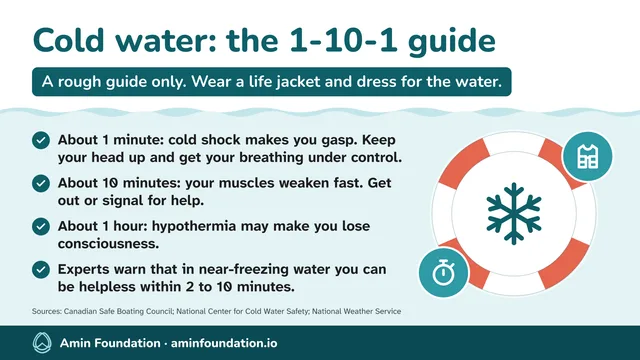
Infographic
Cold water: the 1-10-1 guide
A rough guide only. Wear a life jacket and dress for the water.
What you can do today
Printable
Cold Water Safety
A poster on cold water shock: why water below 70°F needs caution, what to wear, what to do if you fall in, and how to help someone from shore.
Next, read what to do if you fall into cold water, and learn the signs of hypothermia after cold water. If you're thinking about a winter dip, see polar plunge safety.
Common questions
What is cold water shock?
Cold water shock is the body's automatic response to sudden immersion in cold water. The National Weather Service says it causes involuntary gasping and rapid breathing in the first 2-3 minutes or more, plus a spike in heart rate and blood pressure. If you breathe in water during the gasp, you can drown quickly, even in calm water.
What is the 1-10-1 rule?
The Canadian Safe Boating Council describes 1-10-1 as a way to remember three phases of cold water immersion and their approximate times: about 1 minute of cold shock, about 10 minutes of useful movement, and about 1 hour before unconsciousness from hypothermia. The National Center for Cold Water Safety warns these times are misleading, so treat them as rough.
How cold does water have to be to cause cold shock?
Colder than most people think. The National Weather Service says gasping can be triggered by water as warm as 77°F, and that cold shock can be just as severe at 50-60°F as at 35°F. The National Center for Cold Water Safety says to treat any water below 70°F with caution.
Can a strong swimmer drown from cold water shock?
Yes. The National Center for Cold Water Safety says that while hyperventilating from cold shock, swimming even 6-10 feet is often impossible, even for good swimmers. That's why a life jacket, worn before you fall in, matters more than swimming skill.
Tools and printables for this guide
Interactive tool
Cold water and the 1-10-1
Enter a water temperature to see the cold water risk, and learn the 1-10-1 memory aid with the National Center for Cold Water Safety’s caution.
Printable
Cold Water Safety
A poster on cold water shock: why water below 70°F needs caution, what to wear, what to do if you fall in, and how to help someone from shore.
Infographic
Cold water: the 1-10-1 guide
A rough guide only. Wear a life jacket and dress for the water.
Sources
- Cold Water Hazards and Safety (opens in a new tab) National Weather Service
- Cold Shock (opens in a new tab) National Center for Cold Water Safety
- What Is Cold Water? (opens in a new tab) National Center for Cold Water Safety
- Water Temperature Safety Guide (opens in a new tab) National Center for Cold Water Safety
- The 1-10-1 Myth (opens in a new tab) National Center for Cold Water Safety
- 1-10-1 Principle (opens in a new tab) Canadian Safe Boating Council
- Hypothermia (opens in a new tab) National Center for Cold Water Safety
- Physical Incapacitation (opens in a new tab) National Center for Cold Water Safety
- Why Did We Pick 70F (21C)? (opens in a new tab) National Center for Cold Water Safety
- Always Dress for the Water Temperature (opens in a new tab) National Center for Cold Water Safety
- Always Wear Your PFD (opens in a new tab) National Center for Cold Water Safety
- Ice fatality statistics 1976-2025 (opens in a new tab) Minnesota Department of Natural Resources
- As temps rise, officials implore recreators wear simple life-saving device (opens in a new tab) U.S. Army Corps of Engineers (via DVIDS), 2025
More in Cold Water and Ice Safety
Ice Safety: How Thick Does Ice Need to Be?
Official ice thickness guidelines, why no ice is ever 100% safe, clear vs. white ice, where ice is weakest, and NYC Parks' rule on frozen ponds.
What to Do If You Fall Through Ice (and How to Help)
Step-by-step self-rescue if you fall through ice, why ice picks matter, and how to help someone else from shore without walking out onto the ice yourself.