
Drowning Emergencies and Rescue
Reach or Throw, Don't Go: How to Help Someone Who Is Drowning
How to help a drowning person without becoming a second victim: call 911, reach with a pole or rope, throw something that floats, and don't go in.
Key takeaways
- Shout for help and call 911 first, or point at one person and tell them to call.
- Reach from solid ground with a pole, branch, rope, towel or ladder. If you start to be pulled in, let go and try again.
- Throw anything that floats: a ring buoy, a life jacket, a boogie board, an empty cooler or a pool noodle.
- Don't go in. Many people have died trying to rescue someone, and even lifeguards go in only with a flotation device.
- Learn these skills hands-on in a Red Cross water safety or CPR course before you ever need them.
Emergency
Call 911 first, or point at one person and tell them to call. Shout for help and alert a lifeguard if there is one. Then reach or throw something that floats from solid ground. Do not go into the water.
To help someone who is drowning, stay on land and reach or throw, don't go. That is the rule the American Red Cross (opens in a new tab) teaches: reach out with something long, or throw something that floats, while you stay safely on the shore, dock or pool deck. Water Safety USA describes safe, simple rescue the same way: reaching or throwing a flotation aid from the water's edge without entering the water (opens in a new tab).
This page explains each part, the rescue equipment you'll see at pools, docks and beaches, and what to do if a pet falls in.
First: call for help
Every second counts, so get help moving before you do anything else.
- Shout. Yell for help and get the lifeguard's attention if there is one.
- Call 911, or assign it. Say "You, in the blue shirt, call 911" so it actually happens. Our guide to calling 911 near water explains what to say when there is no street address.
- Take a few seconds to look. The National Weather Service suggests you take 10 seconds to assess the situation (opens in a new tab), then alert a lifeguard. Is the person moving forward? Can they answer you? Our guide to the quiet signs of drowning shows what trouble looks like.
- Talk to them. National Weather Service Tallahassee advises yelling to a swimmer in distress to float or tread water and stay calm (opens in a new tab). At the beach, tell them to swim along the shoreline to get out of a rip current.
Reach: from solid ground
If the person is close to the edge, reach out to them with something long and strong.
- What to use. A reaching pole, a branch, a paddle, a rope, a towel or a ladder. The Minnesota Department of Natural Resources lists a rope, ladder or jumper cables (opens in a new tab) for reaching someone from shore.
- Stay on solid ground. Keep your feet on the deck, dock or bank, not on loose rocks, ice or a slippery edge.
- Let go if you are being pulled in. Minnesota DNR says that if the person starts to pull you in, release your grip on the object and start over. A drowning person grabs hard, and you are no help to them if you end up in the water too.
Throw: anything that floats
If they are too far to reach, throw them something that floats so they can hold on while help comes.
- Rescue equipment. Ring buoys (life rings), throw bags (a rope stuffed in a bag) and life jackets are made for this.
- Everyday things that float. National Weather Service Tallahassee suggests a boogie board, an empty cooler, or pool noodles and rafts (opens in a new tab).
- Hold the line. If the float is tied to a rope, keep hold of your end so you can pull the person to the edge. Minnesota DNR's ice-rescue advice is to toss one end of a rope or something that will float to the person.
- Throw early. A person in distress who is still yelling and thrashing can often grab a rope or ring. A person in the instinctive drowning response (opens in a new tab) usually can't, so act at the first sign of trouble.
Don't go: why untrained rescuers drown
It feels wrong to stay on land when someone is in trouble. But going in without training and a flotation device often turns one emergency into two.
- Many would-be rescuers die. The National Weather Service warns that many people have died trying to rescue someone (opens in a new tab) caught in a rip current, and says never to enter the water without a flotation device.
- Even lifeguards take a float. National Weather Service Tallahassee notes that even lifeguards only attempt a rip current rescue using a flotation device (opens in a new tab). It also warns against forming a human chain, because people who try may end up needing rescue themselves.
- Ice is no different. Minnesota DNR says a non-professional shouldn't go out on the ice (opens in a new tab) to make a rescue unless every other option has been ruled out, and that heroics by well-meaning but untrained rescuers sometimes result in two deaths.
- Cold water takes your breath. Sudden cold water can cause gasping and rapid breathing (opens in a new tab) that makes swimming very hard, even for strong swimmers.
If the situation is too dangerous for you to reach or throw, Minnesota DNR says to call 911 and keep reassuring the person that help is on the way.
Rescue equipment at pools, docks and beaches
Ring buoys (life rings), throw bags and reaching poles are made for exactly this kind of rescue. Find out where they are at your pool, dock or beach before anyone swims, and check that they are in place and in good shape. If equipment is missing at a public pool, beach or dock, tell the owner or manager.
Throwing accurately takes practice. Our step-by-step guide to how to throw a ring buoy or throw bag shows how to use each one and how to pull someone in safely. For a home pool, see pool rescue equipment; for lakes and boat launches, see loaner stations and public rescue equipment.
The CDC suggests travelers learn safe rescue techniques such as using poles or ropes (opens in a new tab) so they can help without entering the water.
If a pet falls in
Many people go into water, or onto ice, after a dog. Minnesota DNR's advice is direct: do not risk your life to attempt to save a pet or other animal (opens in a new tab).
- Stay on shore. On ice, Minnesota DNR says to resist the urge to run up to the edge of the hole, because that most often leaves two victims in the water.
- Call 911. Responders have the training and equipment for water and ice rescue.
- Reach or throw from solid ground only, following the steps above.
For ice, see what to do if someone falls through ice.
Get trained
Reading about rescue is a start. Practicing it with an instructor is better.
- The Red Cross teaches "reach or throw, don't go" as part of water competency, alongside knowing the signs of drowning and knowing CPR and first aid (opens in a new tab).
- The National Drowning Prevention Alliance lists CPR training with rescue breaths and basic water rescue skills (opens in a new tab) as one of its layers of protection.
- Our guide on where to learn CPR lists class finders, including free classes in New York City.
Children can practice the idea too. Our game Reach or Throw, Don’t Go lets kids choose the safe way to help, and it collects nothing.
What you can do today
Printable
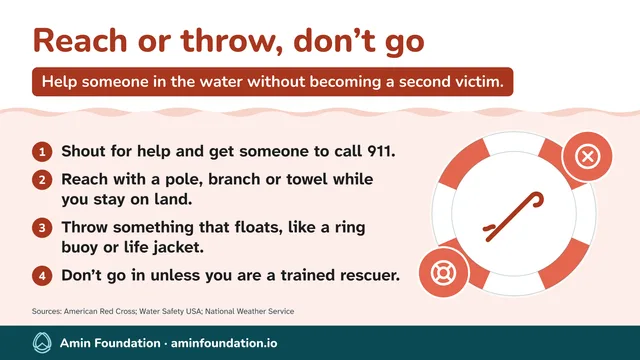
Reach or Throw, Don't Go
A poster of the safe way to help someone in trouble in the water: shout and call 911, reach from solid ground, throw something that floats, and don't go in.
Step by step
Shout and call 911
Shout for help, alert a lifeguard if there is one, and call 911 or tell one specific person to call.
Tell them what to do
Yell to the person to float or tread water and stay calm. At the beach, tell them to swim along the shoreline.
Reach
From solid ground, hold out a pole, branch, rope, towel or ladder. If you feel yourself being pulled in, let go and start again.
Throw
Throw something that floats, such as a ring buoy, life jacket, boogie board, empty cooler or pool noodle. Keep hold of the end of any rope.
Don't go in
Stay out of the water. If you can't reach them or throw to them, keep reassuring them that help is on the way until responders arrive.
Common questions
What does 'reach or throw, don't go' mean?
It is the American Red Cross rule for helping someone in trouble in the water. You reach out to them with something long, or throw them something that floats, from a safe spot on land, a dock or a pool deck. You don't go into the water yourself, because untrained rescuers often drown too.
Should I jump in to save someone who is drowning?
No. A drowning person can pull a rescuer under, and many people have died trying to help. The National Weather Service says never to enter the water without a flotation device, and even lifeguards attempt rip current rescues only with one. Call 911, reach or throw, and let trained rescuers go in.
What can I throw to someone who is drowning?
Anything that floats. Ring buoys and throw bags are made for this. A life jacket, boogie board, empty cooler, pool noodle or inflatable raft can also help, according to the National Weather Service. Hold on to the end of any rope so you can pull them in.
What should I do if my dog falls in the water or through ice?
Stay on shore. The Minnesota Department of Natural Resources says not to risk your life to save a pet or other animal. Call 911, and reach or throw from solid ground only.
Tools and printables for this guide
Printable
Reach or Throw, Don't Go
A poster of the safe way to help someone in trouble in the water: shout and call 911, reach from solid ground, throw something that floats, and don't go in.
Sources
- Water Safety (opens in a new tab) American Red Cross
- Water Competency (opens in a new tab) Water Safety USA
- What if someone else falls in? (opens in a new tab) Minnesota Department of Natural Resources
- Social Media: Rip Currents & Beach Hazards (opens in a new tab) National Weather Service
- Gulf Coast Rip Current Awareness (opens in a new tab) National Weather Service Tallahassee
- Injury and Death During Travel (CDC Yellow Book) (opens in a new tab) CDC
- Drowning Doesn't Look Like Drowning (opens in a new tab) U.S. Army (army.mil), by retired USCG rescue swimmer Mario Vittone
- Layers of Protection (opens in a new tab) National Drowning Prevention Alliance
- Cold Water Hazards and Safety (opens in a new tab) National Weather Service
More in Drowning Emergencies and Rescue
Drowning Emergency: What to Do in the First Minutes
What to do in a drowning emergency: call 911, get the person out without going in, start CPR if trained, and get medical care for anyone who had trouble.
'Dry Drowning' and 'Secondary Drowning': What Parents Need to Know
'Dry drowning' and 'secondary drowning' aren't medical terms. Learn which symptoms after a water incident need medical care, and when a child is fine.
Helping a Child After a Scary Moment in the Water
After a near drowning or a scare in the water: how to check your child's health, talk about it, rebuild their confidence and know when to get more help.