
Check readiness

Private: what you enter stays on this device.

This is the printable version. Turn on JavaScript to use the interactive tool.

What the AAP says by age

Under 1 year: Water play together, not formal lessons yet
The AAP does not recommend infant swim programs for babies under 1, because there is no evidence they lower drowning risk. A parent-and-child water play class is fine for getting used to the pool together. If you are thinking about another kind of infant class, talk with your pediatrician first.
1 to 3 years: Many children can start lessons now
The AAP says swim lessons can begin for many children at age 1, and studies suggest lessons can help reduce drowning risk for children ages 1 to 4. Parent-and-child classes are a good way to start building water safety habits and basic skills such as back floating.
4 to 5 years: Most children are ready by now
By their 4th birthday most children are ready for swim lessons, the AAP says. At this age they can usually learn water survival skills beyond back floating, such as treading water and getting to an exit point.
6 years or older: Now is the time
By age 6, most children in swim lessons can master the front crawl. If your child has not started a learn-to-swim program yet, the AAP says now is the time.

Things to consider (AAP)

  • Emotional maturity: can your child cope with a class and learn from an instructor?
  • Physical and developmental abilities and limitations.
  • Comfort in the water.
  • Not sure? Your pediatrician can help you decide.

What to look for in a program

  • Instructors trained and certified through a nationally recognized learn-to-swim curriculum, and lifeguards on duty with current CPR and first aid certification.
  • Safety habits are taught: never swim alone, and always ask a grown-up before getting in the water.
  • Practice for falling in unexpectedly, including swimming in clothes.
  • You can watch a class first. Children should be swimming most of the time, not waiting for a turn.
  • Several sessions, with steady progress you can see.

For children under 4, also look for

  • “Touch supervision”: an adult within arm’s reach, and parents encouraged to join in.
  • An age-appropriate, warm and secure feel, while still teaching respect for water.
  • Clean water with proper chlorine levels, and snug swimsuits at the legs.
  • Warm water: ideally 87 to 94°F for children 3 and younger.
When can a child start swim lessons?

For many children, swim lessons can start at age 1. That is the American Academy of Pediatrics' advice in Swim Lessons for Children: When to Start & What to Consider (opens in a new tab). But children develop at different rates, so age is only part of the answer. The AAP asks parents to think about three things:

  • Emotional maturity. Can your child cope with a class and learn from an instructor?
  • Physical and developmental abilities and limitations. What can your child's body do right now, and is there anything to plan around?
  • Comfort in the water. Is your child relaxed in the bath or a shallow pool, or frightened?

If you are unsure, the AAP says your pediatrician can help you decide when your child is ready and talk through any concerns.

What the AAP says by age

  • Under 1: The AAP does not recommend infant swim programs for babies under 1, because there is no evidence they lower drowning risk. Some infants can be trained to float on their backs, but they can't yet lift their heads out of the water well enough to breathe. A parent-and-child water play class is fine for getting used to the pool together.
  • Ages 1 to 4: Studies suggest that lessons in water competency and survival skills can help reduce drowning risk for children ages 1 to 4. Parent-and-child classes help build swim readiness and basic skills such as back floating.
  • By the 4th birthday: Most children are ready for lessons. They can usually learn treading water and getting to an exit point.
  • By age 5 or 6: Most children in lessons can master the front crawl. If your child hasn't started yet, the AAP says now is the time.

Lessons matter. A study led by the National Institutes of Health found that formal swimming lessons were associated with an 88% lower drowning risk for children ages 1 to 4 (opens in a new tab), though the authors noted the estimate was imprecise.

How this check works

Answer four short questions: your child's age, how they feel around water, whether they are usually OK being taught by another adult, and whether they have a health condition or developmental difference you want to plan around. The tool shows what the AAP suggests for that age, notes anything to talk over with an instructor or pediatrician, and lists what to look for in a program. It does not diagnose anything or decide for you. Nothing you choose leaves this device.

Swim lessons can be adapted for children with special health needs or developmental disabilities, such as autism. The AAP says these adapted programs reduce drowning risk and can improve swim skills.

Lessons are one layer, not a guarantee

Lessons don't make a child "drown proof." The AAP lists them as one of several layers of protection, alongside close, constant supervision, barriers that block access to water during non-swim time, and life jackets around open water. Children who have had lessons still need watching.

For more, read what age to start swim lessons, what parent-and-baby classes can and can't do and how to choose a swim program.

What you can do today

  1. Answer the four questions above and print the result.
  2. Watch a class at a nearby pool before you sign up.
  3. Find official lesson finders with the swim lesson finder.
  4. Track new skills with the swim progress tracker.

Printables, infographics and games

Printable

Swim Lesson Questions

A one-page list of questions to ask any swim program, for children or adults: instructor certification, lifeguards, class time in the water, cost and comfort.

Infographic

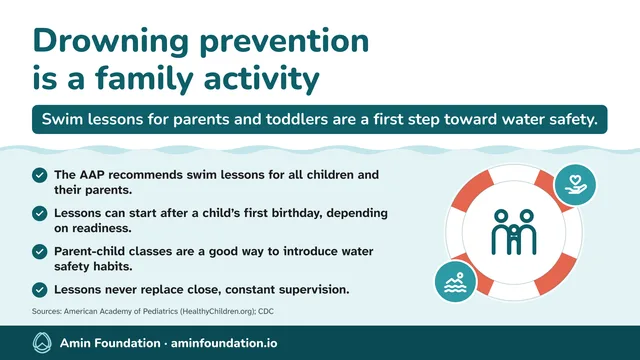
Drowning prevention is a family activity

Swim lessons for parents and toddlers are a first step toward water safety.

More tools: learn to swim

Sources

  1. Swim Lessons for Children: When to Start & What to Consider (opens in a new tab) American Academy of Pediatrics (HealthyChildren.org)
  2. Association between swimming lessons and drowning in childhood: a case-control study (Brenner et al., 2009) (opens in a new tab) National Institute of Child Health and Human Development (NIH)

Updated