
Water Safety for Teens: Risks, Peer Pressure and Real Skills
Why teen drowning risk rises in lakes, rivers and the ocean, how overconfidence, dares and alcohol play a part, and the rescue and CPR skills teens can learn.
Key takeaways
- The AAP says drowning risk falls after age 4 but rises again in the teen years, even among strong swimmers.
- Teens are more likely than younger children to drown in lakes, rivers, ponds and the ocean.
- Overconfidence, dares and alcohol drive much of the risk. Among teens and adults, alcohol is involved in up to 70% of deaths linked to water recreation.
- Almost half of 10- to 17-year-olds who drowned could swim (2005-2014 data). Being able to swim is not the same as being safe.
- Teens can learn CPR, safe rescue and lifeguarding: skills that protect them and the people around them.
Teens drown for different reasons than young children. The American Academy of Pediatrics (AAP) says drowning risk drops after age 4 and then goes up again during the teen years, even among strong swimmers (opens in a new tab). Teens are more likely than younger children to drown in lakes, rivers and the ocean, often away from adults, and they may overestimate their skills, take dares or drink. The best protection is real skill plus a few firm habits: swim where lifeguards are on duty, never alone, sober, feet first, and in a life jacket on any boat.
If you're a teen reading this: this page is for you as much as your parents. Skip to skills you can learn if you like.
Why teens face higher risk in natural water
The AAP explains that while younger children usually drown in pools, teens are more likely to drown in lakes, rivers, oceans, ponds and other natural bodies of water (opens in a new tab), which add waves, currents, sudden drop-offs and poor visibility. CDC reports that almost half of fatal drownings among people 15 and older happen in natural water (opens in a new tab).
Other facts worth knowing:
- Skill isn't the whole story. Water Safety USA reports that almost half of 10- to 17-year-olds who drowned could swim (opens in a new tab), based on national child death review data for 2005-2014.
- Adults often aren't there. The AAP says even among older children and teens, most drownings happen when there is no adult supervision (opens in a new tab).
- Rates jumped recently. CDC found the largest increase in drowning death rates in 2020 was among people aged 15 to 24, up 31.3% from 2019 (opens in a new tab).
- Boys and young men are most affected. Across all ages, males drowned at 2.0 per 100,000 in 2022, compared with 0.6 for females (opens in a new tab). We look at why in why boys and men drown more often.
The AAP's 2026 policy statement sums up the reasons: adolescents may overestimate their swimming skills, misjudge the seriousness of water hazards or engage in risky and impulsive behaviors (opens in a new tab).
Overconfidence and dares
The AAP notes that the part of the brain that controls complex decision-making and impulse control is still developing (opens in a new tab) in the teen years, and that peer pressure can push teens to keep up with or impress others even without the skills. That's normal development, not a character flaw. It just means good habits have to be decided before the moment, not during it.
Moments to plan for:
- Jumping and diving. The AAP says to enter new water feet first, know the depth beforehand, and follow posted no-diving signs (opens in a new tab), because diving into unsafe water can cause serious, sometimes permanent spinal injuries. The Red Cross says to dive only in water clearly marked as safe for diving, at least 9 feet deep with no underwater obstacles (opens in a new tab). See jumping and diving into lakes and rivers.
- Breath-holding contests. CDC warns that hyperventilating before swimming underwater or holding your breath for long periods can cause you to pass out and drown (opens in a new tab). A CDC review of New York cases from 1988 to 2011 found that in all four deaths, the swimmers were aged 17 to 22 and known to be advanced to expert swimmers (opens in a new tab).
- "Swim out to that raft." Open water isn't a pool. The National Weather Service warns that swimming in a pool is not the same as swimming at a surf beach (opens in a new tab), and that cold shock causes gasping and rapid breathing that create a greater risk of drowning, even for confident swimmers in calm waters (opens in a new tab).
- Rip currents. At the beach, the rule is to relax and float, then swim out of the current. The National Weather Service's steps are on our rip currents page.
Ways to say no without losing face. Try one of these, or make up your own:
- "I'll spot you from here."
- "I'm not going in where I can't see the bottom."
- "I promised my family. I'm out."
Alcohol and other drugs
Alcohol and water are a dangerous mix at any age.
Up to 70%
CDC explains that alcohol impairs balance, coordination and judgment, and it increases risk-taking (opens in a new tab). The AAP adds that alcohol use while boating increases drowning risks among passengers as well as boat operators (opens in a new tab), and that it can raise the risk of hypothermia. CDC research found that 25% to 61% of people aged 15 to 34 report drinking alcohol around water (opens in a new tab).
The same goes for other drugs. The Red Cross says don't use alcohol or drugs, including certain prescription medications, before or while swimming, diving or supervising swimmers (opens in a new tab). For the full picture, read why alcohol and swimming don't mix.
Skills teens can learn: rescue, CPR and lifeguarding
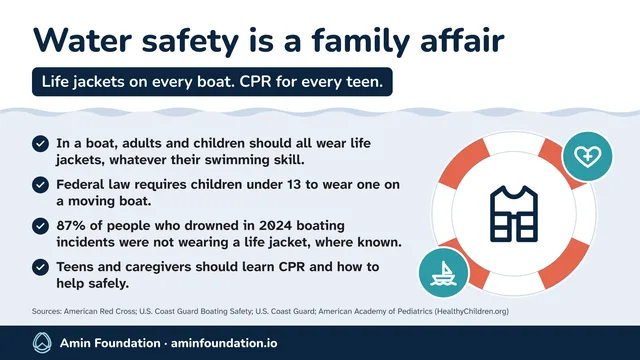
Teens aren't only at risk; they can also be the ones who help. The AAP recommends that caregivers and adolescents learn CPR and know how to perform safe rescue (opens in a new tab).
- Safe rescue: reach or throw, don't go. The Red Cross teaches reach or throw, don't go (opens in a new tab). The National Weather Service warns that many people have died trying to rescue someone caught in a rip current (opens in a new tab) and says never to go in without a flotation device. Learn more in reach or throw, don't go.
- CPR. The AAP suggests asking your child's high school to provide CPR training during health class (opens in a new tab). Find a course through where to learn CPR.
- Lifeguarding. The AAP points out that teens who enjoy lessons may continue with lifeguard training (opens in a new tab), which builds skills and can lead to a summer job. In New York City, NYC Parks Swim Prep (opens in a new tab) offers free coaching for swimmers 16 and older who want to pass the lifeguard qualifying test. See how to become a lifeguard or swim instructor.
- Never learned to swim? You're not alone, and the AAP says it's not too late (opens in a new tab). Many programs teach teens and adults. Start with how to find swim lessons.
- Life jackets on every boat. The AAP says teens should always wear U.S. Coast Guard-approved life jackets in or on boats, jet skis and other watercraft (opens in a new tab), and never rely on inflatable tubes or rafts.
How parents can talk about it
You can't be at every lake or beach party. What you can do is make the safe choice easier and the conversation normal.
- Pick the moment. The AAP suggests calm, device-free times and warns against bringing up alcohol at the last minute, when your teen is leaving the house (opens in a new tab).
- Listen as much as you talk. Ask what their friends do at the lake, and what they'd do if someone wanted to swim after drinking.
- Offer a ride, no questions asked. The AAP recommends telling teens they can call you for a ride home any time, day or night (opens in a new tab) if they or others are drinking.
- Model it. The AAP says adults should wear life jackets when boating, to be good role models (opens in a new tab), and avoid alcohol while supervising or before swimming or boating.
- Agree on a short list. Lifeguarded spots when possible. Never alone. Feet first. Sober in and around the water. Life jacket on boats. Check in when plans change.
Teachers and coaches: our Water Safety Lesson Plan for Grades 9-12 lesson plan turns these ideas into a class discussion.
What you can do today
If you're a teen:
- Pick your "no" line now, before the next dare.
- Sign up for a CPR class with a friend.
- Save a ride-home plan in your phone with a parent or trusted adult.
If you're a parent:
- Have a 10-minute, device-free talk this week using the short list above.
- Make the no-questions-asked ride offer out loud.
- Ask your teen's school whether it teaches CPR, and look into lifeguard or swim prep programs if your teen is a strong swimmer.
Heading off to college or a big trip soon? Read water safety for college students and young adults.
Common questions
My teen is a strong swimmer. Are they really at risk?
Yes. The AAP says teen drowning risk goes up even among strong swimmers, and Water Safety USA reports that almost half of 10- to 17-year-olds who drowned could swim (2005-2014 data). Natural water, dares and alcohol change the odds more than pool skills do.
Is it safe to jump off rocks, docks or bridges into a lake?
Only into water you know is deep enough and clear of hazards. The AAP says to enter new water feet first and follow no-diving signs, because diving into unsafe water can cause serious spinal injuries. The Red Cross says to dive only where it is marked safe, at least 9 feet deep.
How should I talk to my teen about drinking near water?
Pick a calm, device-free moment, not the minute they leave. The AAP suggests listening as much as you talk, setting clear rules, and offering to pick them up any time, no questions asked. Explain that alcohol harms balance, coordination and judgment in the water.
Can my teen train to be a lifeguard?
Many can. The AAP suggests lifeguard training as a way to build water safety skills. In New York City, NYC Parks Swim Prep gives free coaching to swimmers 16 and older who want to pass the lifeguard qualifying test. See our guide to becoming a lifeguard.
Tools and printables for this guide
Lesson plan
Water Safety Lesson Plan for Grades 9-12
A free 50-minute high school lesson: why teens who can swim still drown, alcohol, life jackets and cold water, real data, and a peer safety message.
Sources
- Water Safety for Teens (opens in a new tab) American Academy of Pediatrics (HealthyChildren.org), 2026
- AAP Releases Updated Drowning Prevention Recommendations (opens in a new tab) American Academy of Pediatrics (HealthyChildren.org), 2026
- Underage Drinking: How To Talk With Your Child About Alcohol Use (opens in a new tab) American Academy of Pediatrics (HealthyChildren.org), 2023
- Risk Factors for Drowning (opens in a new tab) CDC, 2026
- Preventing Drowning (opens in a new tab) CDC, 2025
- Vital Signs: Drowning Death Rates, Self-Reported Swimming Skill, Swimming Lesson Participation, and Recreational Water Exposure, United States, 2019-2023 (MMWR 2024;73(20)) (opens in a new tab) CDC (MMWR), 2024
- Fatal and Nonfatal Drowning Outcomes Related to Dangerous Underwater Breath-Holding Behaviors, New York State, 1988-2011 (MMWR 2015;64(19)) (opens in a new tab) CDC (MMWR), 2015
- Life Jackets Save Lives (opens in a new tab) Water Safety USA
- Swimming Safely in Lakes, Rivers & Streams (opens in a new tab) American Red Cross
- Water Safety (opens in a new tab) American Red Cross
- Know BEFORE you go in the water! (opens in a new tab) National Weather Service
- Cold Water Hazards and Safety (opens in a new tab) National Weather Service
- Social Media: Rip Currents & Beach Hazards (opens in a new tab) National Weather Service
- Swim Prep (opens in a new tab) NYC Parks
More in Water Safety by Age
Water Safety for Babies and Crawlers
Protect a baby under 12 months from drowning: keep a hand on them at bath time, empty buckets and pet bowls at crawling height, and plan for distractions.
Water Safety Skills by Age: A Milestone Guide
Which water safety habits and swim skills fit each age, from toddlers to teens and adults learning later, based on AAP and Red Cross guidance.
Water Safety for Toddlers: The Highest-Risk Years
Drowning is the leading cause of death for U.S. children ages 1 to 4. The layers that protect toddlers: barriers, touch supervision, lessons, life jackets.