Practise the steps
Private: what you enter stays on this device.
This is the printable version. Turn on JavaScript to use the interactive tool.
Signs of a rip current
- A gap of flatter water where waves are not breaking, between areas where they are. Rip currents are often found where waves are not breaking.
- A channel of darker water. The water is often darker in a rip current.
- A line of foam, seaweed or debris moving away from the beach. Things floating out to sea show the water moving away from shore.
Not signs: waves breaking in a steady line all along the beach (breaking waves are not the clue. look for the gap where they are not breaking.); a calm, sunny day (weather tells you nothing here: rip currents often form on calm, sunny days.); clear, light-colored water (a rip is more often darker than the water around it.).
If you are caught
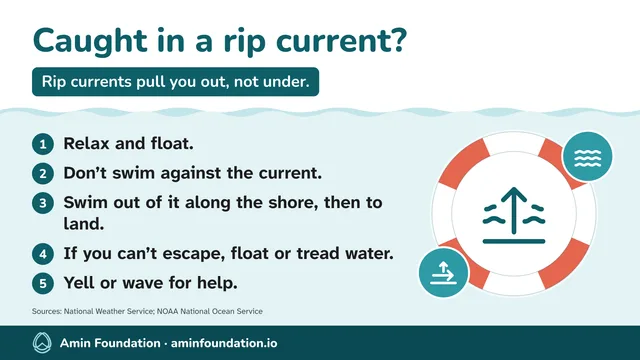
Relax. A rip current pulls you away from shore, not under the water.
Don’t swim straight back against the current.
Swim out of the current along the shoreline (or toward breaking waves), then angle back to the beach.
If you can’t get out, float or tread water.
If you need help, yell and wave to get attention.
If someone else is caught
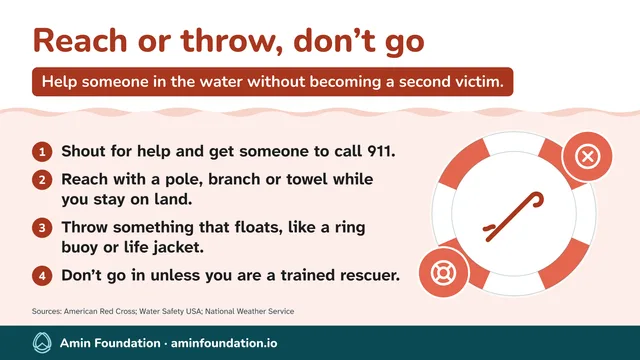
- Do: Get a lifeguard. If there is none, call 911.
- Do: Throw them something that floats.
- Do: From shore, tell them to swim along the shoreline.
- Don’t: Swim out to them right away. Never go in without a flotation device. Even lifeguards rescue people in rip currents with one.
- Don’t: Form a human chain into the water. The National Weather Service warns against human chains.