
How to Help Someone Caught in a Rip Current
Someone is caught in a rip current. Get a lifeguard, call 911, tell them to swim along the shore and throw something that floats. Don't swim out yourself.
Key takeaways
- Call a lifeguard first. If there is no lifeguard, call 911.
- Shout to the person to swim along the shoreline, not straight back to the beach.
- Throw them something that floats, such as a life jacket, a cooler or a ball.
- Don't swim out without a flotation device, and never form a human chain. Even lifeguards use flotation for rip current rescues.
Emergency
Call 911 if there is no lifeguard. If there is a lifeguard, alert them first and point to the person. Don't swim out yourself without something that floats.
To help someone caught in a rip current, get a lifeguard or call 911, shout to them to swim along the shoreline, and throw them something that floats. Do not swim out to them without a flotation device: the National Weather Service warns that many people have died trying to rescue someone caught in a rip current (opens in a new tab).
This is hard advice to follow when someone you love is in the water. It is also the advice that keeps one emergency from becoming two.
Step 1: Take ten seconds, then get help
The National Weather Service (NWS) says that if someone is waving or yelling for you, don't panic, take 10 seconds to assess the situation, then immediately alert a lifeguard (opens in a new tab).
In those ten seconds, ask yourself:
- Is the person unable to get back to shore? The NWS's first question is whether the person is unable to return to shore (opens in a new tab).
- Where is the nearest lifeguard? Run or shout to them and point at the person.
- If there is no lifeguard, call 9-1-1 (opens in a new tab), or have someone else call while you keep watching.
Keep your eyes on the person the whole time. If you lose sight of them, rescuers lose precious time. Tell the 911 dispatcher exactly where you are: the beach name, a street or lifeguard stand number, and what the person is wearing. Our guide to calling 911 near water has a short script.
What trouble looks like
Don't wait for screaming. CDC says drowning happens in seconds and is often silent (opens in a new tab). A retired Coast Guard rescue swimmer explains that drowning people are physiologically unable to call out for help (opens in a new tab) except in rare cases.
The Red Cross says a swimmer needs help right away if they are vertical in the water but unable to move or tread water (opens in a new tab), are not moving forward, or are face down and not moving. Someone yelling and thrashing is also in real trouble and may still be able to grab something you throw. Learn the signs in what drowning looks like.
Step 2: Tell them how to escape
Shout clear, short instructions. The NWS says to advise the person to swim following the shoreline to escape the current (opens in a new tab). You can use words like:
- "Swim sideways!" with your arm pointing along the beach.
- "Float! Lie back and float!"
- "Wave! We see you. Help is coming."
People caught in a rip current often try to swim straight back to shore and wear themselves out. Floating buys time. More on why in rip currents: how to spot one and how to escape.
Step 3: Throw something that floats
The NWS says: if possible, throw the person something that floats (opens in a new tab). The Red Cross suggests a lifejacket, cooler or inflatable ball (opens in a new tab).
Good things to throw:
Throw it so it lands within their reach, then shout to them to hold on and float.
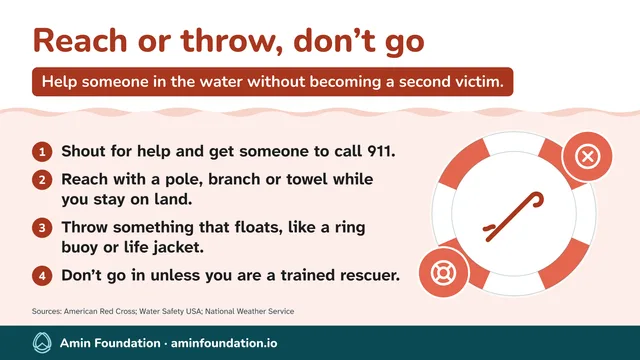
This is the Red Cross rule for every water rescue: reach or throw, don't go (opens in a new tab). Water Safety USA describes safe, simple rescue as reaching and throwing a flotation aid from the water's edge without entering the water (opens in a new tab). See reach or throw, don't go for the full method, including how to use a ring buoy.
Warning
Never enter the water without a flotation device. The National Weather Service says many people have died trying to rescue someone caught in a rip current.
Why untrained rescuers drown
It feels wrong to stand on the sand. But the current that caught one swimmer can catch a second one, who is now tired and frightened too. That is why trained lifeguards always bring something that floats.
The NWS Tallahassee office says:
- Do not attempt a rescue by forming a human chain! (opens in a new tab)
- Even lifeguards only attempt rip current rescues using a flotation device (opens in a new tab).
- Beachgoers who attempt a rip current rescue by themselves or as a human chain may end up needing to be rescued (opens in a new tab).
The Red Cross is direct: do not attempt a rescue yourself unless you are a trained beach lifeguard (opens in a new tab).
If you do go in because there is truly no other choice, take something that floats with you. The NWS says never enter the water without a floatation device (opens in a new tab), and to seek help from a lifeguard or use a floatation device if you go in the water (opens in a new tab). Hold the float out to the person so they grab it, not you.
When the person is back on the sand
Once the person is out of the water, keep 911 on the line or call if you haven't. If they are not breathing, start CPR if you are trained, or follow the dispatcher's instructions.
Even if they seem fine, watch them. Water Safety USA says anyone who has excessive coughing that does not stop, loss of consciousness even for a brief period, or needed rescue breathing or CPR (opens in a new tab) after a drowning episode should be checked by medical professionals. The same goes for chest pain, trouble breathing, confusion or unusual tiredness. Our guide to where to learn CPR explains how to get trained.
Learn rescue skills before you need them
The best time to learn is before the beach trip:
- Swim skills. The Red Cross counts "helping others" as one of the three parts of water competency (opens in a new tab).
- CPR. Water Safety USA recommends learning CPR with both chest compressions and rescue breaths (opens in a new tab).
- The beach plan. Agree as a family that nobody swims out after anyone. Everyone's job is to call, shout and throw.
The NWS also says the waves themselves can knock you down. Even experienced ocean visitors can be overcome by the power of the waves (opens in a new tab), so a guarded beach is always the first choice.
What you can do today
- Print the Reach or Throw, Don't Go and talk through it with everyone you go to the beach with.
- Pack a "throw bag" for the beach: a life jacket for each child, plus one spare adult life jacket you can throw.
- Teach the three shouts: "Swim sideways! Float! Wave!"
- Sign up for a CPR class that teaches rescue breaths.
- Choose guarded beaches. Read why swimming near a lifeguard matters.
Common questions
Should I swim out to save someone in a rip current?
No, not without a flotation device and training. The National Weather Service says many people have died trying to rescue someone caught in a rip current. Get a lifeguard or call 911, and throw something that floats. The Red Cross says not to attempt a rescue yourself unless you are a trained beach lifeguard.
Does a human chain work for a rip current rescue?
No. The National Weather Service office in Tallahassee says not to attempt a rescue by forming a human chain. People in the chain can be knocked down and pulled out too. Even lifeguards only attempt rip current rescues with a flotation device.
What can I throw to someone in a rip current?
Anything that floats and that you can throw: a life jacket, a ring buoy if the beach has one, a cooler or an inflatable ball, as the Red Cross suggests. Throw it so it lands within their reach, and shout to them to hold on and float while help comes.
How do I know if someone is drowning?
Drowning is often quiet. A person in trouble may be upright in the water, unable to move forward, with their mouth at the surface and no breath to call out. Someone waving and yelling is also in real trouble. Alert a lifeguard or call 911 right away.
Tools and printables for this guide
Printable
Reach or Throw, Don't Go
A poster of the safe way to help someone in trouble in the water: shout and call 911, reach from solid ground, throw something that floats, and don't go in.
Sources
- Social Media: Rip Currents & Beach Hazards (opens in a new tab) National Weather Service
- Rip Current Awareness (opens in a new tab) National Weather Service Tallahassee
- Beach and Ocean Safety (opens in a new tab) American Red Cross
- Water Safety (opens in a new tab) American Red Cross
- Water Competency (opens in a new tab) Water Safety USA
- Drowning Doesn't Look Like Drowning (opens in a new tab) U.S. Army (army.mil), by retired USCG rescue swimmer Mario Vittone, 2013
- Preventing Drowning (opens in a new tab) CDC, 2025
- Dangerous Waves (opens in a new tab) National Weather Service
- Mythical Drowning Terms (opens in a new tab) Water Safety USA
More in Beach and Ocean Safety
Beach Safety Checklist for Families
A family beach day checklist: check the forecast, choose a guarded beach, pick a meeting spot, name a Water Watcher, pack life jackets, and know what to do.
Beach Warning Flags: What Each Color Means
What red, double red, yellow, green and purple beach flags usually mean, why flag systems vary from beach to beach, and why no flag never means safe water.
Jetties and Piers: Why Swimming Near Them Is Risky
Why rip currents form beside jetties, groins and piers even on calm days, why the Red Cross says swim 100 feet away, and how to stay safe on the rocks.