
Find the right life jacket

Private: what you enter stays on this device.

This is the printable version. Turn on JavaScript to use the interactive tool.

Sizes on the label (U.S. Coast Guard)

SizeUser weight
Infant33 lb (15 kg) or less
Childover 33 lb up to 55 lb (15-25 kg)
Youthover 55 lb up to 88 lb (25-40 kg)
Adultover 88 lb (40 kg)

Label levels

  • Level 50: For competent swimmers who are near the bank or shore.
  • Level 70: For people who have help or a means of rescue close at hand, or who are near the bank or shore.
  • Level 100: For people who may have to wait for rescue, but are likely to do so in sheltered water.
  • Level 150: For general use, or for use with foul-weather clothing.
  • Level 275: Mainly for offshore use in extreme conditions.

Style

  • Children, weak swimmers and non-swimmers: a foam (inherently buoyant) life jacket. Inflatables are not appropriate for weak or non-swimmers.
  • Infants and young children: a collar for head support and a strap between the legs.
  • Children under 13 must wear one on a moving boat (federal law), except below deck or in an enclosed cabin.

Fit check

  1. Check the label: it must say U.S. Coast Guard approved and list a weight range (and chest size) that fits the person now. Don’t buy a bigger size to grow into.
  2. Zip and buckle it all the way. It should fit snugly.
  3. Raise both arms over your head while a helper gently pulls up on the arm openings. It should not ride up over the chin or ears.
  4. Try it on in the water (shallow, with a helper close by) to make sure the mouth and nose stay clear.
  5. Test it for wear and buoyancy at least once a year.
Why the right life jacket matters

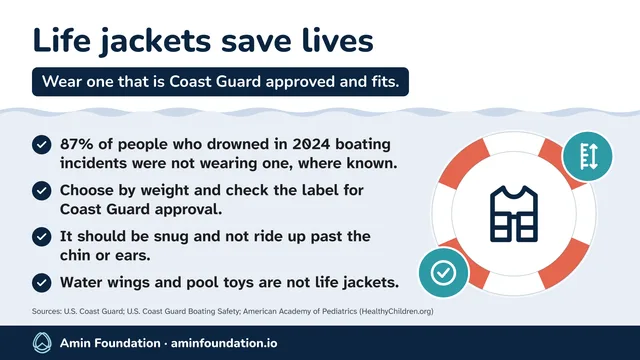
Life jackets work, but only when people wear them and they fit. Where life jacket use was known, the U.S. Coast Guard found that 87% of people who drowned in 2024 boating incidents were not wearing one (opens in a new tab). At U.S. Army Corps of Engineers lakes and rivers in 2024, 91% of people who drowned were not wearing life jackets (opens in a new tab). The CDC (opens in a new tab) says life jackets reduce the risk of drowning while boating for people of all ages and swimming abilities.

Size: buy for the weight, not to grow into

Life jackets are sized by weight. The U.S. Coast Guard's life jacket wear page (opens in a new tab) lists these size categories for newer labels:

Size User weight
Infant 33 lb (15 kg) or less
Child over 33 lb, up to 55 lb
Youth over 55 lb, up to 88 lb
Adult over 88 lb

Always go by the weight range (and chest size) printed on the label. Water Safety USA (opens in a new tab) says not to buy a life jacket for a child to "grow into," and that infants and young children need a collar that supports the head and a strap between the legs.

Style and label level

  • Foam or inflatable? The Coast Guard says inflatable life jackets are not appropriate for weak swimmers or non-swimmers. The National Safe Boating Council adds that inflatables only count toward boat requirements for people over 16, and are generally meant for people over 80 lb, so children need a foam (inherently buoyant) or hybrid jacket (opens in a new tab) in their size range.
  • Level numbers. Newer labels show a performance Level (50, 70, 100, 150 or 275): the number is the minimum buoyancy in newtons. The Coast Guard describes Level 50 for competent swimmers near the shore, Level 70 for people with help close at hand, Level 100 for people who may have to wait for rescue in sheltered water, Level 150 for general use or foul-weather clothing, and Level 275 for offshore use in extreme conditions. Older jackets show a Type (I to V) instead.

The rules for kids on boats

Federal law requires children under 13 to wear a Coast Guard-approved life jacket on a moving boat, except below deck or in an enclosed cabin. Your state may have its own rule. The American Academy of Pediatrics also says children and anyone without strong swim skills should wear a life jacket in, on or near lakes and rivers, and at pools and water parks (opens in a new tab). Water wings and inflatable toys are toys, not safety devices.

How this tool works

Enter the wearer's weight, age, swimming ability and what they'll be doing. The tool shows the size range to look for, foam or inflatable, the label levels that match the trip, any rule that applies, and a fit check: zip and buckle it, raise both arms while a helper pulls up gently on the arm openings, and make sure it doesn't ride up over the chin or ears. The Coast Guard says to try it on in the water and to test it for wear and buoyancy at least once a year. Nothing you enter leaves this device.
Read more in how to choose the right life jacket, the life jacket fit test and life jackets for babies and children.

What you can do today

  1. Weigh each child and check the label on their life jacket.
  2. Do the fit test before your next trip, in shallow water with a helper.
  3. Put a life jacket on every child for the whole boat ride, and wear yours too.

Printables, infographics and games

Printable

Does Your Life Jacket Fit?

A poster of the life jacket fit check: Coast Guard label, right weight, buckled, arms up, lift at the shoulders, plus rules for children and inflatables.

Printable

Boating Safety Checklist

A one-page checklist before you leave the dock: a life jacket that fits for everyone, kids under 13, a float plan, the weather, cold water and no alcohol.

Infographic

Life jackets save lives

Wear one that is Coast Guard approved and fits.

Kids’ game

Life Jacket Fit Check

Pick a life jacket that fits and do the fit test.

More tools: beaches, lakes, boats and cold water

Sources

  1. Recreational Boating Statistics 2024 (opens in a new tab) U.S. Coast Guard
  2. As temps rise, officials implore recreators to wear simple life-saving device (opens in a new tab) U.S. Army Corps of Engineers (via DVIDS)
  3. Preventing Drowning (opens in a new tab) CDC
  4. Life Jacket Wear / Wearing Your Life Jacket (opens in a new tab) U.S. Coast Guard Boating Safety
  5. Life Jackets Save Lives (opens in a new tab) Water Safety USA
  6. Frequently Asked Questions (opens in a new tab) National Safe Boating Council
  7. Drowning Prevention for Curious Toddlers (opens in a new tab) American Academy of Pediatrics (HealthyChildren.org)

Updated