
Rip Currents: How to Spot One and How to Escape
What a rip current is, how to spot one from the sand, and what to do if one pulls you out, in the words of the National Weather Service and NOAA.
Key takeaways
- A rip current is a narrow, fast channel of water flowing away from the beach. It pulls you out, not under.
- If you're caught, relax and float. Don't swim against it. Swim out of it along the shoreline, then angle back to the beach.
- Look for a darker gap between breaking waves, choppy water heading out, or foam and seaweed moving out to sea.
- Rip currents often form on calm, sunny days. Check the beach forecast and swim near a lifeguard.
A rip current is a narrow, fast channel of water that flows away from the beach. If one catches you, relax and float, don't fight it, and swim out of it along the shoreline before you angle back to shore.
Rip currents are the biggest danger at most surf beaches, but they are also something you can learn to spot and escape. This guide uses the words of the National Weather Service (NWS) and NOAA, the federal agencies that study and forecast them.
About 100
80%
What a rip current is
NOAA describes rip currents as powerful, narrow channels of fast-moving water (opens in a new tab) found along the East, Gulf and West coasts and the Great Lakes. The NWS calls them "rivers of the sea" and says they are found on almost any beach with breaking waves (opens in a new tab).
Here is what makes them dangerous:
- They are fast. The NWS says channel rip currents usually flow about 1 to 2 feet per second and may reach speeds up to 8 feet per second (opens in a new tab). NOAA says that can be faster than an Olympic swimmer (opens in a new tab).
- They surge. When a set of bigger waves breaks, the NWS says the speed of the flow can more than double (opens in a new tab) for 30 seconds to a minute. Waders can lose their footing and get carried out. These "rip pulses" are often how people get into trouble.
- They form near structures. The NWS says rip currents commonly form around breaks in sandbars and near inlets, jetties and piers (opens in a new tab), where they are more intense. Learn more in why swimming near jetties and piers is risky.
Rip currents pull you out, not under
This is the most important fact to remember. The NWS says plainly: rip currents pull you away from the shore, they don't pull you under the water (opens in a new tab). The feeling of being dragged down usually comes from a combination of panic, exhaustion, and being hit by breaking waves (opens in a new tab).
Two terms cause confusion:
- Rip tide is not the same thing. NOAA says a rip tide is a specific type of current associated with the swift movement of tidal water through inlets (opens in a new tab) and the mouths of bays and harbors.
- Undertow is a slower flow near the bottom. The NWS says undertow and rip currents are separate phenomena and neither will pull a person under the water (opens in a new tab).
How to spot one from the sand
Rip currents can be hard to see, especially for visitors. The NWS Tallahassee office lists three signs:
- Color: the water is often darker in a rip current (opens in a new tab).
- Texture: rip currents are often found where waves are not breaking. A flat gap between breaking waves can be a rip current flowing out to sea.
- Movement: look for a line of foam, seaweed, or debris moving away from the beach (opens in a new tab).
The NWS rip current scientists add some practical tips:
Not every rip current shows these signs. The NWS says some "flash" rip currents last for several minutes (opens in a new tab) and can form on straight, featureless beaches. If you can't tell, don't go in where you're unsure. The NWS puts it simply: if in doubt, don't go out (opens in a new tab).
Interactive tool
Rip current trainer
Learn to spot a rip current, put the National Weather Service escape steps in order, and practise how to help someone safely from the shore.
If you're caught: relax, float, swim sideways, signal
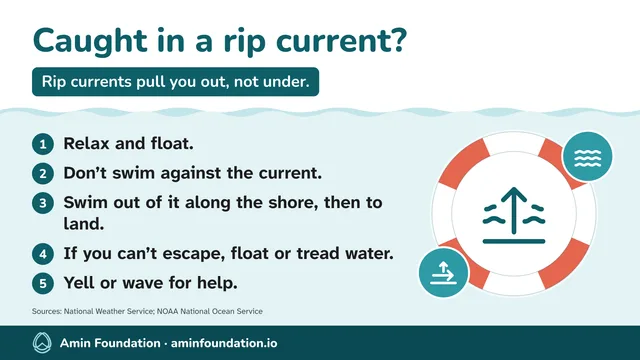
The NWS gives five steps for anyone caught in a rip current:
- Relax. Rip currents don't pull you under (opens in a new tab).
- Don't swim against the current. NOAA warns that people who try to counter a rip current by swimming straight back to shore (opens in a new tab) put themselves at risk of drowning from tiredness.
- Swim out of the current, then to shore. The NWS says to swim out of the current in a direction following the shoreline, or toward breaking waves, then at an angle towards the beach (opens in a new tab).
- If you can't escape, float or tread water. Floating saves your energy. The NWS Tallahassee office says: not a skilled swimmer? Relax and flip on your back to float (opens in a new tab).
- If you need help, yell or wave. Get the attention of lifeguards and people on shore.
A short way to remember it, from the NWS Tallahassee office: stay calm, wave, yell and float.
These steps work best if you have practiced floating and treading water before you need them. The NWS says learning how to swim is the best defense against drowning (opens in a new tab), and that a pool is not the same as a surf beach with crashing waves, wind and currents. Build the skills in water competency lessons first.
Rip currents form on calm days too
Nice weather can fool you. The NWS warns that rip currents often form on calm, sunny days (opens in a new tab), and that great beach weather does not always mean it is safe to swim, or even to play in the shallows.
Two more things the NWS wants beachgoers to know:
- Distant storms matter. Hurricanes that are far away can still create deadly rip currents and waves (opens in a new tab), even when the sky is clear where you are.
- Waves don't need to be huge. The NWS Tallahassee office says waves do not need to be huge for rip currents to form (opens in a new tab).
The tide matters too. On beaches with a tide range under 6 feet, the NWS says rip currents often flow faster about an hour or two on either side of low tide (opens in a new tab). Whether the tide is going out or coming in doesn't change their strength, only the water level does.
Check the forecast and talk to the lifeguard
Many NWS coastal offices issue a surf zone forecast that includes the rip current risk. Before you leave home:
- Check the NWS beach forecast (opens in a new tab). It shows the rip current risk for many beaches.
- Know the three risk levels. The NWS says a low risk still means life threatening rip currents often occur in the vicinity of groins, jetties, reefs, and piers (opens in a new tab). Moderate means they are possible. High means life threatening rip currents are likely in the surf zone (opens in a new tab). On a high-risk day, stay out of the water.
- Read the flags and signs. See what each beach warning flag means.
When you arrive, the NWS says to ask the lifeguard about rip currents and other potentially dangerous water conditions (opens in a new tab) expected that day. Then swim where they are watching. The NWS says to only swim at a beach with lifeguards (opens in a new tab). Read why swimming near a lifeguard matters.
The Red Cross adds one more rule: stay at least 100 feet away from piers and jetties (opens in a new tab), because permanent rip currents often exist near them.
If someone else is caught
Never swim out to save someone without something that floats. The NWS says many people have died trying to rescue someone caught in a rip current (opens in a new tab). Get a lifeguard, call 911 if there isn't one, tell the person to swim along the shoreline, and throw them something that floats. The full steps are in how to help someone caught in a rip current.
What you can do today
- Practice the escape with the Rip current trainer tool, and let kids try the Rip Current Escape game.
- Print the Rip Current Safety for your beach bag, your fridge or your classroom.
- Bookmark the NWS beach forecast (opens in a new tab) and check it the morning of every beach trip.
- Plan to swim only at a guarded beach. If you live in or near New York City, see NYC beach safety for lifeguard hours and rules.
- Practice floating in a pool this week, so "relax and float" feels natural if you ever need it.
Common questions
Do rip currents pull you under the water?
No. The National Weather Service says rip currents pull you away from shore, not under. The feeling of being pulled under usually comes from panic, tiredness and being hit by waves. Undertow, a slower flow along the bottom, doesn't pull people under either.
How fast can a rip current move?
The National Weather Service says channel rip currents usually flow about 1 to 2 feet per second, and can reach 8 feet per second. NOAA says that is faster than an Olympic swimmer. Speeds can also jump suddenly when a set of bigger waves arrives.
Is a rip current the same as a rip tide?
No. NOAA explains that a rip tide is a strong tidal current that moves through inlets and the mouths of bays and harbors. Rip currents are driven by breaking waves and can form on almost any beach with surf, including the Great Lakes.
When are rip currents most likely?
Any time there are breaking waves. On many ocean beaches, the National Weather Service says rip currents often flow faster an hour or two either side of low tide. Distant hurricanes can also send waves that create rip currents on sunny days. Check the beach forecast before you go.
How many people die in rip currents?
NOAA estimates about 100 people are killed by rip currents in the United States each year. Lifeguards rescue tens of thousands more.
Tools and printables for this guide
Interactive tool
Rip current trainer
Learn to spot a rip current, put the National Weather Service escape steps in order, and practise how to help someone safely from the shore.
Printable
Rip Current Safety
A poster on rip currents from National Weather Service advice: how to spot one, how to escape (relax, float, swim along the shore), and how to help someone.
Sources
- What is a rip current? (opens in a new tab) NOAA National Ocean Service
- How to Avoid Getting Caught in a Rip Current (opens in a new tab) National Weather Service
- Rip Current Science (opens in a new tab) National Weather Service
- Rip current safety ahead of the July 4th weekend (opens in a new tab) National Weather Service
- Social Media: Rip Currents & Beach Hazards (opens in a new tab) National Weather Service
- Rip Current Awareness (opens in a new tab) National Weather Service Tallahassee
- NWS Offices Issuing Surf Zone Forecasts (opens in a new tab) National Weather Service
- Beach Forecasts (opens in a new tab) National Weather Service
- Beach and Ocean Safety (opens in a new tab) American Red Cross
- Know BEFORE you go in the water! (opens in a new tab) National Weather Service
More in Beach and Ocean Safety
Beach Safety Checklist for Families
A family beach day checklist: check the forecast, choose a guarded beach, pick a meeting spot, name a Water Watcher, pack life jackets, and know what to do.
Shore Break, Big Waves and Sandbars: Hidden Beach Hazards
Beyond rip currents: how shore break causes neck injuries, why waders get knocked over, what sandbars really do, and how to bodyboard or try surfing safely.
Teaching Kids About Ocean Safety
Simple beach rules kids can remember, flags, lifeguards and rip currents explained in kid language, a float-and-wave practice, and free games and lessons.