
Pool Rescue Equipment: Reaching Poles, Ring Buoys and a Phone
The rescue gear every home or community pool needs: a reaching pole, ring buoy, phone, life jackets and first aid kit, where to keep it, and how to use it.
Key takeaways
- Every pool should have a reaching pole and a ring buoy or other throwable float within easy reach, plus a phone and the address posted for 911.
- Add Coast Guard-approved life jackets in the right sizes and a first aid kit.
- Keep the gear in the open by the pool, never locked away, and check it each season.
- Use it the Red Cross way: reach or throw, don't go.
- Gear works best with people trained in CPR and water rescue.
Every home or community pool should have a reaching pole, a ring buoy or other throwable float, a phone, and the address posted for 911, all within reach of the water. Add life jackets in the right sizes and a first aid kit, and make sure the adults around the pool know how to use them and know CPR.
Rescue gear is the last layer of protection. You hope never to need it. When you do, it has to be right there.
Gear every pool should have
5,900
The U.S. Consumer Product Safety Commission (CPSC) recommends that pool owners have life-saving equipment, such as life rings, floats, or a reaching pole, available and easily accessible (opens in a new tab). The Red Cross list is similar: reaching or throwing equipment, a cell phone, life jackets and a first aid kit (opens in a new tab).
| Item | What it's for |
|---|---|
| Reaching pole, often with a hook on the end | Reaching a person from the edge without getting in |
| Ring buoy or throw bag with rope | Throwing something that floats to a person you can't reach |
| Phone | Calling 911 without leaving the pool |
| Posted address and emergency card | Telling 911 exactly where you are |
| U.S. Coast Guard-approved life jackets | For weak swimmers, in each child's size |
| First aid kit | Cuts, scrapes and other minor injuries |
Name equipment types when you shop, check that floats are designed for rescue rather than play, and follow the maker's instructions.
Where to keep it
- At the water's edge, in plain sight. CPSC says it's important to always be prepared for an emergency by having rescue equipment and a phone near the pool (opens in a new tab).
- Never locked away. A pole in the garage is no help in an emergency.
- Hung, not lying on the deck, where it can't be tripped over, used as a toy or moved.
- Life jackets near the steps, sorted by size.
- Checked every season. Look for cracked poles, frayed rope and faded or split floats. Replace anything damaged.
At community, camp or faith-group pools, assign one person to check the gear before each session.
Posting 911 and your address
When something goes wrong, people forget even their own address.
- Phone by the pool. Pool Safely says to have a phone close by at all times in case you need to call for help (opens in a new tab).
- Address posted. CPSC advises knowing the address of your location so that you can direct emergency personnel to the scene (opens in a new tab). Write it on a waterproof sign by the phone, with the nearest cross street.
- Know when to call. The Red Cross says to know how and when to call 9-1-1 or the local emergency number (opens in a new tab).
Print the Water Emergency Action Plan and fill in your address and who does what.
Emergency
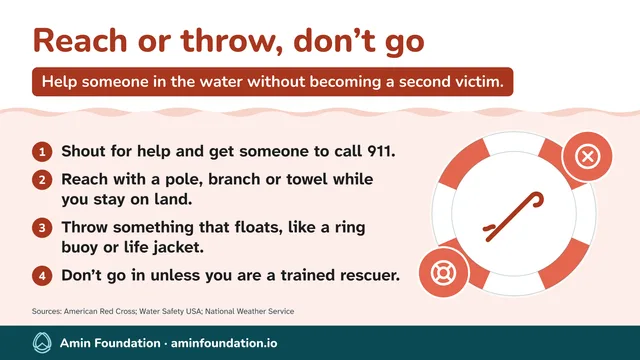
Call 911 for any water emergency, or have someone else call while you help. If a child is missing, check the pool first. To help a person in the water, reach with a pole or throw a float from the edge. Don't go in after them.
Practice: reach, throw, don't go
The Red Cross teaches "reach or throw, don't go" (opens in a new tab) as a safe way to help a drowning person. Water Safety USA describes safe, simple rescue as reaching and throwing a flotation aid from the water's edge without entering the water (opens in a new tab).
Practice before you need it:
- Reach: take the pole off its hooks and hold it out to a swimmer standing in shallow water.
- Throw: throw the ring buoy so it lands near a target, then pull it in by the rope.
- Call: practice saying your address and "a child is in the water" out loud.
Our guides to reach, throw, don't go and how to throw a ring buoy explain each step. Hang the Reach or Throw, Don't Go by the gear.
Training matters as much as gear
Equipment helps only if someone can act. The National Drowning Prevention Alliance says emergency preparation means CPR training with rescue breaths and basic water rescue skills, and having a phone available and ready to call 911 (opens in a new tab).
- Learn CPR. Pool Safely notes that bystanders are often the first to aid a drowning victim, so learning CPR can help save a life (opens in a new tab). Red Cross CPR certification lasts 2 years (opens in a new tab), so put a renewal date in your calendar. Find a class in where to learn CPR.
- Teach older children what to do. The AAP says older children also should learn what to do if they see someone else in the water who is struggling, and how to get help (opens in a new tab).
- We don't print CPR steps. A hands-on class is the right way to learn them.
What you can do today
- Check what you have. Is there a reaching pole and a ring buoy at your pool right now?
- Hang it where everyone can see it, and show every adult and older child.
- Post your address by the phone, and fill in the Water Emergency Action Plan.
- Book a CPR class for at least one adult in your home.
- Work through every other layer with the home pool safety checklist and the Pool barrier check. Hosting soon? See how to host a safe pool party.
Common questions
What safety equipment should be by a home pool?
CPSC recommends life-saving equipment such as life rings, floats or a reaching pole, available and easily accessible. The Red Cross adds a cell phone, life jackets and a first aid kit. Post your address by the phone so anyone can tell 911 where you are.
Where should I keep pool rescue equipment?
In plain sight at the pool's edge, where any adult can grab it in seconds. Don't store it in a shed or garage. Make sure every adult and older child knows where it is.
Should I jump in to save someone in a pool?
Call 911 or have someone call, then reach or throw. The Red Cross teaches reach or throw, don't go: reach with a pole or throw a float from the edge, so you don't become a second person in trouble. CPR and water rescue classes teach what to do next.
Tools and printables for this guide
Interactive tool
Pool barrier check
Check your pool fence and gate against the CPSC barrier guidelines: height, gaps, latches, door alarms and covers. Get a printable list of what to fix.
Printable
Reach or Throw, Don't Go
A poster of the safe way to help someone in trouble in the water: shout and call 911, reach from solid ground, throw something that floats, and don't go in.
Printable
Water Emergency Action Plan
A fill-in emergency plan for a home pool, lake house, camp or event: the address for 911, who calls, where the rescue gear is, and the first steps in order.
Printable
Pool Safety Checklist
A one-page checklist for pool and hot tub owners: four-sided fencing, self-latching gates, alarms, covers, drains, Water Watchers and rescue gear.
Sources
- Pool or Spa Submersion: Estimated Nonfatal Drowning Injuries and Reported Drownings, 2026 Report (opens in a new tab) U.S. Consumer Product Safety Commission, 2026
- Safety Barrier Guidelines for Residential Pools (Publication 362) (opens in a new tab) U.S. Consumer Product Safety Commission, 2023
- Swimming Safety (opens in a new tab) American Red Cross
- Water Safety (opens in a new tab) American Red Cross
- In-Home Drowning (Safety Education Center) (opens in a new tab) U.S. Consumer Product Safety Commission
- Water Competency (opens in a new tab) Water Safety USA
- Layers of Protection (opens in a new tab) National Drowning Prevention Alliance
- Safety Tips (opens in a new tab) Pool Safely (CPSC)
- CPR Training & Certification (opens in a new tab) American Red Cross
- Swim Lessons for Children: When to Start & What to Consider (opens in a new tab) American Academy of Pediatrics (HealthyChildren.org), 2026
More in Pool and Hot Tub Safety
Above-Ground Pool Safety: Ladders, Barriers and Rules
Secure an above-ground pool: remove or lock the ladder, clear anything a child can climb, add a barrier, check for recalled strap models, and never dive in.
Hot Tub and Spa Safety for Kids and Adults
Use a hot tub or spa safely: lock the cover after every use, keep children under 5 out, stay at 104°F or below, avoid alcohol, and keep away from drains.
Inflatable and Portable Pool Safety
Kiddie, inflatable and portable pools can drown a toddler. Empty small pools after every use, fence larger ones, and watch every minute of splash time.