
Drowning Emergencies and Rescue
Drowning Myths vs. Facts
Do drowning people yell for help? Can you drown in shallow water? Common drowning myths, each answered with facts from the CDC, AAP, Red Cross and CPSC.
Key takeaways
- Drowning is usually quiet. People in trouble often can't shout or wave.
- Good swimmers drown too, especially in lakes, rivers, the ocean and cold water, and after drinking alcohol.
- Floaties and pool noodles are toys, not safety devices. Use a properly fitted Coast Guard-approved life jacket.
- Swim lessons lower risk but never make a child 'drown proof'. Children still need close, constant supervision, even with a lifeguard.
- A young child can drown in 1 or 2 inches of water, often when nobody expected them to be near it.
Emergency
Call 911 if someone is in trouble in the water, then reach or throw something that floats. Don't go in after them.
Many common beliefs about drowning are wrong, and some of them cost lives. The biggest myth is that you would hear it: in fact, drowning happens in seconds and is often silent (opens in a new tab), according to the CDC. Below, each myth is answered with facts from official sources, so you can share them with confidence.
Test yourself first, or after reading:
Interactive tool
Drowning myths quiz
Myth or fact? Test 14 common beliefs about drowning, from floaties to dry drowning, with every answer checked against official sources.
Myth: You'd hear someone drowning
Fact: Drowning is usually quick and quiet. The CPSC says children often slip under the water silently (opens in a new tab), and even people near or in the pool have reported hearing nothing unusual. A retired Coast Guard rescue swimmer explains on army.mil (opens in a new tab) that, except in rare cases, people who are drowning are physically unable to call out for help, and can't wave either.
What to do instead: watch, don't listen. See what drowning really looks like.
Myth: Good swimmers don't drown
Fact: Swimming skill helps, but it doesn't make anyone safe in every situation.
- The AAP says teens are at higher risk because they may overestimate their swimming skills, misjudge hazards or take impulsive risks (opens in a new tab).
- Water Safety USA reports that almost half of 10- to 17-year-olds who drowned could swim (opens in a new tab) (child death review data, 2005-2014).
- At U.S. Army Corps of Engineers lakes and rivers in 2024, 91% of people who drowned were not wearing life jackets and 87% were adults (opens in a new tab).
- Cold water can cause gasping and rapid breathing (opens in a new tab) in the first minutes, which can lead to drowning even in strong swimmers.
Myth: Floaties keep kids safe
Fact: Air-filled and foam toys are not safety devices. The CDC says do not rely on air-filled or foam toys (opens in a new tab), and the AAP warns that floaties, water wings and inflatable toys can deflate and do not prevent drowning (opens in a new tab).
What to do instead: use a properly fitted, U.S. Coast Guard-approved life jacket. The Coast Guard notes that adult-size life jackets may not work for children (opens in a new tab), so choose a child size. For young children and weak swimmers, the AAP recommends an adult who can swim stay within arm's length. See water wings, floaties and swim vests.
Myth: Lifeguards mean I can relax
Fact: Lifeguards can't see everything. Pool Safely says parents should still act as Water Watchers when a lifeguard is on duty (opens in a new tab), because lifeguards may not see the whole pool. The Red Cross agrees: even if lifeguards are present (opens in a new tab), you or another responsible adult should stay with your children.
Lifeguards still matter a great deal. At the beach, the National Weather Service says to swim only at a beach with lifeguards (opens in a new tab). Use both: a lifeguard and your own eyes.
Myth: It takes deep water
Fact: A young child can drown in very little water. The CPSC says a child can drown in as little as 2 inches of water (opens in a new tab), and the AAP says babies can drown in 1 or 2 inches (opens in a new tab), silently and within seconds. Bathtubs, buckets, toilets and small inflatable pools all count. The CPSC estimates nearly 90 children drown inside the home every year, two-thirds of them in bathtubs.
Myth: Swim lessons make a child "drown proof"
Fact: Lessons lower risk, but they don't remove it. The CDC says formal swimming lessons can reduce the risk of drowning, but children who have had lessons still need close and constant supervision (opens in a new tab). The AAP calls lessons one layer of protection (opens in a new tab), alongside supervision, barriers and life jackets. See what the research says about swim lessons.
Myth: You only need to watch kids at swim time
Fact: Most young children who drown weren't expected to be near water. The AAP reports that 69% of drownings of children 4 and younger happened during non-swim times (opens in a new tab). Locked doors, fences around pools and emptied buckets matter most when nobody is swimming. See drowning when nobody is swimming.
69%
More myths, quickly
| Myth | Fact |
|---|---|
| "If someone is drowning, jump in and save them." | Call 911 and reach or throw something that floats. The National Weather Service warns that many people have died trying to rescue someone (opens in a new tab). See Reach or Throw, Don't Go: How to Help Someone Who Is Drowning. |
| "If a child is missing, search the house first." | The Red Cross says check the water first (opens in a new tab). The CPSC says most children who drowned in pools or spas had been missing for 5 minutes or less. |
| "Hands-only CPR is all a drowning victim needs." | Drowning is a breathing emergency. AHA/AAP guidance says resuscitation must focus on restoring breathing as much as circulation (opens in a new tab). Take a course that teaches rescue breaths. |
| "A little alcohol around water is harmless." | The CDC says alcohol is involved in up to 70% of deaths linked to water recreation (opens in a new tab) among teens and adults, and the Coast Guard lists it as the leading known factor in fatal boating incidents (opens in a new tab) (2024). |
| "Holding your breath underwater for as long as possible is a fun game." | The CDC says don't hyperventilate before swimming underwater or hold your breath for long periods (opens in a new tab). |
| "A rip current pulls you under." | Rip currents pull you away from shore, not under (opens in a new tab). Relax and float, then swim out of the current along the shore. See Rip Currents: How to Spot One and How to Escape. |
| "My child can 'dry drown' days after swimming." | These aren't medical terms, and drowning symptoms start right away. See 'Dry Drowning' and 'Secondary Drowning': What Parents Need to Know. |
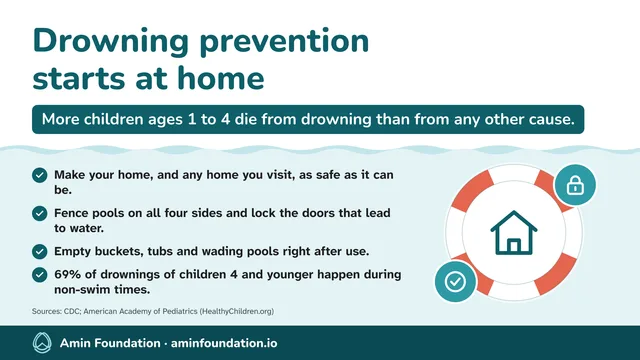
Infographic
Drowning prevention starts at home
More children ages 1 to 4 die from drowning than from any other cause.
Why myths matter
Myths aren't harmless. If you expect drowning to be loud, you may look away at the wrong moment. If you think floaties work, you may step back when you should stay within reach. Getting the facts right is one of the simplest things a family can do.
What you can do today
Common questions
Can you drown in shallow water?
Yes. The CPSC says a child can drown in as little as 2 inches of water, and the AAP says babies can drown in 1 or 2 inches, silently and within seconds. Bathtubs, buckets and toilets are real drowning hazards for young children.
Do drowning people splash and yell for help?
Usually not. The CDC says drowning happens in seconds and is often silent. A person who is drowning is usually physically unable to call out or wave, because their body is focused on breathing.
Do lifeguards mean parents can relax?
No. Pool Safely says parents should still act as Water Watchers when a lifeguard is on duty, because lifeguards may not see the whole pool. Lifeguards are an important layer of protection, but they work best alongside your own close attention.
Tools and printables for this guide
Interactive tool
Drowning myths quiz
Myth or fact? Test 14 common beliefs about drowning, from floaties to dry drowning, with every answer checked against official sources.
Infographic
Drowning prevention starts at home
More children ages 1 to 4 die from drowning than from any other cause.
Sources
- Preventing Drowning (opens in a new tab) CDC
- In-Home Drowning (Safety Education Center) (opens in a new tab) U.S. Consumer Product Safety Commission
- Drowning Doesn't Look Like Drowning (opens in a new tab) U.S. Army (army.mil), by retired USCG rescue swimmer Mario Vittone
- Drowning Prevention for Curious Toddlers: What Parents Need to Know (opens in a new tab) American Academy of Pediatrics (HealthyChildren.org)
- Infant Drowning Prevention & Water Safety: How to Protect Your Baby (opens in a new tab) American Academy of Pediatrics (HealthyChildren.org)
- AAP Releases Updated Drowning Prevention Recommendations (opens in a new tab) American Academy of Pediatrics (HealthyChildren.org)
- Swim Lessons for Children: When to Start & What to Consider (opens in a new tab) American Academy of Pediatrics (HealthyChildren.org)
- Safety Tips (opens in a new tab) Pool Safely (CPSC)
- Life Jacket Wear / Wearing Your Life Jacket (opens in a new tab) U.S. Coast Guard Boating Safety
- Life Jackets Save Lives (opens in a new tab) Water Safety USA
- As temps rise, officials implore recreators wear simple life-saving device (opens in a new tab) U.S. Army Corps of Engineers via DVIDS
- Risk Factors for Drowning (opens in a new tab) CDC
- Water Safety (opens in a new tab) American Red Cross
- Social Media: Rip Currents & Beach Hazards (opens in a new tab) National Weather Service
- 2024 American Heart Association and American Academy of Pediatrics Focused Update on Special Circumstances: Resuscitation Following Drowning (opens in a new tab) American Heart Association and American Academy of Pediatrics (Circulation 2024)
- Recreational Boating Statistics 2024 (opens in a new tab) U.S. Coast Guard
- Cold Water Hazards and Safety (opens in a new tab) National Weather Service
- Rip current safety ahead of the July 4th weekend (opens in a new tab) National Weather Service
More in Drowning Emergencies and Rescue
Reach or Throw, Don't Go: How to Help Someone Who Is Drowning
How to help a drowning person without becoming a second victim: call 911, reach with a pole or rope, throw something that floats, and don't go in.
How to Throw a Ring Buoy or Throw Bag
How to use rescue equipment at pools, docks and beaches: throw bags, ring buoys and reaching poles, what to throw if there's none, and pulling someone in.
Drowning Emergency: What to Do in the First Minutes
What to do in a drowning emergency: call 911, get the person out without going in, start CPR if trained, and get medical care for anyone who had trouble.