
Do Swim Lessons Prevent Drowning? What the Research Says
Swim lessons lower drowning risk but don't make anyone drown proof. What the research shows, why good swimmers still drown, and the other layers that protect.
Key takeaways
- Swim lessons reduce drowning risk, but they don't prevent drowning on their own. CDC says children who have had lessons still need close, constant supervision.
- A 2009 NIH-led study linked formal lessons to an 88% lower drowning risk for children ages 1 to 4, but the estimate was imprecise (anywhere from 3% to 99%).
- The AAP says lessons don't make kids drown proof, and there's no evidence infant programs under age 1 lower risk.
- Good swimmers drown too. Almost half of 10- to 17-year-olds who drowned in 2005-2014 could swim, where swimming ability was known.
- Use lessons together with the other layers: supervision, barriers, life jackets and emergency preparation.
Swim lessons lower the risk of drowning, but they don't prevent it on their own. Research links formal lessons to lower drowning risk in young children, yet the American Academy of Pediatrics (AAP) is clear that lessons don't make anyone "drown proof," so supervision, barriers and life jackets are still needed.
That's not a reason to skip lessons. It's a reason to treat them as one strong layer of protection among several.
What the evidence shows
Lessons help. CDC says formal swimming lessons can reduce the risk of drowning (opens in a new tab). The AAP says studies suggest that water competency and survival skills training through swim lessons can help reduce drowning risk for children ages 1 to 4, and its 2026 policy recommends beginning swimming classes after a child's first birthday (opens in a new tab).
The best-known study. Researchers led by the National Institute of Child Health and Human Development (part of NIH) compared children who drowned with similar children who didn't. They found that formal swimming lessons were associated with an 88% reduction in drowning risk for children ages 1 to 4 (opens in a new tab) (published 2009). Three things matter when you read that number:
- It was imprecise. The true reduction could have been anywhere from 3% to 99%.
- The result for older children wasn't statistically significant. For ages 5 to 19, fewer children who drowned had taken lessons, but the difference could have been due to chance.
- The authors themselves warned that lessons alone will not prevent drowning and that "even the most proficient swimmers can drown." They recommended lessons together with adult supervision and pool fencing.
Worldwide, basic swim skills are a proven strategy. The World Health Organization estimates that investing in day care for preschool children and teaching children basic swim skills would mean 774,000 fewer child drowning deaths (opens in a new tab) between now and 2050.
Not for babies. The AAP says there is currently no evidence that infant swim programs for babies under 1 (opens in a new tab) lower their drowning risk. See swim classes for babies.
Why no child is "drown proof"
The AAP says it plainly: "swim lessons don't make kids 'drown proof.'" (opens in a new tab) There are a few reasons.
- Finishing lessons isn't the same as being competent. Water Safety USA notes that people who complete entry-level swim lessons, particularly young children, may still not have the skills (opens in a new tab) for water competency.
- Young children drown when nobody expects them in the water. The AAP reports that 69% of drownings in children 4 and younger (opens in a new tab) happened during non-swim times. That's when fences, locked doors and other barriers matter most.
- Real emergencies are harder than lessons. That's why the AAP says lessons should include realistic conditions, such as falling in and swimming in clothes.
Good swimmers drown too
Being a strong swimmer helps, but it isn't protection on its own.
Almost half
- People overestimate their skills. In a 2020 Red Cross survey, 85% of Americans said they could swim, but only 56% of those self-described swimmers (opens in a new tab) could do all five basic water safety skills. The AAP says teens in particular may overestimate their swimming skills and misjudge hazards.
- Cold water. During cold shock, swimming even 6 to 10 feet is often impossible (opens in a new tab), even for good swimmers, according to the National Center for Cold Water Safety.
- Alcohol. Among teens and adults, alcohol is involved in up to 70% of deaths (opens in a new tab) linked to water recreation, CDC says.
- Breath-holding. CDC warns that hyperventilating or holding your breath underwater for long periods can make you pass out and drown (opens in a new tab).
- Open water. The Red Cross reminds swimmers to adjust for river currents, ocean rip currents, water temperature and shallow or unclear water (opens in a new tab), none of which a calm pool teaches.
For older kids who already swim well, see supervising confident swimmers.
Skills plus layers of protection
The National Drowning Prevention Alliance describes five layers of protection (opens in a new tab) and says no single layer prevents every drowning:
- Barriers and alarms, such as the four-sided pool fencing the Red Cross recommends
- Supervision by a sober, focused adult, with touch supervision for young children and weak swimmers
- Water competency, which is where lessons come in
- Life jackets: the Red Cross says children, inexperienced swimmers and all boaters should wear Coast Guard-approved life jackets
- Emergency preparation, including learning CPR and knowing to reach or throw, not go
The AAP's 2026 policy makes the same point, calling for "close, constant, attentive and capable adult supervision and early swim lessons" as part of multiple layers of prevention. Check your own setup with the pool safety checklist.
Myths to drop
| Myth | Fact |
|---|---|
| "Once my child has had lessons, they're drown proof." | Lessons lower risk but don't remove it. Children who have had lessons still need close, constant supervision. |
| "Babies should start lessons before age 1 to be safe." | The AAP says there's no evidence infant programs under 1 lower drowning risk. |
| "Strong swimmers don't need life jackets." | In 2024, where life jacket use was known, 87% of people who drowned in boating incidents (opens in a new tab) weren't wearing one (U.S. Coast Guard). Wear one on every boat trip, whatever your skill. |
| "A lifeguard means I can relax." | Pool Safely says parents should still act as water watchers when a lifeguard is on duty (opens in a new tab), because lifeguards may not see the whole pool. |
Test yourself with the myths quiz, and read drowning myths and facts.
Interactive tool
Drowning myths quiz
Myth or fact? Test 14 common beliefs about drowning, from floaties to dry drowning, with every answer checked against official sources.
What you can do today
- If your child is 1 or older and ready, sign them up for lessons. Start with finding swim lessons near you.
- Check which of the five water competency skills each family member has.
- Walk around your home or rental and check the barriers: fences, gates, door locks.
- Pick a water watcher for your next pool day, and keep phones away.
- Sign up for a CPR class.
Common questions
Can swim lessons prevent drowning?
They lower the risk but can't prevent every drowning. CDC says formal swimming lessons can reduce drowning risk, and one NIH-led study linked lessons to much lower risk in children ages 1 to 4. But the AAP says lessons don't make children drown proof, so supervision, fences and life jackets are still needed.
Is my child safe in the water after swim lessons?
Safer, but not safe on their own. Water Safety USA notes that young children who finish beginner lessons may still not be water competent. Keep an adult who can swim within arm's reach of young children and weak swimmers, and watch older children closely and constantly.
Can a good swimmer drown?
Yes. Almost half of 10- to 17-year-olds who drowned in 2005-2014 could swim, where their ability was known. Cold water, currents, alcohol, breath-holding and overconfidence can overwhelm strong swimmers.
What else helps prevent drowning?
Use several layers together. The National Drowning Prevention Alliance lists barriers and alarms, supervision, water competency, life jackets and emergency preparation. It says no single layer prevents every drowning.
Tools and printables for this guide
Interactive tool
Drowning myths quiz
Myth or fact? Test 14 common beliefs about drowning, from floaties to dry drowning, with every answer checked against official sources.
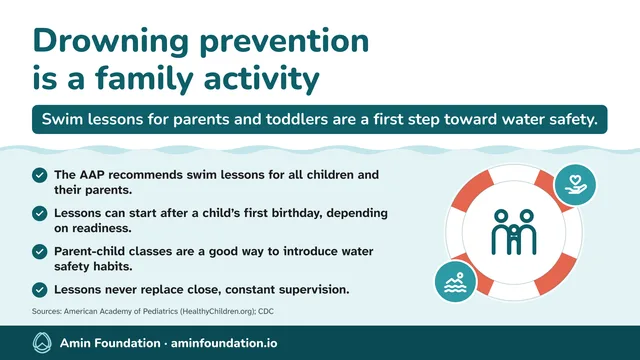
Infographic
Drowning prevention is a family activity
Swim lessons for parents and toddlers are a first step toward water safety.
Sources
- Preventing Drowning (opens in a new tab) CDC
- Association between swimming lessons and drowning in childhood: a case-control study (Arch Pediatr Adolesc Med 2009;163(3):203-210) (opens in a new tab) Brenner RA et al., National Institute of Child Health and Human Development (NIH)
- Swim Lessons for Children: When to Start & What to Consider (opens in a new tab) American Academy of Pediatrics (HealthyChildren.org)
- AAP Releases Updated Drowning Prevention Recommendations (opens in a new tab) American Academy of Pediatrics (HealthyChildren.org)
- Drowning Prevention for Curious Toddlers: What Parents Need to Know (opens in a new tab) American Academy of Pediatrics (HealthyChildren.org)
- Water Competency (opens in a new tab) Water Safety USA
- Life Jackets Save Lives (opens in a new tab) Water Safety USA
- Aquatics Centennial Campaign (opens in a new tab) American Red Cross
- Layers of Protection (opens in a new tab) National Drowning Prevention Alliance
- Drowning (fact sheet) (opens in a new tab) World Health Organization
- Risk Factors for Drowning (opens in a new tab) CDC
- Cold Shock (opens in a new tab) National Center for Cold Water Safety
- Water Safety (opens in a new tab) American Red Cross
- Recreational Boating Statistics 2024 (opens in a new tab) U.S. Coast Guard
- Safety Tips (opens in a new tab) Pool Safely (CPSC)
More in Swimming Lessons
How to Find Swim Lessons Near You, Including Free and Low-Cost Options
Find swim lessons near you for kids or adults with official YMCA, Red Cross, USA Swimming and city parks locators, plus ways to find free or low-cost classes.
Free Swim Lessons in NYC: Parks, Swim for Life and More
Every free and low-cost swim program in New York City we could verify: NYC Parks Learn to Swim, summer pools, school programs, YMCA, adaptive swim and Queens.
How to Choose a Swim Lesson Program: Questions to Ask
What to look for in swim lessons for kids or adults: certified instructors, lifeguards, class size, survival skills and questions to ask before you enroll.