Myth or fact?
Private: what you enter stays on this device.
Without JavaScript, every statement and its answer are listed below.
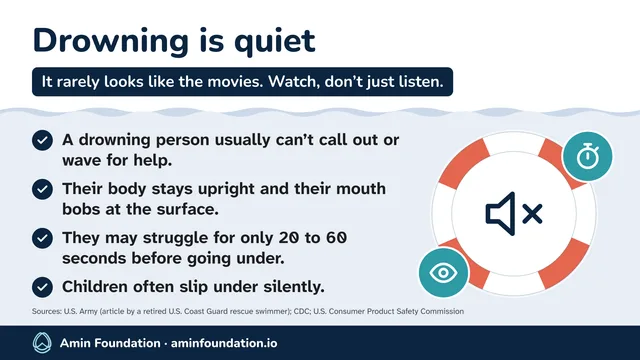
You will hear it if someone is drowning: there will be splashing and shouting.
Myth. Drowning is usually quick and quiet. People in trouble often can’t call out or wave, and children can slip under silently.
Floaties, water wings and pool noodles keep a child safe in the water.
Myth. Air-filled and foam toys are not safety devices. They can deflate or slip off. Use a fitted U.S. Coast Guard-approved life jacket and stay within arm’s reach.
Source: American Academy of Pediatrics, Drowning Prevention for Curious Toddlers (opens in a new tab)
Most young children who drown were not expected to be in the water at the time.
Fact. True. The AAP reports that 69% of drownings of children 4 and younger happened during non-swim times. Barriers and locked doors matter most then.
Source: American Academy of Pediatrics, Drowning Prevention for Curious Toddlers (opens in a new tab)
Swim lessons make a child “drown proof.”
Myth. Lessons lower the risk but do not remove it. Children who have had lessons still need close, constant supervision.
When a lifeguard is on duty, parents can relax.
Myth. Lifeguards may not see the whole pool. A parent or caregiver should still be the Water Watcher.
Source: Pool Safely (CPSC), Safety Tips (opens in a new tab)
A rip current pulls you under the water.
Myth. Rip currents pull you away from shore, not under. Relax and float, then swim out of the current along the shoreline.
Source: National Weather Service, Rip current safety (opens in a new tab)
If a rip current pulls you out, relax and float first, then swim along the shoreline to get out of it.
Fact. True. That is what the National Weather Service teaches. Swimming straight back against the current wears you out.
Source: National Weather Service, Rip current safety (opens in a new tab)
A young child can drown in just an inch or two of water.
Fact. True. Babies can drown in 1 or 2 inches of water, including in buckets, toilets and bathtubs.
Source: American Academy of Pediatrics, Infant Drowning Prevention & Water Safety (opens in a new tab)
Good swimmers don’t need a life jacket on a boat.
Myth. The Red Cross says to wear a Coast Guard-approved life jacket when boating, whatever your swimming skill. Most people who drown in boating incidents were not wearing one.
Source: American Red Cross, Water Safety (opens in a new tab)
“Dry drowning” can strike hours or days after a child seems fine.
Myth. “Dry drowning” and “secondary drowning” are not medical terms. Signs of drowning start right away. Get medical care for a cough that won’t stop, trouble breathing, confusion or unusual tiredness after trouble in the water.
Source: Water Safety USA, Mythical Drowning Terms (opens in a new tab)
If someone is drowning, jump in and pull them out.
Myth. Many people have died trying to rescue someone. Call 911, then reach or throw something that floats. Don’t go in.
Source: American Red Cross, Water Safety (opens in a new tab)
If a child is missing, check the water first.
Fact. True. Seconds count. Check the pool, the bath and any nearby water before you search anywhere else.
Source: American Red Cross, Water Safety (opens in a new tab)
Cold water is only dangerous in winter.
Myth. Cold shock can make you gasp and breathe fast in water as warm as 77°F, and warm air does not mean warm water. Dress for the water and wear a life jacket.
Source: National Weather Service, Cold Water Hazards and Safety (opens in a new tab)
Holding your breath underwater for as long as you can is a safe game.
Myth. Hyperventilating and holding your breath for a long time underwater can make you pass out and drown.