
Free Water Safety Lesson Plans for Schools (K-12)
Free, printable water safety lesson plans for grades K-2, 3-5, 6-8 and 9-12, each one class period long and aligned to National Health Education Standards.
Key takeaways
- We offer four free water safety lesson plans, one for each grade band from kindergarten to grade 12, each designed for a single class period.
- Each plan lists the National Health Education Standards it supports and comes as a printable PDF.
- Younger students learn simple rules: ask first, a grown-up watches, life jackets, and shout for help instead of going in.
- Older students learn about lakes, rip currents, cold water, alcohol, peer pressure and how to help without going in.
- Send learning home with a parent workshop plan, printables and games that collect no data.
We offer four free, printable water safety lesson plans for schools: one each for grades K-2, 3-5, 6-8 and 9-12. Each fits a single class period, includes a warm-up, activities, a short assessment and a take-home piece, and lists the National Health Education Standards (opens in a new tab) it supports. Download the PDF from each lesson's page on our resource library and teach it as written, or adapt it for your class.
Why teach water safety in school
Drowning is one of the leading causes of death for children in the United States. The CDC says more children ages 1 to 4 die from drowning than from any other cause, and for ages 5 to 14 drowning is the second leading cause of unintentional injury death (opens in a new tab), after motor vehicle crashes.
School reaches every child, including those whose families don't swim. The USA Swimming Foundation says that if a parent doesn't know how to swim, there is only a 19% chance that a child in the household will learn (opens in a new tab). A classroom lesson can't teach swimming, but it can teach the rules and habits that keep children alive, and send the message home.
The American Red Cross describes water competency as three parts: water smarts, swimming skills and helping others (opens in a new tab). Our lessons focus on water smarts and helping others, and point families to swim lessons for the rest.
Grades K-2: ask first, a grown-up watches
Young children need a few simple rules they can say out loud. The K-2 lesson teaches four: ask a grown-up first, swim only when a grown-up is watching, wear a life jacket, and shout for a grown-up instead of going in. Children practice asking before going near any water, including bathtubs and buckets, and learn the difference between a life jacket and a water toy.
Lesson plan
Water Safety Lesson Plan for Grades K-2
A free 35-minute water safety lesson for kindergarten to grade 2: ask before going near water, a grown-up watches, life jackets, and shout for help.
Grades 3-5: water smart, swim skills, helping safely
Students in grades 3 to 5 can learn the Red Cross's five water competency skills, why drowning is often quiet, how to check that a life jacket fits, and how to help someone without going in. They also practice what to say on a 911 call. Pair it with our reach or throw, don't go guide and game.
Lesson plan
Water Safety Lesson Plan for Grades 3-5
A free 45-minute lesson for grades 3-5: the five water competency skills, why drowning is quiet, life jacket fit, reach or throw don't go, and how to call 911.
Grades 6-8: lakes, rip currents and choices
Middle schoolers start going to lakes, rivers and beaches with more independence. The CDC says that for children 5 to 14, over 40% of drownings happen in natural water (opens in a new tab). This lesson covers why lakes and oceans aren't pools, how to spot and escape a rip current, cold water shock, and making safe decisions with friends.
Lesson plan
Water Safety Lesson Plan for Grades 6-8
A free 50-minute middle school lesson: why lakes and oceans aren't pools, rip currents, cold water shock, and making safe choices with friends.
Grades 9-12: risk, data and speaking up
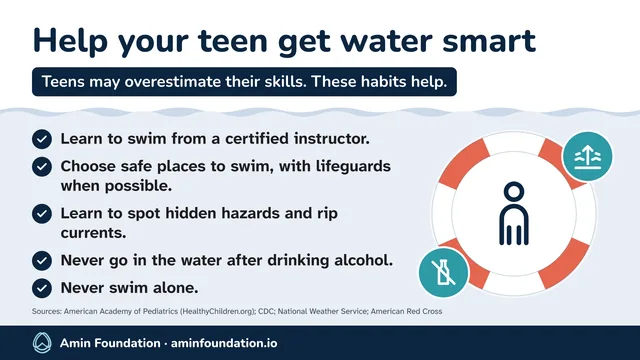
Many teens feel confident in the water, and that can be part of the risk. The AAP says teens may overestimate their swimming skills, misjudge hazards or take impulsive risks (opens in a new tab). The high school lesson uses real CDC and Coast Guard data on alcohol, life jackets and cold water, asks students to judge whether a source is reliable, and ends with each student creating an accurate safety message for their peers. It also explains why CPR with rescue breaths matters and where to learn it; see where to learn CPR.
Lesson plan
Water Safety Lesson Plan for Grades 9-12
A free 50-minute high school lesson: why teens who can swim still drown, alcohol, life jackets and cold water, real data, and a peer safety message.
Other free classroom resources
- American Red Cross Longfellow's WHALE Tales. Nine free water safety lessons (opens in a new tab) for kindergarten through grade 5, for a classroom or other dry-land setting, with lesson plans, videos, posters and activity sheets in English and Spanish. The Red Cross licenses the materials for educational use.
- Red Cross free online courses. The Red Cross offers short free online courses (opens in a new tab), including Water Safety for Parents and Caregivers and Becoming an Ambassador for Water Safety, which teachers can share with families or take themselves.
Games for classroom play
Our kids' games live on a separate site that collects nothing: no accounts, no forms, no ads and no tracking. Progress stays on the device. They work well on a classroom screen or tablets at the end of a lesson.
Bringing families in
Children are great messengers, but parents make the rules at home. To extend the lesson:
- Send home our home water safety checklist and ask families to complete it together.
- Invite families to sign a water safety pledge with their child.
- Host a short parent session at a PTA meeting, open house or family night, using our parent workshop plan.
- Share our guide to talking to kids about water safety without scaring them.
Lesson plan
Water Safety Workshop for Parents and Caregivers
A free 60-minute water safety workshop for parents of young children: home hazards, Water Watchers, pools, swim lessons and the first minutes.
Printable
Home Water Safety Checklist
A one-page, room-by-room checklist to find and fix drowning hazards at home: bathtubs, toilets, buckets, coolers, doors, hot tubs and pools.
Printable
Family Water Safety Pledge
A pledge for kids and grown-ups to read, tick and sign together: ask first, swim with a grown-up watching, wear life jackets, and get help without going in.
When to teach it
Any time works, but two dates give you a reason to make it an event:
- May is National Water Safety Month, just before summer break.
- July 25 is World Drowning Prevention Day, a good fit for summer school and camps.
Our guide to World Drowning Prevention Day and Water Safety Month has ideas for schools.
Teaching tips
- Keep it calm and practical. Focus on what students can do, not on frightening stories.
- Be sensitive to loss. A student in your class may have lost someone to drowning. Let students know they can step out or talk to the school counselor, and give a heads-up to families if you can.
- Watch for students who can't swim. Many won't say so. Share free lesson options with every family, not only those you think need them. See free swim lessons in NYC or how to find swim lessons near you.
What you can do today
Common questions
Are these water safety lesson plans really free?
Yes. All of our lesson plans, printables and games are free to use in classrooms, camps, libraries and community groups. There is nothing to sign up for. The games collect no information about children.
How long is each lesson?
Each is designed for one class period: about 35 minutes for grades K-2, 45 minutes for grades 3-5, and 50 minutes for grades 6-8 and 9-12. Each plan has a warm-up, activities, a short assessment and a take-home piece.
Do the lessons teach swimming?
No. They are classroom lessons about water safety: rules, recognizing danger, helping without going in and calling 911. Learning to swim takes lessons in the water with a trained instructor. Our swim lessons guides explain how to find them.
Tools and printables for this guide
Printable
Family Water Safety Pledge
A pledge for kids and grown-ups to read, tick and sign together: ask first, swim with a grown-up watching, wear life jackets, and get help without going in.
Printable
Home Water Safety Checklist
A one-page, room-by-room checklist to find and fix drowning hazards at home: bathtubs, toilets, buckets, coolers, doors, hot tubs and pools.
Lesson plan
Water Safety Lesson Plan for Grades K-2
A free 35-minute water safety lesson for kindergarten to grade 2: ask before going near water, a grown-up watches, life jackets, and shout for help.
Lesson plan
Water Safety Lesson Plan for Grades 3-5
A free 45-minute lesson for grades 3-5: the five water competency skills, why drowning is quiet, life jacket fit, reach or throw don't go, and how to call 911.
Lesson plan
Water Safety Lesson Plan for Grades 6-8
A free 50-minute middle school lesson: why lakes and oceans aren't pools, rip currents, cold water shock, and making safe choices with friends.
Lesson plan
Water Safety Lesson Plan for Grades 9-12
A free 50-minute high school lesson: why teens who can swim still drown, alcohol, life jackets and cold water, real data, and a peer safety message.
Lesson plan
Water Safety Workshop for Parents and Caregivers
A free 60-minute water safety workshop for parents of young children: home hazards, Water Watchers, pools, swim lessons and the first minutes.
Sources
- Drowning Facts (opens in a new tab) CDC
- Risk Factors for Drowning (opens in a new tab) CDC
- Water Safety (opens in a new tab) American Red Cross
- Longfellow's WHALE Tales (opens in a new tab) American Red Cross
- Swimming + Water Safety classes and free online courses (opens in a new tab) American Red Cross
- New National Health Education Standards (opens in a new tab) SHAPE America
- Saving Lives and Building Champions (opens in a new tab) USA Swimming Foundation
- AAP Releases Updated Drowning Prevention Recommendations (opens in a new tab) American Academy of Pediatrics (HealthyChildren.org)
More in Community Water Safety
Vacation Water Safety: New Places, New Water
Plan a safer family trip near water: check the destination, pack life jackets, name Water Watchers, and learn the risks of lakes, beaches and pools abroad.
Vacation Rental Pool Safety: What to Check Before You Book
Booking a short-term rental with a pool or hot tub? What to ask the host, what to check on arrival, and what to do if the fence, gate or alarms aren't there.
Summer Camp Water Safety: Questions Parents Should Ask
What to ask a camp, day camp or child care program about swimming: swim tests, buddy checks, lifeguards, field trips and staff training, with New York rules.