
World Drowning Prevention Day and Water Safety Month: How to Take Part
World Drowning Prevention Day is July 25 and National Water Safety Month is May. Simple ways for schools, faith groups, families and local leaders to join in.
Key takeaways
- World Drowning Prevention Day is held every year on July 25, after a United Nations General Assembly resolution in April 2021.
- National Water Safety Month is every May in the U.S., coordinated by the Pool & Hot Tub Alliance with national partners.
- About 300,000 people drown worldwide each year, and about 4,000 in the U.S., according to WHO and the CDC.
- The best activities lead to action: a swim lesson sign-up, a CPR class, a pool gate check or a named Water Watcher.
- Share our free infographics with their embed codes, and keep every fact tied to its source.
World Drowning Prevention Day is July 25 each year, and National Water Safety Month is every May in the United States. Both are chances to turn awareness into action: get a child or adult signed up for swim lessons, book a CPR class, check a pool gate, or name a Water Watcher for the summer. This page has ideas for schools, faith and cultural groups, families and local leaders.
What these observances are
World Drowning Prevention Day (July 25). The World Health Organization says the day was declared through the April 2021 UN General Assembly resolution A/RES/75/273 (opens in a new tab), "Global drowning prevention," and is held every year on July 25. WHO describes it as an opportunity to highlight the impact of drowning on families and communities and to offer life-saving solutions. Ahead of the 2026 day, WHO launched PROTECT (opens in a new tab), a package of seven strategies, with the theme "Unite to turn the tide."
National Water Safety Month (May). National Water Safety Month (opens in a new tab) is an annual U.S. awareness campaign coordinated by the Pool & Hot Tub Alliance, with support from the American Red Cross, the National Drowning Prevention Alliance, the National Recreation and Park Association and the World Waterpark Association. Its site has safety tips, a pledge and a list of state proclamations.
Why it matters
- The World Health Organization says there are around 300,000 drowning deaths worldwide (opens in a new tab) each year, and that children under 5 make up nearly a quarter of them.
- In the U.S., the CDC counts about 4,000 unintentional drowning deaths a year (opens in a new tab) (2012-2021 average), and over 4,500 a year from 2020 to 2022 (opens in a new tab).
- More children ages 1 to 4 die from drowning than from any other cause in the U.S.
There is hope in the data too. WHO says the global drowning death rate has fallen 38% since 2000, from 6.1 to 3.8 per 100,000 people. Prevention works.
~300,000
WHO's seven PROTECT strategies
WHO's July 2026 package names seven proven ways to reduce drowning. They make a good structure for a talk or a social media series:
- Physical infrastructure that promotes safe interaction with water.
- Rescue and resuscitation capability for bystanders and professional responders.
- Occupational safety for work around water.
- Transport safety standards for water travel.
- Education in basic swimming and water safety.
- Child-care systems and safeguarding.
- Threat preparedness for floods and other emergencies.
Ideas for schools
- Teach one of our free K-12 water safety lesson plans in May, before summer break.
- Send a home water safety checklist and a list of local free swim lessons to every family.
- Invite a CPR instructor for older students or staff.
- Ask students to make an accurate safety poster that cites its source.
Ideas for faith and cultural groups
- Make a short announcement before summer and before holiday travel.
- Host a workshop after prayers, services or weekend classes; see water safety for faith groups.
- Sign a family water safety pledge together.
- Plan this summer's picnics and youth trips with Water Watchers and life jackets.
Ideas for families
Ideas for local leaders and organizations
- Host a community water safety workshop.
- Share free and low-cost swim lesson options in your newsletter.
- Check whether your state has proclaimed May as Water Safety Month on the NWSM proclamations page (opens in a new tab).
- Look at the gaps in your area; our guide to drowning disparities explains what CDC data show and what helps.
Share infographics (with embed codes)
Our free infographics cover topics like the quiet signs of drowning, layers of protection and life jackets. Each one has an embed code you can copy onto a school, community or news website, with a simple credit link back to the source page. You're welcome to use them in newsletters and presentations too.
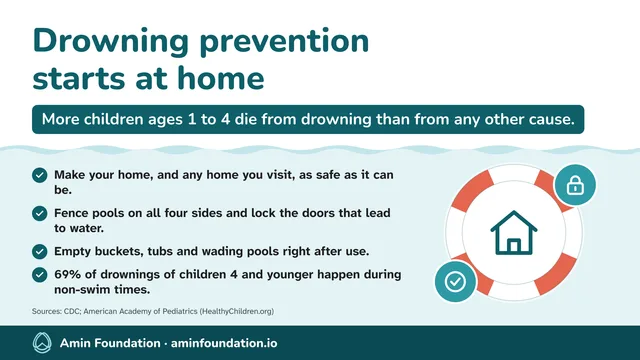
Infographic
Drowning prevention starts at home
More children ages 1 to 4 die from drowning than from any other cause.
When you share any number, keep its year and source. The National Drowning Prevention Alliance's layers of protection (opens in a new tab) are a good frame: barriers and alarms, supervision, water competency, life jackets and emergency preparation, used together.
Local media and social posts
- Pitch real local news. A free swim lesson day, a CPR class, a new life jacket loaner station or a school program is a story. Awareness alone usually isn't.
- Keep it hopeful and practical. Lead with what people can do this week.
- Be gentle with loss. If you share a family's story, do it only with their permission, and focus on prevention, not on the details of what happened.
What you can do today
Printable
Family Water Safety Pledge
A pledge for kids and grown-ups to read, tick and sign together: ask first, swim with a grown-up watching, wear life jackets, and get help without going in.
Printable
Pool Safety Checklist
A one-page checklist for pool and hot tub owners: four-sided fencing, self-latching gates, alarms, covers, drains, Water Watchers and rescue gear.
Common questions
When is World Drowning Prevention Day?
July 25, every year. The World Health Organization says the day was declared through the April 2021 UN General Assembly resolution on global drowning prevention, and is an opportunity to highlight the impact of drowning on families and communities and share life-saving solutions.
When is National Water Safety Month?
May. National Water Safety Month is an annual U.S. awareness campaign coordinated by the Pool & Hot Tub Alliance with support from the American Red Cross, the National Drowning Prevention Alliance, the National Recreation and Park Association and the World Waterpark Association.
What can schools do for drowning prevention awareness?
Teach a free water safety lesson in May before summer break, send a home checklist to families, share where to find free swim lessons, and invite a CPR instructor for older students or staff. Summer schools and camps can use July 25.
Tools and printables for this guide
Printable
Family Water Safety Pledge
A pledge for kids and grown-ups to read, tick and sign together: ask first, swim with a grown-up watching, wear life jackets, and get help without going in.
Printable
Pool Safety Checklist
A one-page checklist for pool and hot tub owners: four-sided fencing, self-latching gates, alarms, covers, drains, Water Watchers and rescue gear.
Infographic
Drowning prevention starts at home
More children ages 1 to 4 die from drowning than from any other cause.
Sources
- World Drowning Prevention Day (opens in a new tab) World Health Organization
- Drowning (fact sheet) (opens in a new tab) World Health Organization
- WHO launches seven strategies to prevent drowning (opens in a new tab) World Health Organization
- National Water Safety Month (opens in a new tab) Pool & Hot Tub Alliance
- Drowning Facts (opens in a new tab) CDC
- Drowning Increases in the U.S. (Vital Signs) (opens in a new tab) CDC
- Layers of Protection (opens in a new tab) National Drowning Prevention Alliance
More in Community Water Safety
Vacation Water Safety: New Places, New Water
Plan a safer family trip near water: check the destination, pack life jackets, name Water Watchers, and learn the risks of lakes, beaches and pools abroad.
Vacation Rental Pool Safety: What to Check Before You Book
Booking a short-term rental with a pool or hot tub? What to ask the host, what to check on arrival, and what to do if the fence, gate or alarms aren't there.
Summer Camp Water Safety: Questions Parents Should Ask
What to ask a camp, day camp or child care program about swimming: swim tests, buddy checks, lifeguards, field trips and staff training, with New York rules.