
Water Competency: The 5 Skills That Can Save Your Life
Water competency means the skills to stay safe in water: get in and resurface, float or tread, turn, swim 25 yards and get out. How to check them safely.
Key takeaways
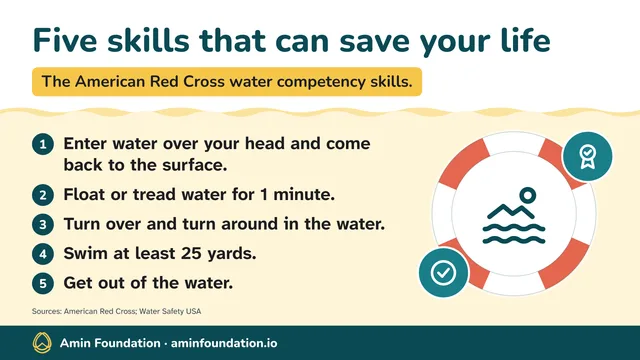
- The Red Cross lists five water competency skills: enter water over your head and return to the surface, float or tread water for 1 minute, turn over and turn around, swim at least 25 yards, and exit the water.
- Water competency has three parts: water smarts, swimming skills and helping others.
- In a 2020 Red Cross survey, 85% of Americans said they could swim, but only 56% of those self-described swimmers could do all five skills.
- Check skills only with a lifeguard or instructor present. The deep-water skill should never be tested alone.
- Being water competent in a pool is not the same as being safe in a lake, river or ocean.
Water competency means having the skills and knowledge to stay safe in and around water. The American Red Cross lists five core swimming skills: enter water that's over your head and return to the surface, float or tread water for at least 1 minute, turn over and turn around, swim at least 25 yards, and exit the water.
These five skills are the goal of good swim lessons, for children and adults alike. This page explains each one, how to check them safely, and why they don't automatically carry over to lakes, rivers and the ocean.
What water competency means
The Red Cross describes water competency as a way of improving water safety for yourself and others by avoiding common dangers, building basic water safety skills, and knowing how to prevent and respond to drowning emergencies. It has three parts (opens in a new tab):
- Water smarts: knowing the risks and making safe choices
- Swimming skills: the five core skills below
- Helping others: watching children closely, spotting trouble and helping safely
The five skills in order
The Red Cross lists the swimming skills in this order. Think of them as what you'd need if you fell into deep water by surprise.
- Enter water that's over your head, then return to the surface. If you fall or jump in, you first need to get back up to air.
- Float or tread water for at least 1 minute. Staying at the surface gives you time to breathe, calm down and plan.
- Turn over and turn around in the water. You need to be able to find the nearest exit, which may be behind you.
- Swim at least 25 yards. That's about the length of many pools: enough to reach the side, a ladder or help.
- Exit the water. Climbing out at a wall, ladder or shore, without steps, is a real skill.
The AAP's version for children is similar. It says all children should learn (opens in a new tab) to get back to the surface from underwater, propel themselves at least 25 yards and get out of the water.
Many people who "can swim" can't do all five
56%
In the same 2020 survey, 85% of Americans said they could swim. So many confident swimmers have gaps they don't know about.
Finishing lessons isn't the same as being competent, either. Water Safety USA notes that people who complete entry-level swim lessons, especially young children, may still not have the skills (opens in a new tab) for water competency, and they still need close, direct supervision.
Water smarts
The Red Cross lists sensible precautions for everyone near water, even if you're not planning to swim:
Helping others
The third part of water competency is helping others without putting yourself in danger. The Red Cross lists:
- Paying close attention to children and weak swimmers you're supervising
- Knowing the signs that someone is drowning. See what drowning looks like.
- Knowing ways to help safely, such as "reach or throw, don't go." See reach, throw, don't go.
- Knowing CPR and first aid
Check your family's skills safely
Use our check to see which skills each person has and which to work on:
Interactive tool
Water competency self-check
Check yourself or your child against the five Red Cross water competency skills, see what to practise next, and review water smarts and safe helping.
To check skills in the water, follow these rules:
A skill counts when the swimmer can do it calmly and without help. If they need to grab the wall halfway, that's useful information, not a failure.
Water competency in different water
The Red Cross says to learn these five skills in every type of water you may encounter (opens in a new tab), such as home pools, oceans, lakes, rivers and streams. Skills learned in a calm pool are a starting point, not the finish line.
- Ocean. The National Weather Service says swimming in a pool is not the same as swimming at a surf beach (opens in a new tab), where waves, wind and currents can quickly use up your energy.
- Lakes and rivers. Currents, drop-offs and poor visibility make the same skills harder. See skills for open water.
- Cold water. The National Center for Cold Water Safety says that while someone is hyperventilating from cold shock, swimming even 6 to 10 feet is often impossible (opens in a new tab), even for good swimmers.
That's why the AAP says young children near water and non-swimmers (opens in a new tab) should wear Coast Guard-approved life jackets, and why everyone should wear one on a boat.
Building the skills in lessons
When you choose a program, ask how it teaches and checks these skills. Good programs build toward them on purpose. In the Red Cross Learn-to-Swim program, for example, Level 3 (Stroke Development) (opens in a new tab) is where guided practice helps students achieve water competency.
See how swim lesson levels work and how to choose a swim lesson program.
Remember that skills are one layer of protection, not a guarantee. Read do swim lessons prevent drowning? for why supervision, barriers and life jackets still matter.
What you can do today
- Write down the five skills and check which ones each person in your family can do.
- For any skill marked "not yet," ask your swim instructor to work on it, or find a class.
- At your next lifeguarded pool visit, practice floating, turning around and climbing out at the wall together.
- Learn the "helping others" part too: how drowning looks, and reach or throw, don't go.
- Before a trip to a lake or beach, pack life jackets for children and weaker swimmers.
Common questions
What are the 5 water competency skills?
The American Red Cross lists them as: enter water that's over your head, then return to the surface; float or tread water for at least 1 minute; turn over and turn around in the water; swim at least 25 yards; and exit the water.
Is water competency the same as knowing how to swim?
Not quite. Water competency includes swimming skills, but also water smarts, such as knowing your limits and swimming sober, and helping others safely, such as reach or throw, don't go. Many people who say they can swim can't do all five core skills.
When can a child be water competent?
It depends on the child. The AAP says all children should learn to get back to the surface from underwater, swim at least 25 yards and get out of the water. Water Safety USA notes that young children who finish beginner lessons may still not be water competent, so they still need close supervision.
How can I check my child's water competency?
Ask their swim instructor to assess the five skills, or check them together at a lifeguarded pool. Start in water where your child can stand, stay within arm's reach, and only try the deep-water skill with a lifeguard or instructor right there.
Tools and printables for this guide
Interactive tool
Water competency self-check
Check yourself or your child against the five Red Cross water competency skills, see what to practise next, and review water smarts and safe helping.
Sources
- Water Safety (opens in a new tab) American Red Cross
- Aquatics Centennial Campaign (opens in a new tab) American Red Cross
- Kids Swim Lessons (opens in a new tab) American Red Cross
- Water Competency (opens in a new tab) Water Safety USA
- Swim Lessons for Children: When to Start & What to Consider (opens in a new tab) American Academy of Pediatrics (HealthyChildren.org)
- AAP Releases Updated Drowning Prevention Recommendations (opens in a new tab) American Academy of Pediatrics (HealthyChildren.org)
- Know BEFORE you go in the water! (opens in a new tab) National Weather Service
- Cold Shock (opens in a new tab) National Center for Cold Water Safety
- Preventing Drowning (opens in a new tab) CDC
More in Swimming Lessons
How to Find Swim Lessons Near You, Including Free and Low-Cost Options
Find swim lessons near you for kids or adults with official YMCA, Red Cross, USA Swimming and city parks locators, plus ways to find free or low-cost classes.
Free Swim Lessons in NYC: Parks, Swim for Life and More
Every free and low-cost swim program in New York City we could verify: NYC Parks Learn to Swim, summer pools, school programs, YMCA, adaptive swim and Queens.
What Age Should Kids Start Swim Lessons?
The AAP says many children can start swim lessons at age 1, depending on readiness. Learn what to expect at each age and how to tell if your child is ready.