
How Should a Life Jacket Fit? The Fit Test
A life jacket should be snug and stay below the chin when lifted. The Coast Guard's five-step fit test, an in-water check, and signs a jacket is worn out.
Key takeaways
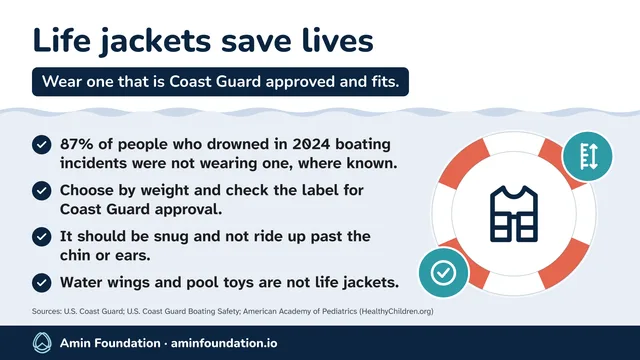
- A life jacket that fits is snug, fully fastened and doesn't ride up over the chin or ears.
- Do the shoulder lift test: arms up, a friend pulls up on the shoulders, and the jacket stays put.
- Then test it in shallow water with an adult watching. The wearer's face and airway should stay clear.
- Check jackets at least once a year. Throw out any that are torn, waterlogged, faded or damaged.
A life jacket should fit snugly, be fully buckled or zipped, and stay below the wearer's chin and ears when someone pulls up on the shoulders. The U.S. Coast Guard explains why fit matters: too big, and the life jacket will ride up around your face. Too small, it will not be able to keep your body afloat (opens in a new tab).
Fit is easy to check in two minutes, at home and then in the water. Do it for every person, every season, and every time a child has a growth spurt.
Snug, buckled and zipped
Start with the label. The Coast Guard says to check the label for user weight and chest size (opens in a new tab). Pick the size for the wearer's weight today.
Then put it on properly:
The Safe Boating Campaign sums it up: a snug fit is a proper fit (opens in a new tab).
The shoulder lift test
This is the Coast Guard's five-step fit test from its How to Choose the Right Life Jacket (opens in a new tab) guide:
- Check the label to make sure the jacket is the right size and weight range for the wearer.
- Fasten it properly. Every buckle, zipper and strap.
- Hold your arms straight up over your head.
- Ask a friend to grasp the tops of the arm openings and gently pull up.
- Look for room above the openings. There should be no excess room, and the jacket should not ride up over the chin or face.
If the jacket slides up to the ears or the chin, tighten the straps and try again. If it still rides up, it's too big. Try a smaller size or a different style.
For children, the test is the same. Lift gently by the shoulders. If the child's chin and ears slip down inside the jacket, it doesn't fit. More on children's sizes in life jackets for babies and children.
Tip
Make it a game. Kids can practice the fit test with our Life Jacket Fit Check game, then try it for real with you.
Test it in shallow water
A jacket that passes on land can still behave differently in the water. The Coast Guard says: for the best fit, try the life jacket in shallow water under safe and supervised conditions (opens in a new tab). Its main life jacket page adds: try your lifejacket or buoyancy aid on in the water to ensure your airway is clear (opens in a new tab).
How to do the in-water check:
- Choose calm, shallow water where the wearer can stand, such as a pool's shallow end.
- Keep an adult in the water within arm's reach of any child. The AAP calls this touch supervision (opens in a new tab).
- Have the wearer lean back and relax their arms and legs.
- Watch the face. The mouth and nose should stay clear of the water, and the jacket shouldn't ride up over the chin.
- Notice how it floats. Water Safety USA says not all U.S. Coast Guard-approved life jackets perform the same way (opens in a new tab): some will turn a person face up and some won't. Testing helps you know what yours does.
The Safe Boating Campaign also says some jackets will turn an unconscious wearer face up, and to test before use (opens in a new tab).
Practicing in a pool also helps children get used to how a life jacket feels. Water Safety USA says life jackets are not swim lesson aids, but exposure to life jackets during swimming lessons (opens in a new tab) teaches a child how one should fit and feel.
Signs a jacket is worn out
The Coast Guard says foam life jackets should be tested for wear and buoyancy at least once a year (opens in a new tab), and that waterlogged, faded or otherwise damaged ones should be thrown out.
Check foam jackets for:
The Safe Boating Campaign adds: no rips, waterlogging or mildew, and store in a dry place when not boating (opens in a new tab).
Inflatable jackets need more care. The Coast Guard says they must have a full cylinder and all status indicators on the inflator must be green (opens in a new tab), or the device is not serviceable. See inflatable life jackets: how they work for the full check.
When to re-check fit
- At the start of every boating or beach season.
- When a child gains weight or grows taller.
- When someone wears it over different clothes, such as a winter jacket.
- When you borrow or rent a jacket. Do the fit test before you leave the dock.
What you can do today
- Do the shoulder lift test on every life jacket in your home. It takes two minutes per person.
- Print the Does Your Life Jacket Fit? and keep it with your life jackets.
- Throw out damaged jackets and replace them with Coast Guard-approved ones that fit.
- Book a pool session to test jackets in the water with your kids.
- Need a new one? Use the Life jacket finder and our guide to choosing the right life jacket.
Common questions
How do I know if a life jacket is too big?
If you lift it by the shoulders and it slides up over the chin or face, or there is extra room above the arm and neck openings, it's too big. The Coast Guard says a jacket that's too big will ride up around your face. Choose the size for the wearer's weight now.
Should a life jacket be tight?
It should be snug. The Coast Guard says a foam life jacket worn correctly fits snugly and doesn't rise above the chin or ears. It shouldn't stop you breathing or moving your arms. If it pinches or you can't move, try another size or style.
How do I test a life jacket in the water?
In shallow water, under safe, supervised conditions, have the wearer lean back and relax. The jacket should hold their face and airway out of the water without riding up. Children should practice with an adult in the water within arm's reach.
How often should I check a life jacket?
The Coast Guard says to test foam jackets for wear and buoyancy at least once a year, and to throw out any that are waterlogged, faded or otherwise damaged. Inflatable jackets need regular checks and maintenance, following the owner's manual.
Tools and printables for this guide
Interactive tool
Life jacket finder
Find the right life jacket size, style and label level by weight, age, swimming ability and activity, based on U.S. Coast Guard guidance, plus a fit check.
Printable
Does Your Life Jacket Fit?
A poster of the life jacket fit check: Coast Guard label, right weight, buckled, arms up, lift at the shoulders, plus rules for children and inflatables.
Sources
- How to Choose the Right Life Jacket (brochure, PDF) (opens in a new tab) U.S. Coast Guard
- Life Jacket Wear / Wearing Your Life Jacket (opens in a new tab) U.S. Coast Guard Boating Safety
- Life Jackets (opens in a new tab) Safe Boating Campaign (National Safe Boating Council)
- Life Jackets Save Lives (opens in a new tab) Water Safety USA
- AAP Releases Updated Drowning Prevention Recommendations (opens in a new tab) American Academy of Pediatrics (HealthyChildren.org), 2026
More in Boating and Life Jackets
Boating Safety Checklist: Before You Leave the Dock
A pre-departure boating checklist: life jackets for all, weather, a float plan, Coast Guard-required gear, the engine cut-off switch and a passenger briefing.
Boating Safety Courses in New York: Who Needs One
New York's Brianna's Law requires a state-approved safety course for all operators of motorized boats. Who it covers, how to take one, and free options.
Boating Under the Influence: The Risks
Why alcohol and drugs make boating so dangerous for operators and passengers, what the Coast Guard's numbers show, and how to plan a sober skipper.