
Drowning Disparities: Why Some Communities Face Higher Risk
CDC data show American Indian, Alaska Native and Black Americans face higher drowning rates. What the numbers say, the history behind them, and what helps.
Key takeaways
- From 1999 to 2019, drowning death rates for people 29 and under were 2.0 times higher for American Indian and Alaska Native people and 1.5 times higher for Black people than for White people.
- The gap is largest for Black children ages 10 to 14 in swimming pools, at 7.6 times the White rate.
- In 2023, 36.8% of Black adults and 25.8% of Hispanic adults said they can't swim, compared with 6.9% of White adults.
- CDC links these gaps to history and access: segregated and closed pools, excluded clubs, and no nearby pool today.
- What helps is structural: affordable, culturally welcoming lessons, more public pools and lifeguards, and community-led programs.
Drowning does not affect every community equally. CDC data show that from 1999 to 2019, drowning death rates for people 29 and younger were 2.0 times higher for American Indian and Alaska Native people and 1.5 times higher for Black people (opens in a new tab) than for White people. The CDC links these gaps to history and to unequal access to pools and swim lessons, not to the choices of individual families, and it names fixes that communities can act on.
What CDC data show
A 2021 CDC report looked at drowning deaths among people 29 and younger from 1999 to 2019. The overall rate was 1.3 per 100,000 people. By race and ethnicity:
| Group (ages 29 and under, 1999-2019) | Drowning deaths per 100,000 | Compared with White |
|---|---|---|
| American Indian or Alaska Native | 2.5 | 2.0 times higher |
| Black | 1.8 | 1.5 times higher |
| White | 1.2 | (baseline) |
Source: CDC, MMWR 2021 (opens in a new tab).
The gaps are much bigger for some ages and places. The CDC's health equity page (opens in a new tab) reports:
- Black children ages 5 to 9 drown at 2.6 times the rate of White children, and ages 10 to 14 at 3.6 times.
- In swimming pools, Black children ages 10 to 14 drown at 7.6 times the rate of White children.
- American Indian and Alaska Native people under 30 have the highest drowning rates in natural water, 2.7 times the White rate.
- Black children and youth are more likely to drown in public pools; White children and youth are more likely to drown in home pools.
7.6x
Recent years
Drowning rose during the pandemic years. The CDC says drowning death rates for Black people were 28% higher in 2021 than in 2019 (opens in a new tab). From 2019 to 2022, the highest rates every year (opens in a new tab) were among American Indian and Alaska Native people (2.6 to 3.1 per 100,000) and Black people (1.5 to 1.9). Rates for Hispanic people, not historically high, rose about 25% from 2019 to 2022.
The American Academy of Pediatrics says drowning deaths are rising again and that the burden falls disproportionately on Black, Native Hawaiian/Pacific Islander and rural children (opens in a new tab).
Swimming skills and lesson access
Swimming ability and lessons follow the same pattern. In a 2023 national survey, the CDC found:
- About 40 million U.S. adults (15.4%) said they don't know how to swim, and 54.7% had never taken a swimming lesson.
- 36.8% of Black adults and 25.8% of Hispanic adults said they can't swim, compared with 6.9% of White adults and 22.4% of adults of other races and ethnicities.
- About half of White adults (51.8%) had ever taken a lesson, compared with 36.9% of Black adults and 28.1% of Hispanic adults.
Source: CDC, MMWR 2024 (opens in a new tab).
Among children, the USA Swimming Foundation reports that 64% of African American children and 45% of Hispanic/Latino children (opens in a new tab) have little to no swimming ability, and the American Red Cross reports that 79% of children in households earning less than $50,000 (opens in a new tab) have few to no swimming skills (both from a 2017 study).
The CDC's national survey doesn't report South Asian, Bangladeshi or other Asian American groups separately; they fall within "other." We don't know of reliable U.S. figures for those communities, which is one reason the Amin Foundation focuses on desi families.
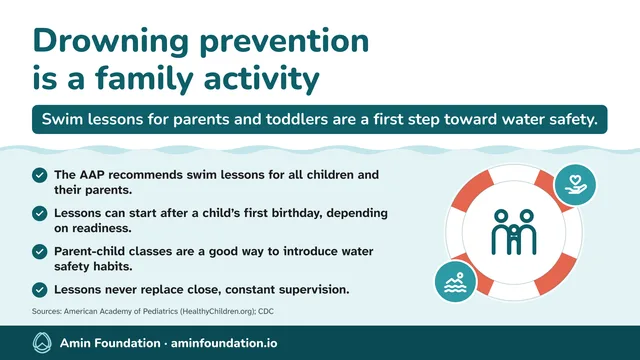
Infographic
Drowning prevention is a family activity
Swim lessons for parents and toddlers are a first step toward water safety.
History and barriers
The CDC's 2024 report explains that these gaps have deep roots:
- Racially segregated pools (opens in a new tab) led to fewer swimming options for Black people, and the pools available were often too small and shallow for swimming.
- When integration was required, many public pools closed, and private clubs restricted who could join.
- Today, lack of a nearby pool is a major barrier to swimming lessons reported by Black and American Indian and Alaska Native people.
Other barriers are cultural and practical. A pediatrician writing for the AAP describes how swim attire that conflicts with modest dress (opens in a new tab) keeps some families out of lessons, and how women-only sessions brought them in. Cost matters too: the Red Cross figure above shows how income shapes swimming skills.
Swimming also tends to run in families. The USA Swimming Foundation says that if a parent doesn't know how to swim, there is only a 19% chance a child in the household will learn. That's why gaps can last for generations, and why adult lessons matter.
What helps
The CDC's Vital Signs (opens in a new tab) report names actions for communities and states:
- make swim and water safety training available and affordable for everyone;
- decide whether new policies or laws are needed to improve access to safe swimming;
- find areas without safe places to swim, and build or revitalize pools there;
- prioritize training that is diverse, equitable, culturally appropriate and inclusive;
- use the U.S. National Water Safety Action Plan to create state and local action plans.
The CDC's 2024 report says that plan calls for affordable, accessible, culturally competent swim lessons (opens in a new tab) and more publicly accessible pools. The AAP adds that laws on fencing, life jackets, lifeguard standards and safe natural-water designations are proven tools.
Communities are already doing this work: free city lessons, school swim programs for second graders, women-only swim hours, and grants for providers. The USA Swimming Foundation funds learn-to-swim programs (opens in a new tab) for children and adults who otherwise wouldn't have the chance to learn. If you want to start something local, see how to start a community swim program.
Using the data dashboard
Our drowning data dashboard is built only from official data, with the source listed for every number. Teachers, journalists and community leaders can use it alongside this page to make the case for local action.
What you can do today
Common questions
Which groups have the highest drowning rates in the U.S.?
According to the CDC, American Indian and Alaska Native people and Black people have had the highest drowning death rates. From 2019 to 2022, rates ranged from 2.6 to 3.1 per 100,000 for American Indian and Alaska Native people and 1.5 to 1.9 for Black people, every year.
Why are drowning rates higher for Black Americans?
The CDC points to history and access, not to individuals. Segregated pools were few and often too small or shallow for swimming, many pools closed when integration was ordered, and private clubs excluded Black families. Today, lack of a nearby pool is still a major barrier to swim lessons.
How many American adults can't swim?
In a 2023 national survey, the CDC found that about 40 million U.S. adults, or 15.4%, said they don't know how to swim. More than half (54.7%) had never taken a swimming lesson.
Tools and printables for this guide
Interactive tool
Swim lesson finder
Enter a ZIP code to open the official swim lesson finders from the YMCA, Red Cross, USA Swimming, U.S. Masters Swimming and, in NYC, NYC Parks.
Infographic
Drowning prevention is a family activity
Swim lessons for parents and toddlers are a first step toward water safety.
Sources
- Persistent Racial/Ethnic Disparities in Fatal Unintentional Drowning Rates Among Persons Aged ≤29 Years, United States, 1999-2019 (MMWR 2021;70(24)) (opens in a new tab) CDC (MMWR)
- Health Disparities in Drowning (opens in a new tab) CDC
- Vital Signs: Drowning Death Rates, Self-Reported Swimming Skill, Swimming Lesson Participation, and Recreational Water Exposure, United States, 2019-2023 (MMWR 2024;73(20)) (opens in a new tab) CDC (MMWR)
- Drowning Increases in the U.S. (Vital Signs) (opens in a new tab) CDC
- Saving Lives and Building Champions (opens in a new tab) USA Swimming Foundation
- Drowning Prevention & Facts (opens in a new tab) American Red Cross
- AAP Releases Updated Drowning Prevention Recommendations (opens in a new tab) American Academy of Pediatrics (HealthyChildren.org)
- Addressing Cultural and Religious Barriers to Water Safety (AAP Voices, Anisa Ibrahim, MD, FAAP) (opens in a new tab) American Academy of Pediatrics
- 2027 grant applications (Learn-to-Swim grants) (opens in a new tab) USA Swimming Foundation
More in Community Water Safety
Vacation Water Safety: New Places, New Water
Plan a safer family trip near water: check the destination, pack life jackets, name Water Watchers, and learn the risks of lakes, beaches and pools abroad.
Vacation Rental Pool Safety: What to Check Before You Book
Booking a short-term rental with a pool or hot tub? What to ask the host, what to check on arrival, and what to do if the fence, gate or alarms aren't there.
Summer Camp Water Safety: Questions Parents Should Ask
What to ask a camp, day camp or child care program about swimming: swim tests, buddy checks, lifeguards, field trips and staff training, with New York rules.